


Targeting senescence as an anticancer therapy
- PMID: 36065138
- PMCID: PMC9627790
- DOI: 10.1002/1878-0261.13312
Targeting senescence as an anticancer therapy
Abstract
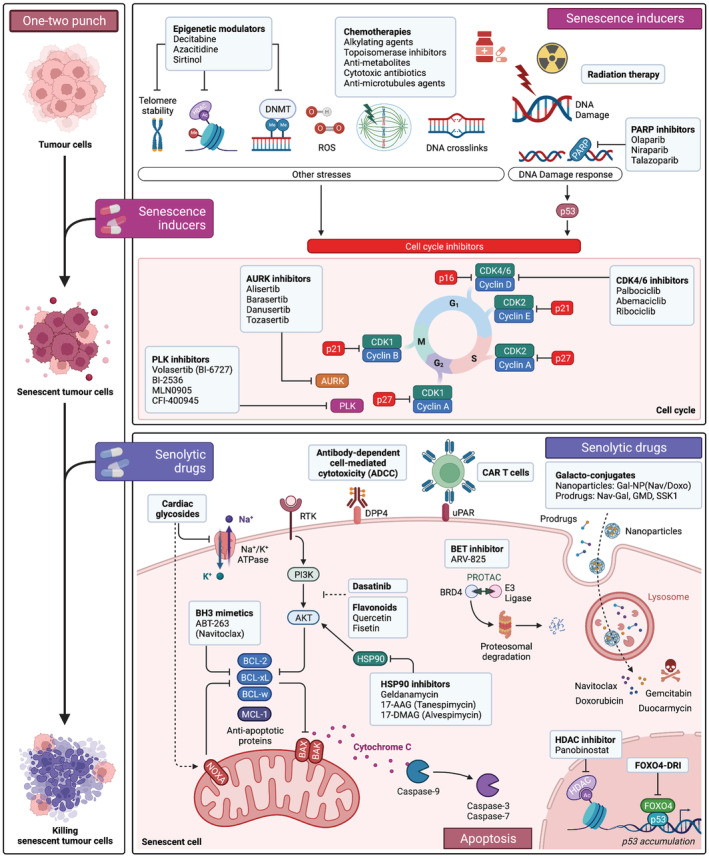
Cellular senescence is a stress response elicited by different molecular insults. Senescence results in cell cycle exit and is characterised by multiple phenotypic changes such as the production of a bioactive secretome. Senescent cells accumulate during ageing and are present in cancerous and fibrotic lesions. Drugs that selectively kill senescent cells (senolytics) have shown great promise for the treatment of age-related diseases. Senescence plays paradoxical roles in cancer. Induction of senescence limits cancer progression and contributes to therapy success, but lingering senescent cells fuel progression, recurrence, and metastasis. In this review, we describe the intricate relation between senescence and cancer. Moreover, we enumerate how current anticancer therapies induce senescence in tumour cells and how senolytic agents could be deployed to complement anticancer therapies. "One-two punch" therapies aim to first induce senescence in the tumour followed by senolytic treatment to target newly exposed vulnerabilities in senescent tumour cells. "One-two punch" represents an emerging and promising new strategy in cancer treatment. Future challenges of "one-two punch" approaches include how to best monitor senescence in cancer patients to effectively survey their efficacy.
Keywords: cellular senescence; chemotherapy; oncogene-induced senescence; radiotherapy; senolytics; therapy-induced senescence.
© 2022 The Authors. Molecular Oncology published by John Wiley & Sons Ltd on behalf of Federation of European Biochemical Societies.
Conflict of interest statement
JG has acted as a consultant for Unity Biotechnology, Geras Bio, Myricx Pharma and Merck KGaA. Unity Biotechnology and Pfizer have funded research in JG's laboratory. JG owns equity in Geras Bio. JG is a named inventor in MRC and Imperial College patents related to senolytic therapies.
Figures
References
-
- Gorgoulis V, Adams PD, Alimonti A, Bennett DC, Bischof O, Bishop C, et al. Cellular senescence: defining a path forward. Cell. 2019;179:813–27. - PubMed
-
- Hernandez‐Segura A, Nehme J, Demaria M. Hallmarks of cellular senescence. Trends Cell Biol. 2018;28:436–53. - PubMed
-
- Di Micco R, Fumagalli M, Cicalese A, Piccinin S, Gasparini P, Luise C, et al. Oncogene‐induced senescence is a DNA damage response triggered by DNA hyper‐replication. Nature. 2006;444:638–42. - PubMed
Publication types
MeSH terms
Substances
Grants and funding
LinkOut - more resources
Full Text Sources
Medical
