Review
. 2022;4(11):723-734.
doi: 10.1038/s42254-022-00506-7. Epub 2022 Aug 31.

The physics of respiratory particle generation, fate in the air, and inhalation

Affiliations
Review

The physics of respiratory particle generation, fate in the air, and inhalation

Lidia Morawska et al. Nat Rev Phys. 2022.

Abstract

Given that breathing is one of the most fundamental physiological functions, there is an urgent need to broaden our understanding of the fluid dynamics that governs it. There would be many benefits from doing so, including a better assessment of respiratory health, a basis for more precise delivery of pharmaceutical drugs for treatment, and the understanding and potential minimization of respiratory infection transmission. We review the physics of particle generation in the respiratory tract, the fate of these particles in the air on exhalation and the physics of particle inhalation. The main focus is on evidence from experimental studies. We conclude that although there is qualitative understanding of the generation of particles in the respiratory tract, a basic quantitative knowledge of the characteristics of the particles emitted during respiratory activities and their fate after emission, and a theoretical understanding of particle deposition during inhalation, nevertheless the general understanding of the entire process is rudimentary, and many open questions remain.

Keywords: Applied physics; Physics.


Conflict of interest statement

Competing interestsThe authors declare no competing interests.

Figures
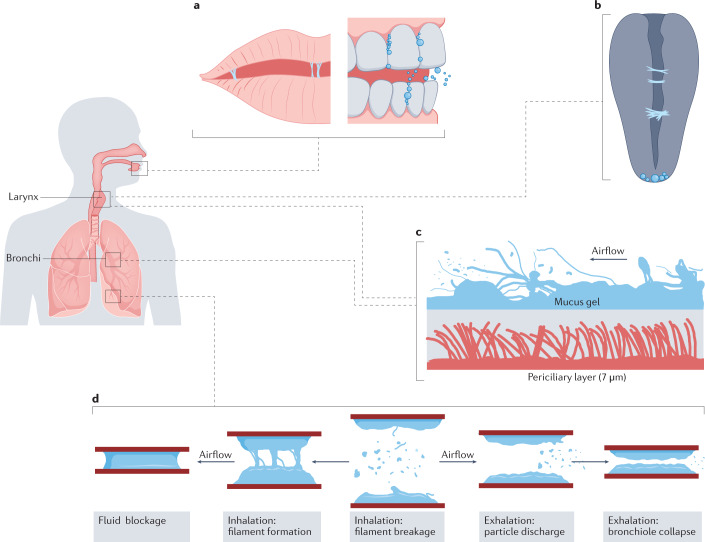
Fig. 1
Fig. 1. Sites and mechanisms of particle generation.
a | Fluid film, filament or bubble breakage (FFBB) in the mouth during speech. b | FFBB due to filament formation at the vocal cords. c | Turbulent aerosolization of viscoelastic mucus from the airway lining in the larynx and large bronchi due to turbulent airflow, based on snapshot of ligament-mediated fragmentation of viscoelastic liquid presented in ref.. d | FFBB in small airway bronchioles due to clearance of fluid blockages formed during exhalation and airway reopening.
Fig. 2
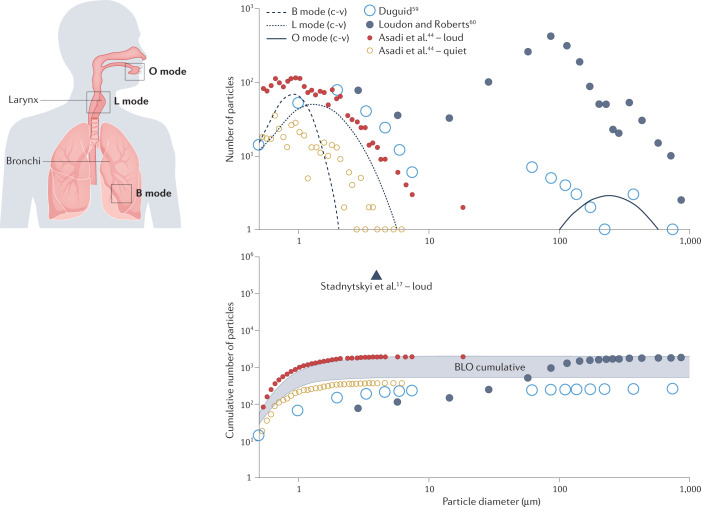
Fig. 2. A trimodal distribution of particles emitted by speaking subjects, and their cumulative emissions.
BLO data (where B represents particles from bronchioles, L larynx and O mouth) are from ref.. Other data are from refs.,,. The BLO cumulative shaded range spans the c-v to aah-v particle totals from all three modes for uncorrected data (where c-v represents speech and aah-v represents sustained vocalization; see text for details).
Fig. 3
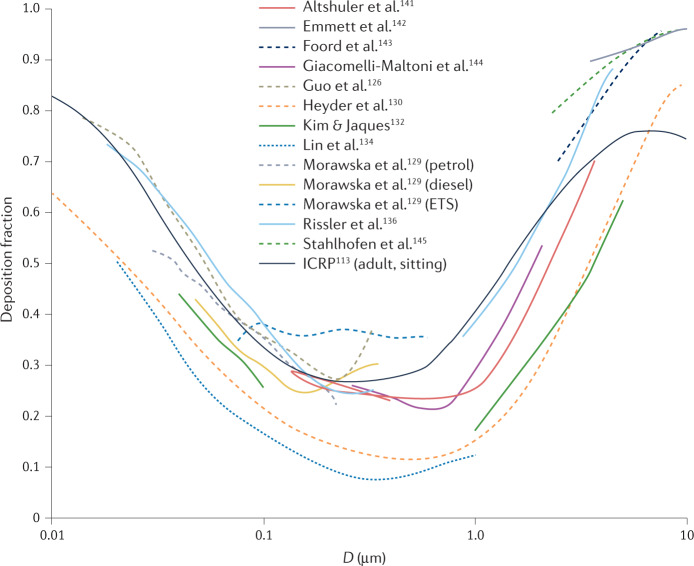
Fig. 3. Total deposition fraction for healthy adults.
The deposition fraction is shown as a function of the particle size D obtained from reported experimental studies,,,,,,,– and calculated from the ICRP as average values between males and females while sitting (black solid line). ETS, environmental tobacco smoke. The studies are listed in Supplementary Table 2.

References

    1. Morawska L, Buonanno G. The physics of particle formation and deposition during breathing. Nat. Rev. Phys. 2021;3:300–301. doi: 10.1038/s42254-021-00307-4. - DOI - PMC - PubMed
    1. Wei J, Li Y. Airborne spread of infectious agents in the indoor environment. Am. J. Infect. Control. 2016;44:S102–S108. doi: 10.1016/j.ajic.2016.06.003. - DOI - PMC - PubMed
    1. Rayleigh L. On the stability, or instability, of certain fluid motions. Proc. Lond. Math. Soc. 1879;1:57–72. doi: 10.1112/plms/s1-11.1.57. - DOI
    1. Stadnytskyi V, Anfinrud P, Bax A. Breathing, speaking, coughing or sneezing: what drives transmission of SARS-CoV-2? J. Intern. Med. 2021;290:1010–1027. doi: 10.1111/joim.13326. - DOI - PMC - PubMed
    1. Johnson G, et al. Modality of human expired aerosol size distributions. J. Aerosol Sci. 2011;42:839–851. doi: 10.1016/j.jaerosci.2011.07.009. - DOI

LinkOut - more resources