Editorial
doi: 10.1158/2643-3230.BCD-22-0100.
Reduced PU.1 Expression Collaborates with Tet2 Loss to Trigger Myeloid Leukemogenesis
Affiliations
- PMID: 36065607
- PMCID: PMC9445751
- DOI: 10.1158/2643-3230.BCD-22-0100
Item in Clipboard
Editorial
Reduced PU.1 Expression Collaborates with Tet2 Loss to Trigger Myeloid Leukemogenesis
Blood Cancer Discov.
.
Abstract
The leukemic transformation of hematopoietic stem and progenitor cells in the setting of Tet2 deficiency is driven by PU.1 gene network loss through complementary reduction in PU.1 expression and hypermethylation of ETS loci at the enhancers of PU.1 target genes. See related article by Aivalioti et al., p. 444 (6).
©2022 American Association for Cancer Research.
Figures
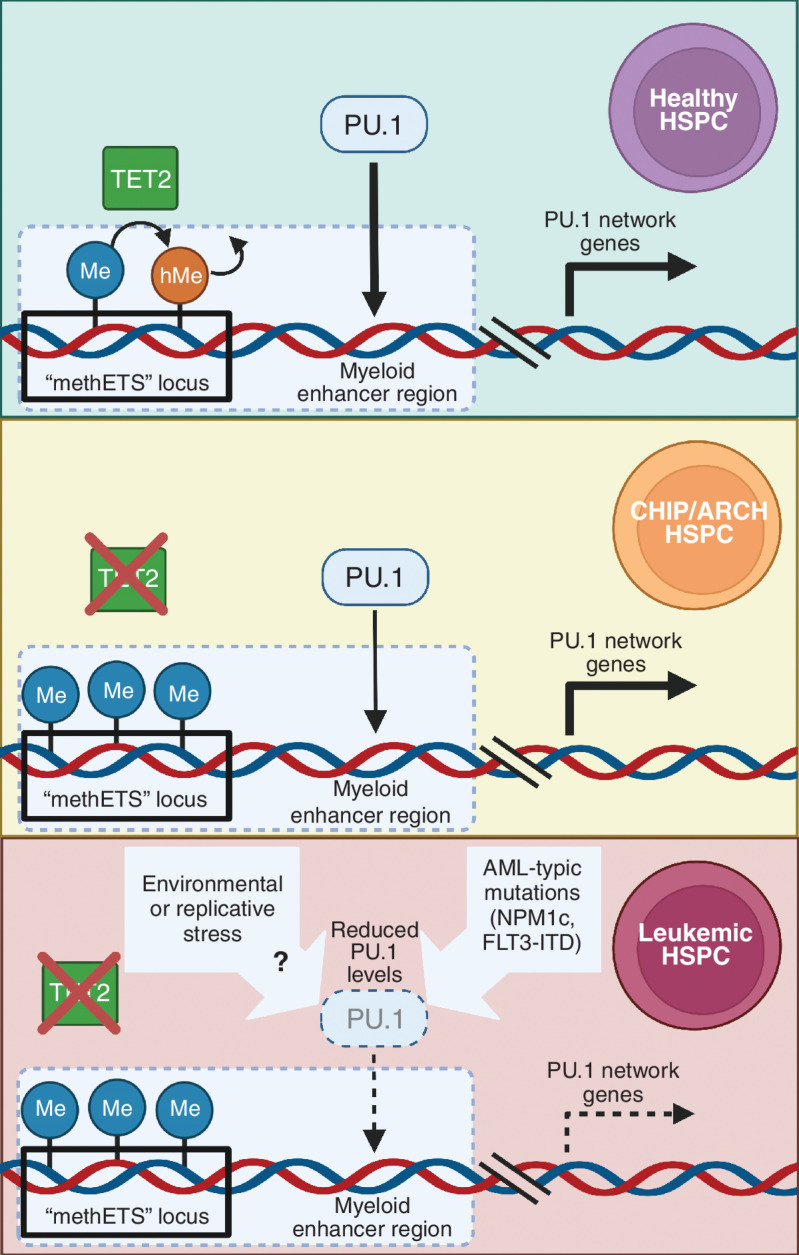
In healthy hematopoietic stem and progenitor cells (HSPC), TET2 promotes the first step in cytosine demethlation, the conversion of methylcytosine (Me; blue lollipop icons) to hydroxymethylcytosine (hMe; orange lollipop icons) residues at the enhancer regions of myeloid target genes. This allows appropriate PU.1 binding and subsequent transactivation of myeloid maturation genes. In the context of TET2 deficiency associated with clonal hematopoiesis of indeterminate potential/age-related clonal hematopoiesis (CHIP/ARCH) loss of TET2 activity in HSPC results in hypermethylation of specific ETS binding sites located in many PU.1 target gene enhancers (termed by the authors as methylation-sensitive ETS, or methETS, loci; depicted by black box outline) which in turn may reduce the capacity for PU.1 to transactivate gene expression at these targets (depicted by reduced thickenss of the PU.1 arrow). AML-typic mutations and potentially other aging-related environmental factors that reduce PU.1 expression can act in concert with hypermethylation of methETS loci to further abolish PU.1 binding at these regions (depicted by broken lines around PU.1 and arrow). Resultant dysregulation of the PU.1 network ultimately results in leukemic transformation of HSPC.
Comment on
-
PU.1-Dependent Enhancer Inhibition Separates Tet2-Deficient Hematopoiesis from Malignant Transformation.Blood Cancer Discov. 2022 Sep 6;3(5):444-467. doi: 10.1158/2643-3230.BCD-21-0226. Blood Cancer Discov. 2022. PMID: 35820129 Free PMC article.
References
-
- Steidl U, Rosenbauer F, Verhaak RGW, Gu X, Ebralidze A, Otu HH, et al. Essential role of Jun family transcription factors in PU.1 knockdown-induced leukemic stem cells. Nat Genet 2006;38:1269–77. - PubMed
Publication types
MeSH terms
Substances
Grants and funding
LinkOut - more resources
Full Text Sources