


Anthropometric parameters-derived estimation of muscle mass predicts all-cause mortality in heart failure patients
- PMID: 36065759
- PMCID: PMC9773643
- DOI: 10.1002/ehf2.14121
Anthropometric parameters-derived estimation of muscle mass predicts all-cause mortality in heart failure patients
Abstract
Aims: Reduction in appendicular skeletal muscle mass index (ASMI) assessed by dual-energy X-ray absorptiometry (DEXA) has been shown to be independently associated with a higher mortality rate in patients with heart failure (HF). However, DEXA is not suitable for measurement of muscle mass in a daily clinical setting and in large population-based studies. The aim of this study was to determine whether ASMI predicted from anthropometric indicators (predicted ASMI) serves as an alternative to DEXA-measured ASMI for predicting all-cause death in HF patients.
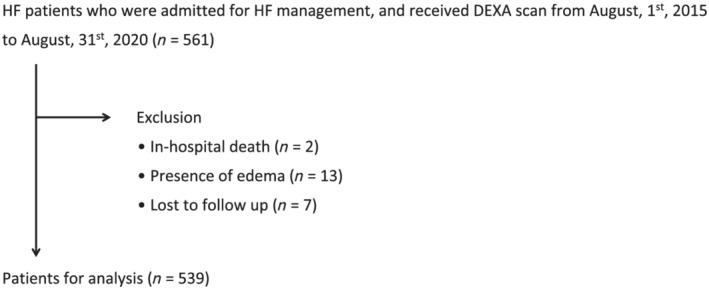
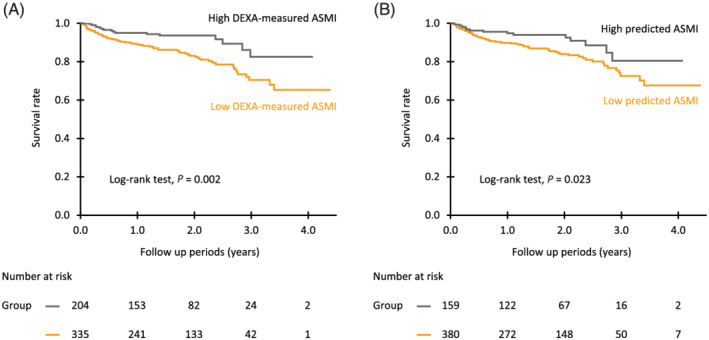
Methods and results: Data for 539 HF patients who received a DEXA scan and measurements of calf circumferences (CC) and mid-arm circumferences (MAC) in our hospital were analysed. Predicted ASMI was calculated as we previously reported: predicted ASMI (kg/m2 ) = [0.214 × weight (kg) + 0.217 × CC (cm) - 0.189 × MAC (cm) + 1.098 (male = 1, female = -1) + 0.576]/height2 (m2 ). Low ASMI values were defined as <7.00 kg/m2 and <5.40 kg/m2 for men and women, respectively, according to the criteria of the Asian Working Group for Sarcopenia. The median follow-up period was 1.75 years (interquartile range, 0.96-2.37 years), and 79 patients (15%) died. Kaplan-Meier survival curves showed that patients with low DEXA-measured ASMI and patients with low predicted ASMI had significantly lower survival rates than those for patients with high ASMI. In multivariate Cox proportional hazard analyses adjusted for age, sex, logarithmic B-type natriuretic peptide, cystatin C based-estimated glomerular filtration rate, and gait speed, DEXA-measured ASMI [hazard ratio (HR), 0.982; 95% confidence interval (CI), 0.967-0.998; P = 0.026] and predicted ASMI (HR, 0.979; 95% CI, 0.962-0.996; P = 0.018) were independent predictors of all-cause mortality. Inclusion of predicted ASMI into the adjustment model significantly improved continuous net reclassification improvement (0.338; 95% CI, 0.103-0.572; P < 0.01) and integrated discrimination improvement (0.020; 95% CI, 0.004-0.035; P < 0.05) for predicting mortality after discharge.
Conclusions: Predicted ASMI, as well as DEXA-measured ASMI, can predict all-cause death in HF patients, and calculation of predicted ASMI will be useful for detecting high-risk patients in a daily clinical setting and in large population-based studies.
Keywords: Calf circumference; Dual-energy X-ray absorptiometry; Heart failure; Mortality; Muscle mass; Sarcopenia.
© 2022 The Authors. ESC Heart Failure published by John Wiley & Sons Ltd on behalf of European Society of Cardiology.
Conflict of interest statement
None declared.
Figures
References
-
- Buckinx F, Landi F, Cesari M, Fielding RA, Visser M, Engelke K, Maggi S, Dennison E, al‐Daghri NM, Allepaerts S, Bauer J, Bautmans I, Brandi ML, Bruyère O, Cederholm T, Cerreta F, Cherubini A, Cooper C, Cruz‐Jentoft A, McCloskey E, Dawson‐Hughes B, Kaufman JM, Laslop A, Petermans J, Reginster JY, Rizzoli R, Robinson S, Rolland Y, Rueda R, Vellas B, Kanis JA. Pitfalls in the measurement of muscle mass: A need for a reference standard. J Cachexia Sarcopenia Muscle. 2018; 9: 269–278. - PMC - PubMed
-
- von Haehling S, Garfias Macedo T, Valentova M, Anker MS, Ebner N, Bekfani T, Haarmann H, Schefold JC, Lainscak M, Cleland JGF, Doehner W, Hasenfuss G, Anker SD. Muscle wasting as an independent predictor of survival in patients with chronic heart failure. J Cachexia Sarcopenia Muscle. 2020; 11: 1242–1249. - PMC - PubMed
-
- Konishi M, Akiyama E, Matsuzawa Y, Sato R, Kikuchi S, Nakahashi H, Maejima N, Iwahashi N, Kosuge M, Ebina T, Hibi K, Misumi T, Haehling S, Anker SD, Tamura K, Kimura K. Prognostic impact of muscle and fat mass in patients with heart failure. J Cachexia Sarcopenia Muscle. 2021; 12: 568–576. - PMC - PubMed
-
- Konishi M, Kagiyama N, Kamiya K, Saito H, Saito K, Ogasahara Y, Maekawa E, Misumi T, Kitai T, Iwata K, Jujo K, Wada H, Kasai T, Nagamatsu H, Ozawa T, Izawa K, Yamamoto S, Aizawa N, Makino A, Oka K, Momomura SI, Matsue Y. Impact of sarcopenia on prognosis in patients with heart failure with reduced and preserved ejection fraction. Eur J Prev Cardiol. 2021; 28: 1022–1029. - PubMed
Publication types
MeSH terms
LinkOut - more resources
Full Text Sources
Medical
Research Materials
Miscellaneous
