


Age-associated epigenetic changes in mammalian sperm: implications for offspring health and development
- PMID: 36066418
- PMCID: PMC9825272
- DOI: 10.1093/humupd/dmac033
Age-associated epigenetic changes in mammalian sperm: implications for offspring health and development
Abstract
Background: Modern reproductive behavior in most developed countries is characterized by delayed parenthood. Older gametes are generally less fertile, accumulating and compounding the effects of varied environmental exposures that are modified by lifestyle factors. Clinicians are primarily concerned with advanced maternal age, while the influence of paternal age on fertility, early development and offspring health remains underappreciated. There is a growing trend to use assisted reproductive technologies for couples of advanced reproductive age. Thus, the number of children born from older gametes is increasing.
Objective and rationale: We review studies reporting age-associated epigenetic changes in mammals and humans in sperm, including DNA methylation, histone modifications and non-coding RNAs. The interplay between environment, fertility, ART and age-related epigenetic signatures is explored. We focus on the association of sperm epigenetics on epigenetic and phenotype events in embryos and offspring.
Search methods: Peer-reviewed original and review articles over the last two decades were selected using PubMed and the Web of Science for this narrative review. Searches were performed by adopting the two groups of main terms. The first group included 'advanced paternal age', 'paternal age', 'postponed fatherhood', 'late fatherhood', 'old fatherhood' and the second group included 'sperm epigenetics', 'sperm', 'semen', 'epigenetic', 'inheritance', 'DNA methylation', 'chromatin', 'non-coding RNA', 'assisted reproduction', 'epigenetic clock'.
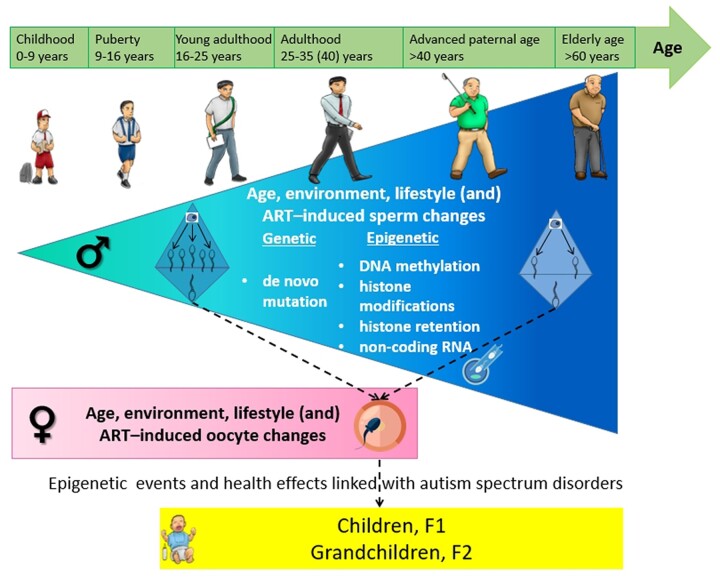
Outcomes: Age is a powerful factor in humans and rodent models associated with increased de novo mutations and a modified sperm epigenome. Age affects all known epigenetic mechanisms, including DNA methylation, histone modifications and profiles of small non-coding (snc)RNA. While DNA methylation is the most investigated, there is a controversy about the direction of age-dependent changes in differentially hypo- or hypermethylated regions with advanced age. Successful development of the human sperm epigenetic clock based on cross-sectional data and four different methods for DNA methylation analysis indicates that at least some CpG exhibit a linear relationship between methylation levels and age. Rodent studies show a significant overlap between genes regulated through age-dependent differentially methylated regions and genes targeted by age-dependent sncRNA. Both age-dependent epigenetic mechanisms target gene networks enriched for embryo developmental, neurodevelopmental, growth and metabolic pathways. Thus, age-dependent changes in the sperm epigenome cannot be described as a stochastic accumulation of random epimutations and may be linked with autism spectrum disorders. Chemical and lifestyle exposures and ART techniques may affect the epigenetic aging of sperm. Although most epigenetic modifications are erased in the early mammalian embryo, there is growing evidence that an altered offspring epigenome and phenotype is linked with advanced paternal age due to the father's sperm accumulating epigenetic changes with time. It has been hypothesized that age-induced changes in the sperm epigenome are profound, physiological and dynamic over years, yet stable over days and months, and likely irreversible.
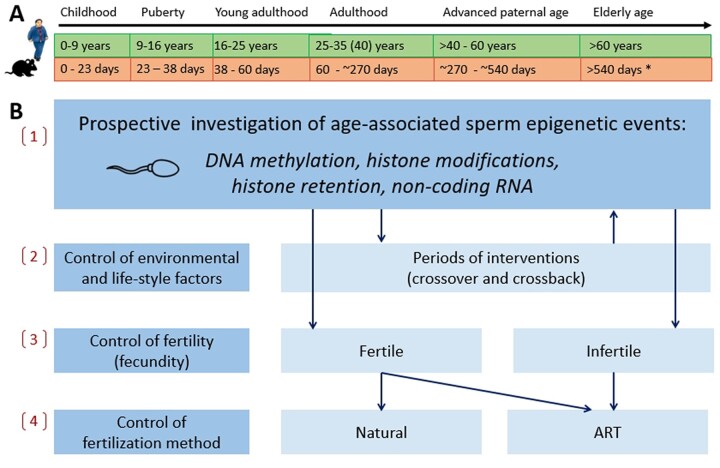
Wider implications: This review raises a concern about delayed fatherhood and age-associated changes in the sperm epigenome that may compromise reproductive health of fathers and transfer altered epigenetic information to subsequent generations. Prospective studies using healthy males that consider confounders are recommended. We suggest a broader discussion focused on regulation of the father's age in natural and ART conceptions is needed. The professional community should be informed and should raise awareness in the population and when counseling older men.
Keywords: DNA methylation; advanced paternal age; age; assisted reproductive technologies; delayed parenthood; epigenetic clock; epigenetics; non-coding RNA; pregnancy success; sperm.
© The Author(s) 2022. Published by Oxford University Press on behalf of European Society of Human Reproduction and Embryology.
Figures
References
-
- Aitken RJ. Not every sperm is sacred; a perspective on male infertility. Mol Hum Reprod 2018;24:287–298. - PubMed
-
- Aoki V, Liu L, Jones K, Hatasaka H, Gibson M, Peterson C, Carrell D.. Sperm protamine 1/protamine 2 ratios are related to in vitro fertilization pregnancy rates and predictive of fertilization ability. Fertil Steril 2006;86:1408–1415. - PubMed
-
- Ashapkin VV, Kutueva LI, Vanyushin BF.. Dnmt2 is the most evolutionary conserved and enigmatic cytosine DNA methyltransferase in eukaryotes. Russ J Genet 2016;52:237–248. - PubMed
