Association of Daily Step Count and Intensity With Incident Dementia in 78 430 Adults Living in the UK
- PMID: 36066874
- PMCID: PMC9449869
- DOI: 10.1001/jamaneurol.2022.2672
Association of Daily Step Count and Intensity With Incident Dementia in 78 430 Adults Living in the UK
Erratum in
-
Error in Open Access Status.JAMA Neurol. 2022 Oct 1;79(10):1086. doi: 10.1001/jamaneurol.2022.3612. JAMA Neurol. 2022. PMID: 36083577 Free PMC article. No abstract available.
Abstract
Importance: Step-based recommendations may be appropriate for dementia-prevention guidelines. However, the association of step count and intensity with dementia incidence is unknown.
Objective: To examine the dose-response association between daily step count and intensity and incidence of all-cause dementia among adults in the UK.
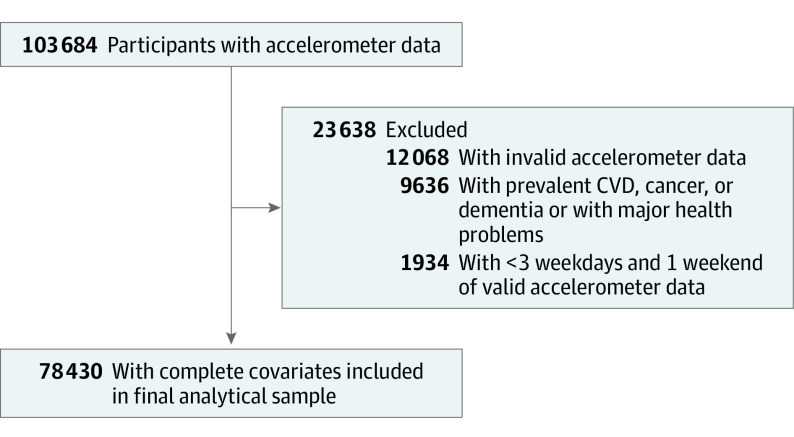
Design, setting, and participants: UK Biobank prospective population-based cohort study (February 2013 to December 2015) with 6.9 years of follow-up (data analysis conducted May 2022). A total of 78 430 of 103 684 eligible adults aged 40 to 79 years with valid wrist accelerometer data were included. Registry-based dementia was ascertained through October 2021.
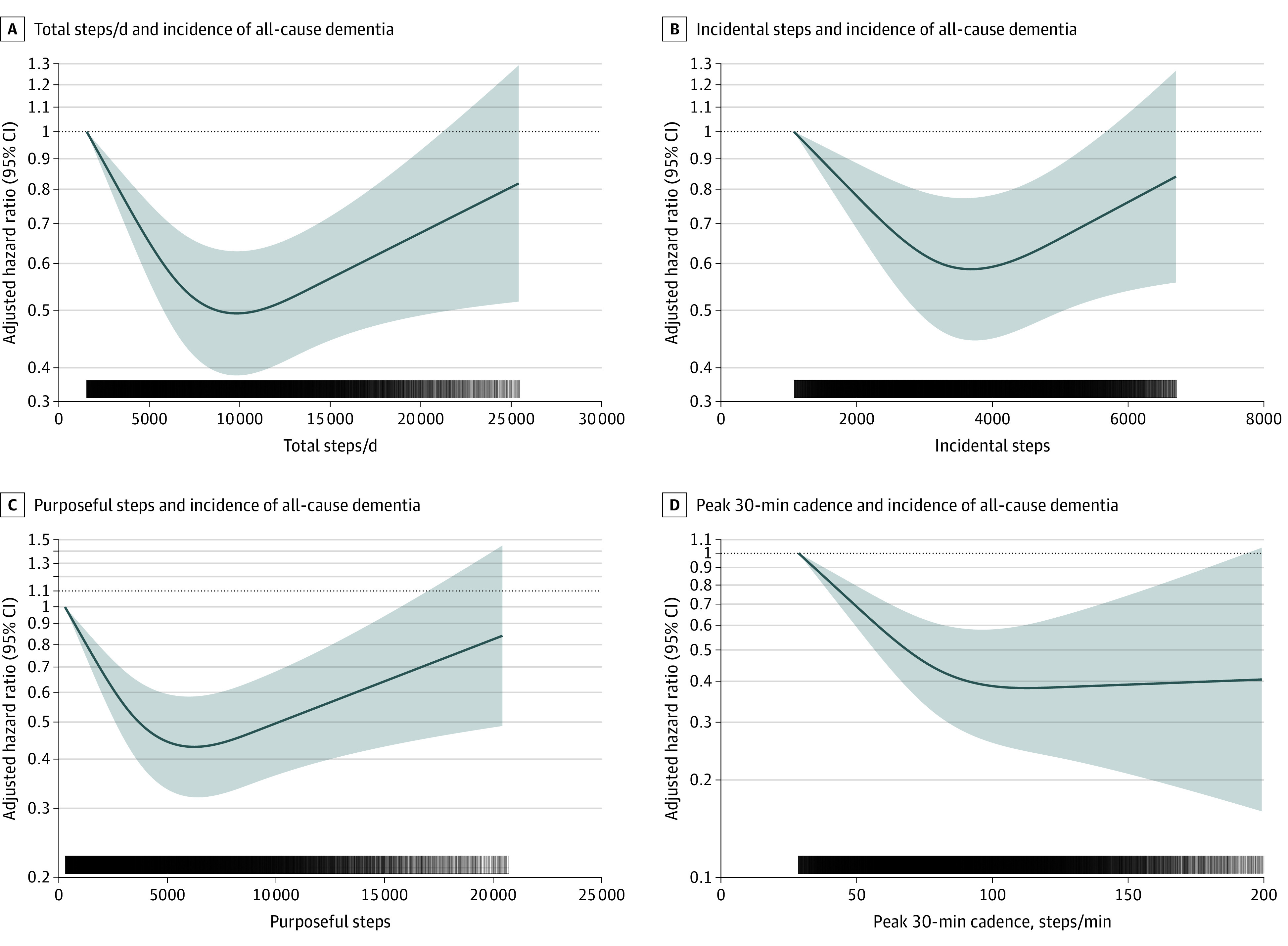
Exposures: Accelerometer-derived daily step count, incidental steps (less than 40 steps per minute), purposeful steps (40 steps per minute or more), and peak 30-minute cadence (ie, mean steps per minute recorded for the 30 highest, not necessarily consecutive, minutes in a day).
Main outcomes and measures: Incident dementia (fatal and nonfatal), obtained through linkage with inpatient hospitalization or primary care records or recorded as the underlying or contributory cause of death in death registers. Spline Cox regressions were used to assess dose-response associations.
Results: The study monitored 78 430 adults (mean [SD] age, 61.1 [7.9] years; 35 040 [44.7%] male and 43 390 [55.3%] female; 881 [1.1%] were Asian, 641 [0.8%] were Black, 427 [0.5%] were of mixed race, 75 852 [96.7%] were White, and 629 [0.8%] were of another, unspecified race) over a median (IQR) follow-up of 6.9 (6.4-7.5) years, 866 of whom developed dementia (mean [SD] age, 68.3 [5.6] years; 480 [55.4%] male and 386 [54.6%] female; 5 [0.6%] Asian, 6 [0.7%] Black, 4 [0.4%] mixed race, 821 [97.6%] White, and 6 [0.7%] other). Analyses revealed nonlinear associations between daily steps. The optimal dose (ie, exposure value at which the maximum risk reduction was observed) was 9826 steps (hazard ratio [HR], 0.49; 95% CI, 0.39-0.62) and the minimal dose (ie, exposure value at which the risk reduction was 50% of the observed maximum risk reduction) was 3826 steps (HR, 0.75; 95% CI, 0.67-0.83). The incidental cadence optimal dose was 3677 steps (HR, 0.58; 95% CI, 0.44-0.72); purposeful cadence optimal dose was 6315 steps (HR, 0.43; 95% CI, 0.32-0.58); and peak 30-minute cadence optimal dose was 112 steps per minute (HR, 0.38; 95% CI, 0.24-0.60).
Conclusions and relevance: In this cohort study, a higher number of steps was associated with lower risk of all-cause dementia. The findings suggest that a dose of just under 10 000 steps per day may be optimally associated with a lower risk of dementia. Steps performed at higher intensity resulted in stronger associations.
Conflict of interest statement
Figures
Comment in
-
Is 112 the New 10 000?-Step Count and Dementia Risk in the UK Biobank.JAMA Neurol. 2022 Oct 1;79(10):973-974. doi: 10.1001/jamaneurol.2022.2312. JAMA Neurol. 2022. PMID: 36066878 No abstract available.
-
Daily step count linked to dementia risk.Nat Rev Neurol. 2022 Nov;18(11):637. doi: 10.1038/s41582-022-00730-w. Nat Rev Neurol. 2022. PMID: 36151478 No abstract available.
References
Publication types
MeSH terms
Grants and funding
LinkOut - more resources
Full Text Sources
Other Literature Sources
Medical