Review
. 2022 Sep 28;122(18):14881-14910.
doi: 10.1021/acs.chemrev.1c01012. Epub 2022 Sep 6.

Toward Next Generation Lateral Flow Assays: Integration of Nanomaterials

Affiliations
Review

Toward Next Generation Lateral Flow Assays: Integration of Nanomaterials

Amadeo Sena-Torralba et al. Chem Rev. .

Abstract

Lateral flow assays (LFAs) are currently the most used point-of-care sensors for both diagnostic (e.g., pregnancy test, COVID-19 monitoring) and environmental (e.g., pesticides and bacterial monitoring) applications. Although the core of LFA technology was developed several decades ago, in recent years the integration of novel nanomaterials as signal transducers or receptor immobilization platforms has brought improved analytical capabilities. In this Review, we present how nanomaterial-based LFAs can address the inherent challenges of point-of-care (PoC) diagnostics such as sensitivity enhancement, lowering of detection limits, multiplexing, and quantification of analytes in complex samples. Specifically, we highlight the strategies that can synergistically solve the limitations of current LFAs and that have proven commercial feasibility. Finally, we discuss the barriers toward commercialization and the next generation of LFAs.


Conflict of interest statement

The authors declare no competing financial interest.

Figures

Figure 1
Figure 1
(A, i) Picture of microscope lenses attached to a smartphone camera that were used to photograph the detection area colorimetric LFA strips. (A, ii) Picture of the LFA strips taken with the microscopic lens and the smartphone camera. Reprinted (adapted) with permission from ref (39). Copyright 2019 Elsevier. (B, i) Schematic representation of a 3D-printed cartridge that contains all the optical apparatus for smartphone-based quantification of colorimetric and fluorescent LFAs. (B, ii) Screenshots from the universal detection app, showing the image analysis features for assay quantification. Reprinted (adapted) with permission from ref (42). Copyright 2020 Elsevier. (C, i) Picture of a portable UCNPs-LFA reader with dimensions of 24 × 9.4 × 5.4 cm and 0.9 kg weight. (C, ii) Schematic representation of the evaluation of the strips, in which the laser light is transmitted by the dichroic mirror at 45° to the detection zone. The smartphone camera captures the luminescence emission of the UCNPs present in the test and control lines, while the infrared filter blocks the laser’s residual light. Reprinted (adapted) with permission from ref (48). Copyright 2019 Elsevier.
Figure 2
Figure 2
(A, i) Schematic representation of the MPQ quantification procedure of LFAs using a PoC MPQ reader. Reprinted (adapted) with permission from ref (54). Copyright 2016 Elsevier. (A, ii) Schematic representation of the simultaneous quantification of three LFA strips using a cartridge and the MPQ reader. Reprinted (adapted) with permission from ref (51). Copyright 2016 American Chemical Society. (B) Pictures of a portable LFA reader used for the quantification of the heat generated on the LFA TL due to thermal contrast amplification. The reader includes sensors for the evaluation of both heat conduction and radiation. Reprinted (adapted) with permission from ref (58). Copyright 2016 Springer. (C, i) Schematic representation of a SERS reader. (C, ii) Picture of the SERS reader during the scanning of the LFA strips. Reprinted (adapted) with permission from ref (59). Copyright 2019 Wiley.
Figure 3
Figure 3
(A, i) Schematic representation of a sensitivity enhancement approach based on the introduction of a cellulose nanofiber (CNF) aerogel after the conjugate pad. (A, ii) SEM image of the CNF aerogel, showing an average pore size of 250 μm. (A, iii) Comparison of the flow after 30, 60, and 90 s in strips with and without the CNF aerogel. Reprinted (adapted) with permission from ref (66). Copyright 2021 Elsevier. (B, i) Schematic representation of a sensitivity enhancement approach based on the incorporation of a dissolvable wax barrier after the test line. (B, ii) Optical microscopy picture (40×) of wax barriers with different widths. (B, iii) Picture of the LFA strips with and without the wax barrier, after the detection of HIgG (0–1000 ng mL–1). Reprinted (adapted) with permission from ref (70). Copyright 2020 Elsevier. (C, i) Modulation of the direction of flow of graphene quantum dots by the adjustment of the electrolyte solution pH in a paper-based electrophoretic bioassay. (C, ii) Separation of a mixture of CdSe@ZnS QDs, CdTe QDs, and N,S-doped carbon dots according to the electrophoretic mobility of the nanomaterials. Reprinted (adapted) with permission from ref (71). Copyright 2021 American Chemical Society.
Figure 4
Figure 4
(A, i) Schematic representation of a sensitivity enhancement approach based on sample preconcentration by magnetic focusing. (A, ii, a) TEM image, (b) HAADF-STEM image, and (c–f) EDS elemental mapping images of Pt–P2VP@SPION. Reprinted (adapted) with permission from ref (74). Copyright 2021 American Chemical Society. (B, i) Schematic representation of a sensitivity enhancement approach based on sample filtration. (B, ii) AuNP-based LFA approach for the detection of E. coli in tap water (0–109 CFU mL–1). Reprinted (adapted) with permission from ref (10). Copyright 2021 The Royal Society of Chemistry.
Figure 5
Figure 5
(A, i) TEM image of carbon nanoparticles that form aggregates of 10–100 nm. (A, ii) Photograph of LFA strips after detecting E. coli (0–7.09 pg μL–1) using carbon nanoparticles (black) and AuNPs (red). Reprinted (adapted) with permission from ref (77). Copyright 2021 MDPI. (B, i) TEM image of the magnetic QD nanobeads. (B, ii) Picture of the nanobeads before and after the magnetic enrichment step. (B, iii) Picture of the LFA strips after the detection of H1N1 (0–106 pfu mL–1), showing an LoD of 500 pfu mL–1 by naked eye. Reprinted (adapted) with permission from ref (81). Copyright 2021 Elsevier. (C, i) Color palette generated in the TL of the LFA upon the ratiometric combination of different concentrations of 650-QDs (target-dependent) and 450-NBs (target-independent) reporters. (C, ii) Calibration curve for HIgG detection using LFA strips with increasing concentrations (0–0.1%) of 450-NBS in TL. Reprinted (adapted) with permission from ref (82). Copyright 2021 Wiley. (D, i) Schematic representation of a nanodiamond-based LFA for the detection of HIV-1 RNA. (D, ii) An omega-shaped stripline resonator is fixed under the LFA strip to selectively separate the fluorescence signal at the TL from the background autofluorescence. Reprinted (adapted) with permission from ref (84). Copyright 2020 Springer Nature.
Figure 6
Figure 6
(A) Schematic representation of the signal amplification strategy using water-soluble nanofibers and the silver enhancement reaction. Reprinted (adapted) with permission from ref (88). Copyright 2018 Elsevier. (B) Signal amplification strategy using AuNPs coated with Pt ultrathin layers (Au@Pt4L), for the detection of PSA. Reprinted (adapted) with permission from ref (91). Copyright 2017 American Chemical Society.
Figure 7
Figure 7
(A, i) Schematic representation of a dual-flow LFA fabricated using 5 wax patterned nitrocellulose membrane layers. (A, ii) 25 and 45 nm AuNPs are introduced into the first and second inlet, respectively. This sequential addition of differently sized AuNPs allows for reproducible SERS signal enhancement on the TL. Reprinted (adapted) with permission from ref (104). Copyright 2021 American Chemical Society. (B, i) A bacteriophage covalently coupled to AuNPs by carbodiimide coupling is used as a highly specific bioreceptor. (B, ii) The Bacteriophage LFA system enables the quantitative detection of S. enteritidis using SERS. Reprinted (adapted) with permission from ref (105). Copyright 2021 Elsevier.
Figure 8
Figure 8
(A, i) Schematic representation of a multiplexed assay based on two consecutive TLs for the detection of IgM and IgG for SARS-Cov-2 spike proteins. (A, ii) Elemental mapping images of the SiO2@DQD used as fluorescent labels in the publication by Wang et al. (A, iii) Picture of the LFA strips after performing the assay for the detection of SARS-cov-2 antibodies, where the red fluorescence signal generated in the M, G, and C lines indicates the presence of IgM (M) or IgG (G), with a positive control (C). Reprinted (adapted) with permission from ref (117). Copyright 2021 The Royal Society of Chemistry. (B, i) Schematic representation of the mobile phone reader used to quantitatively evaluate multiplexed LFA microarrays. (B, ii) Picture of the algorithmically determined immunoreaction spot layout, where each row corresponds to a different spotting condition (1–7). (B, iii) Heat map of the microarray used to optimize the spot configuration by machine learning. Reprinted (adapted) with permission from ref (127). Copyright 2020 Springer Nature.
Figure 9
Figure 9
(i) Schematic representation of the multichannel device created by Kyoung Han et al. in which wax patterned-NC membranes were stacked in multiple layers (ii) to create flow paths that allow for the sequential flow of the sample and signal amplification reagents to the test line. (iii) Picture of the device after the detection of GDH and Clostridioides difficile toxins A and B. Reprinted (adapted) with permission from ref (129). Copyright 2021 Elsevier.
Figure 10
Figure 10
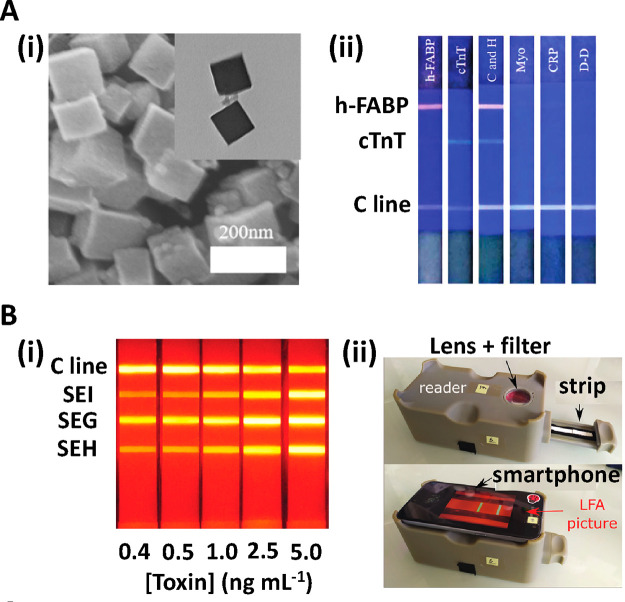
(A, i) SEM and TEM images of the ZrMOF@CdTe NPs, which show a cubic shape and a size around 120 nm. (A, ii) Multiplexed LFA based on the use of two TLs and ZrMOF@CdTe NPs with yellow and green fluorescent emissions. Reprinted (adapted) with permission from ref (133). Copyright 2021 The Royal Society of Chemistry. (B, i) Multiplexed LFAs showing the simultaneous detection of the staphylococcal enterotoxins I, G, and H, using lanthanide-doped nanoparticles. (B, ii) Smartphone-based readout system for the on-site LFA’s quantification. Reprinted (adapted) with permission from ref (134). Copyright 2021 The Royal Society of Chemistry.
Figure 11
Figure 11
Multiplexing strategy based on the detection of CK-MB, cTnI, and myoglobin cardiac biomarkers in a single TL, using three Raman reporters. Reprinted (adapted) with permission from ref (136). Copyright 2018 Elsevier
Figure 12
Figure 12
(A, i) Schematic representation of red blood cells clogging the filtration membrane. (A, ii) The use of the differential pad avoids the formation of the blood fouling layer, while the filtration and calibration pads are responsible for the separation and storage of the serum sample, respectively. Reprinted (adapted) with permission from ref (171). Copyright 2018 The Royal Society of Chemistry. (B, i) Schematic representation of the integrated PCR amplicon purification approach based on the immobilization of functionalized graphene oxide on the sample pad. (B, ii) The three-layered GO sample pad enables the scrubbing of almost all the residual primers and primer-dimers with <40 pb out of the sample matrix. Reprinted (adapted) with permission from ref (172). Copyright 2017 American Chemical Society.
Figure 13
Figure 13
(A) Schematic representation of a 10 min preconcentration approach based on the incorporation of a dialysis membrane onto the sample pad of an LFA strip. PEG conjugated to a fiberglass membrane is used as the dialysate. Reprinted (adapted) with permission from ref (173). Copyright 2016 Elsevier. (B) Schematic representation of a paper electrophoretic device powered by a smartphone battery. The whole blood sample is driven by electrophoresis toward the detection zone, avoiding the clogging on the nitrocellulose pores. Reprinted (adapted) with permission from ref (71). Copyright 2021 American Chemical Society.
Figure 14
Figure 14
(A) Schematic representation of the face mask-LFA capable of detecting exhaled SARS-CoV-2. Once the water reservoir is pressed, the water flow moves the collected aerosol sample toward the paper μPAD, which contains the freeze-dried assay reagents. (B) First, the RNA is extracted, and then, it is amplified by RT-RPA and detected by the Cas12a SHERLOCK method. The output is visualized in an LFA strip that is built into the face mask. (C) Pictures of the face mask interior and exterior. Reprinted (adapted) with permission from ref (182). Copyright 2021 Springer Nature.

References

    1. Land K. J.; Boeras D. I.; Chen X. S.; Ramsay A. R.; Peeling R. W. REASSURED Diagnostics to Inform Disease Control Strategies, Strengthen Health Systems and Improve Patient Outcomes. Nat. Microbiol. 2019, 4, 46–54. 10.1038/s41564-018-0295-3. - DOI - PMC - PubMed
    1. Quesada-González D.; Merkoçi A. Nanoparticle-Based Lateral Flow Biosensors. Biosens. Bioelectron. 2015, 73, 47–63. 10.1016/j.bios.2015.05.050. - DOI - PubMed
    1. Parolo C.; Merkoçi A. Paper-Based Nanobiosensors for Diagnostics. Chem. Soc. Rev. 2013, 42, 450–457. 10.1039/C2CS35255A. - DOI - PubMed
    1. Brangel P.; Sobarzo A.; Parolo C.; Miller B. S.; Howes P. D.; Gelkop S.; Lutwama J. J.; Dye J. M.; McKendry R. A.; Lobel L.; et al. A Serological Point-of-Care Test for the Detection of IgG Antibodies against Ebola Virus in Human Survivors. ACS Nano 2018, 12, 63–73. 10.1021/acsnano.7b07021. - DOI - PubMed
    1. Pregnancy Tests, Clearblue. https://uk.clearblue.com/pregnancy-tests (accessed 2020-03-10).

Publication types