. 2022 Sep 6;13(1):5240.
doi: 10.1038/s41467-022-32786-z.

Genomic surveillance of SARS-CoV-2 Omicron variants on a university campus

Affiliations

Genomic surveillance of SARS-CoV-2 Omicron variants on a university campus

Ana A Weil et al. Nat Commun. .

Abstract

Novel variants continue to emerge in the SARS-CoV-2 pandemic. University testing programs may provide timely epidemiologic and genomic surveillance data to inform public health responses. We conducted testing from September 2021 to February 2022 in a university population under vaccination and indoor mask mandates. A total of 3,048 of 24,393 individuals tested positive for SARS-CoV-2 by RT-PCR; whole genome sequencing identified 209 Delta and 1,730 Omicron genomes of the 1,939 total sequenced. Compared to Delta, Omicron had a shorter median serial interval between genetically identical, symptomatic infections within households (2 versus 6 days, P = 0.021). Omicron also demonstrated a greater peak reproductive number (2.4 versus 1.8), and a 1.07 (95% confidence interval: 0.58, 1.57; P < 0.0001) higher mean cycle threshold value. Despite near universal vaccination and stringent mitigation measures, Omicron rapidly displaced the Delta variant to become the predominant viral strain and led to a surge in cases in a university population.


Conflict of interest statement

H.Y.C. reports consulting with Ellume, Pfizer, The Bill and Melinda Gates Foundation, Glaxo Smith Kline, and Merck. H.Y.C. received research funding from Gates Ventures, Sanofi Pasteur, and support and reagents from Ellume and Cepheid outside of the submitted work. G.S.G. received research grants and research support from the US National Institutes of Health, the University of Washington, the Bill & Melinda Gates Foundation, Gilead Sciences, Alere Technologies, Merck & Co., Janssen Pharmaceutica, Cerus Corporation, ViiV Healthcare, Bristol-Myers Squibb, Roche Molecular Systems, Abbott Molecular Diagnostics, and THERA Technologies/TaiMed Biologics, Inc, all outside of the submitted work. J.A.E. reports research support from Gates Ventures, AstraZeneca, GlaxoSmithKline, Merck, and Pfizer, and consulting with Sanofi Pasteur, AstraZeneca, Teva Pharmaceuticals, and Meissa Vaccines, outside of the submitted work. M.B. reports research support from Vir Biotechnology, GSK, Regeneron, Gilead Sciences, Janssen Pharmaceutica, Ridgeback, Merck, Gates Ventures, and consulting with Vir Biotechnology, Moderna, Helocyte, and Merck outside of the submitted work. The remaining authors declare no competing interests.

Figures
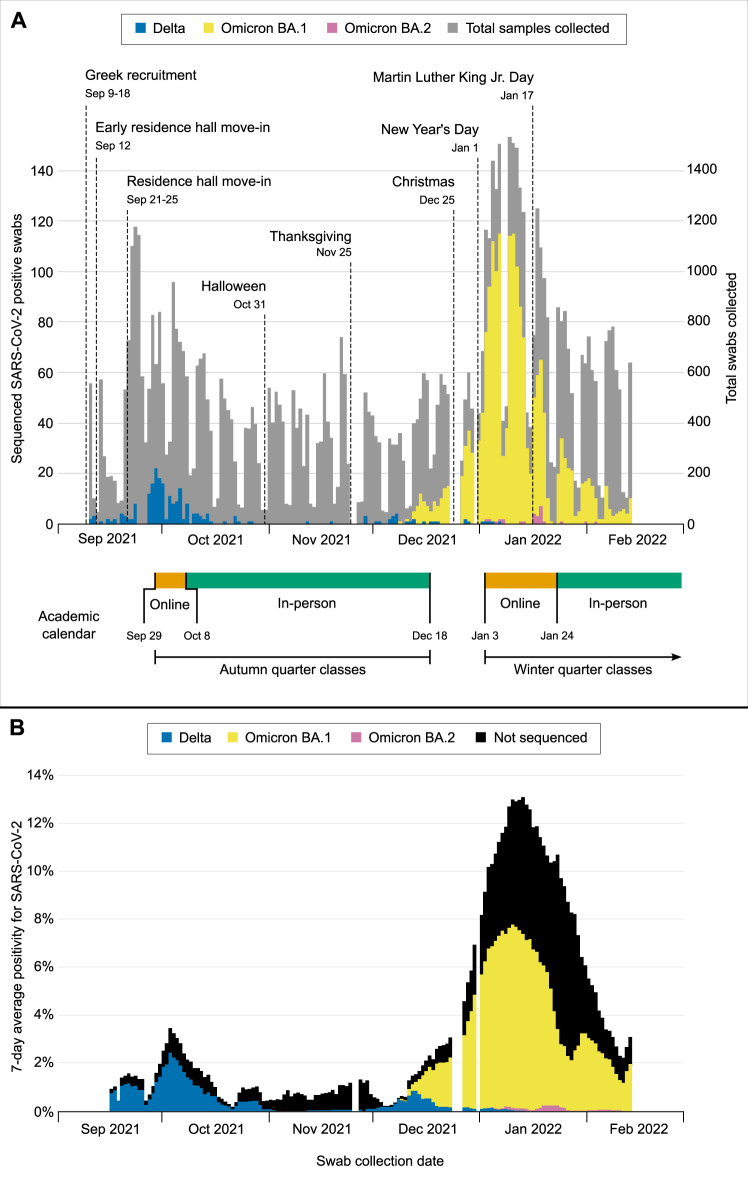
Fig. 1
Fig. 1. Sequenced SARS-CoV-2-positive samples collected from September 10, 2021 to February 14, 2022, by Pango Lineage.
A Daily counts of total samples collected and positive samples. B SARS-CoV-2 7-day average percent positivity. Campus events, holidays, and breaks in coursework that impacted university populations are shown. Testing demand was reduced on weekends, and operations were paused for holidays (represented by gaps in testing), inclement weather, and campus closures.
Fig. 2
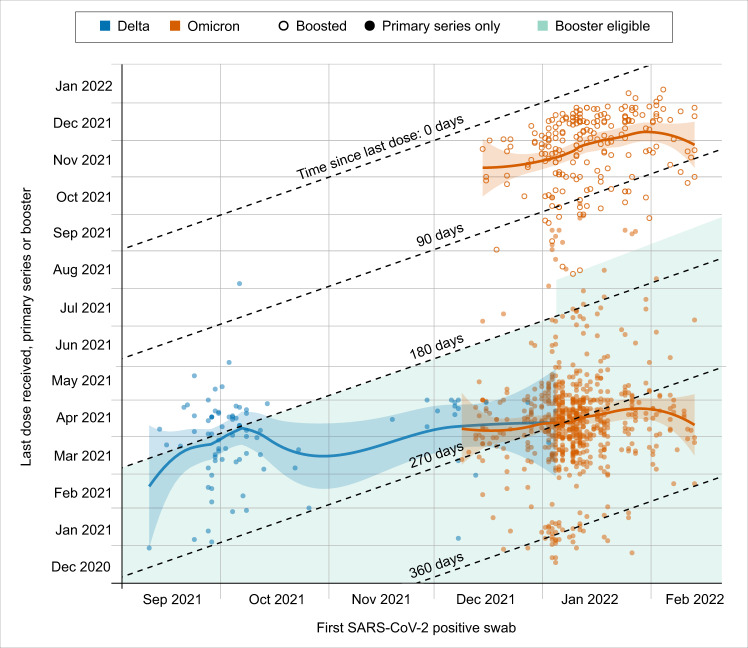
Fig. 2. Interval between Delta or Omicron infection and last mRNA vaccine dose received.
Local fitted polynomial regression using the loess function of the R stats package, with α = 0.75 and second-degree polynomials is shown as shaded 95% CIs shown for each variant and by booster status for Omicron. Period of booster eligibility is 180 or 150 days (beginning January 4, 2022) after primary series completion. In the US, a booster dose of BNT162b2 was available with limited eligibility on Sept 25, 2021, mRNA-1273 and Ad26.COV.2.S on Oct 20, 2021, and general eligibility on Nov 21, 2021. Not shown are participants who were unvaccinated, partially vaccinated, had unknown vaccination status, or received a vaccine other than BNT162b2 or mRNA-1273.
Fig. 3
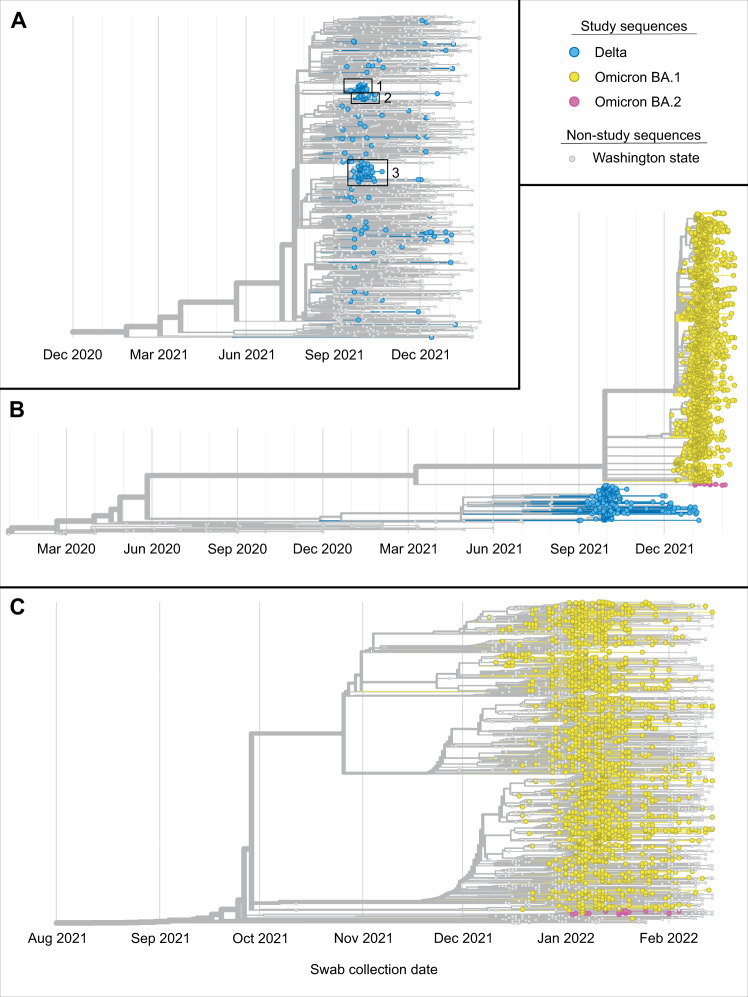
Fig. 3. Phylogenetics of sequenced campus viral genomes.
A Phylogenetic tree of 209 sequenced Delta samples collected on the UW campus and 1174 randomly selected genomes from samples collected in Washington during the same time period. Three monophyletic clusters containing exclusively or almost exclusively study genomes are boxed and numbered. B Phylogenetic tree containing sequences for campus samples collected between September 4, 2021 and February 14, 2022 (N = 1939) plus the Wuhan/Hu-1 reference genome and approximately 100 GISAID Washington state genomes collected from March 2020 to August 2021. The tree also contains genomes for 94 samples collected in Washington state from March 2020 to August 2021 (gray nodes) and the Wuhan/Hu-1 reference genome (gray node, far left) for context. Delta variant campus genomes are in yellow, and Omicron variant genomes are in blue. C Phylogenetic tree of 1730 sequenced Omicron samples collected on the UW campus plus the Wuhan-Hu-1 reference genome, and 1512 randomly selected genomes for samples collected in Washington during the same time period. Trees are available in the project Github repository: https://github.com/amcasto/huskytesting_deltaomicron.
Fig. 4
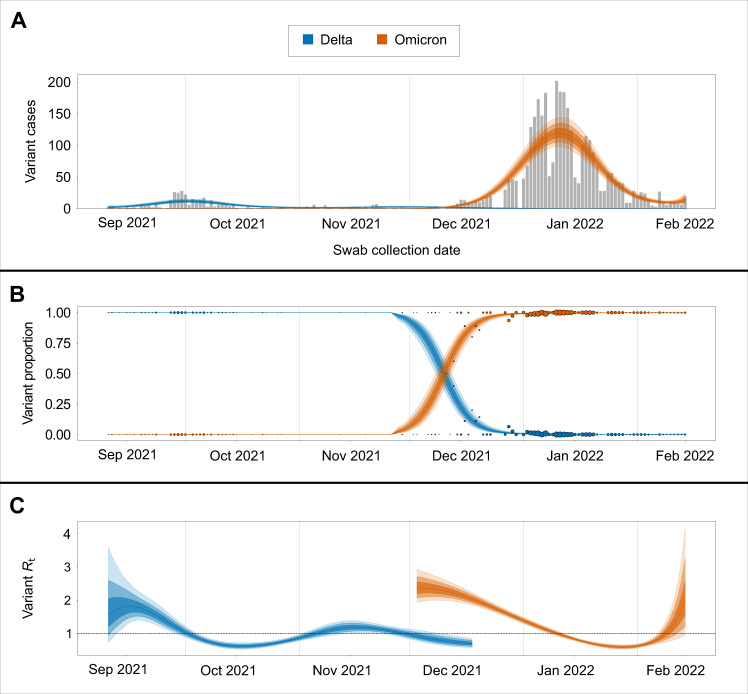
Fig. 4. Transmission dynamics of Delta and Omicron over study period.
A SARS-CoV-2-positive samples (gray bars) against posterior variant-specific incidence over the study period. B Observed variant proportion of sequenced positive SARS-CoV-2 samples against posterior variant proportion. Radius of points corresponds to counts of sequenced samples for that day. C Posterior estimates of variant-specific effective reproduction numbers. Shaded intervals in all plots correspond to 50%, 80%, and 95% credible intervals.

References

    1. Viana R, et al. Rapid epidemic expansion of the SARS-CoV-2 Omicron variant in southern Africa. Nature. 2022;603:679–686. doi: 10.1038/s41586-022-04411-y. - DOI - PMC - PubMed
    1. CDC COVID-19 Response Team. SARS-CoV-2 B.1.1.529 (Omicron) Variant—United States, December 1–8, 2021. MMWR Morb. Mortal. Wkly Rep. 2021;70:1731–1734. doi: 10.15585/mmwr.mm7050e1. - DOI - PMC - PubMed
    1. Brandal LT, et al. Outbreak caused by the SARS-CoV-2 Omicron variant in Norway, November to December 2021. Eur. Surveill. Bull. Eur. Sur Mal. Transm. Eur. Commun. Dis. Bull. 2021;26:2101147. - PMC - PubMed
    1. Smith-Jeffcoat, S. E. Multistate Outbreak of SARS-CoV-2 B.1.1.529 (Omicron) Variant Infections Among Persons in a Social Network Attending a Convention—New York City, November 18–December 20, 2021. MMWR Morb. Mortal. Wkly. Rep. 71, 238–242 (2022). - PMC - PubMed
    1. Thorne LG, et al. Evolution of enhanced innate immune evasion by SARS-CoV-2. Nature. 2021;602:487–495. doi: 10.1038/s41586-021-04352-y. - DOI - PMC - PubMed

Publication types

Supplementary concepts