


Cerebro-cerebellar motor networks in clinical subtypes of Parkinson's disease
- PMID: 36068246
- PMCID: PMC9448730
- DOI: 10.1038/s41531-022-00377-w
Cerebro-cerebellar motor networks in clinical subtypes of Parkinson's disease
Abstract
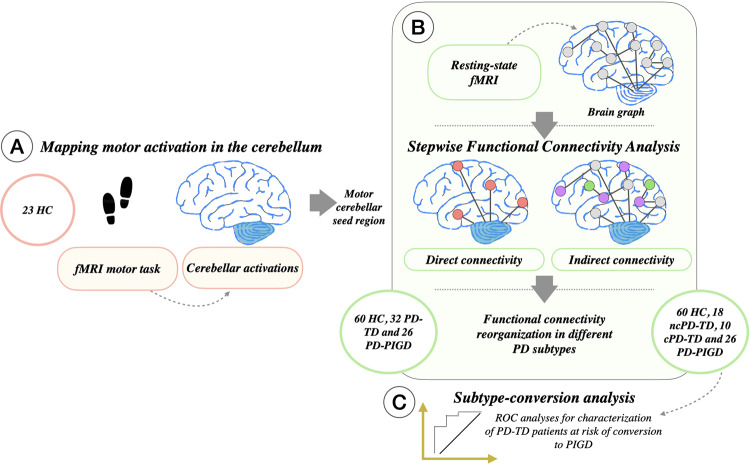
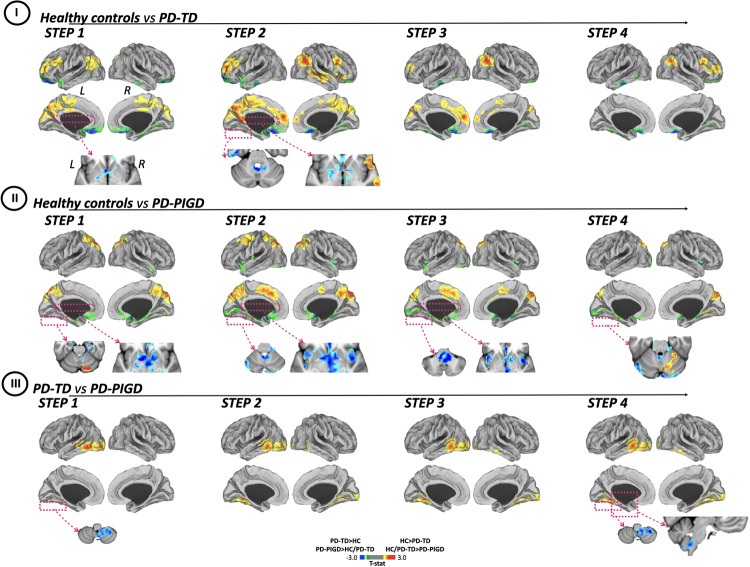
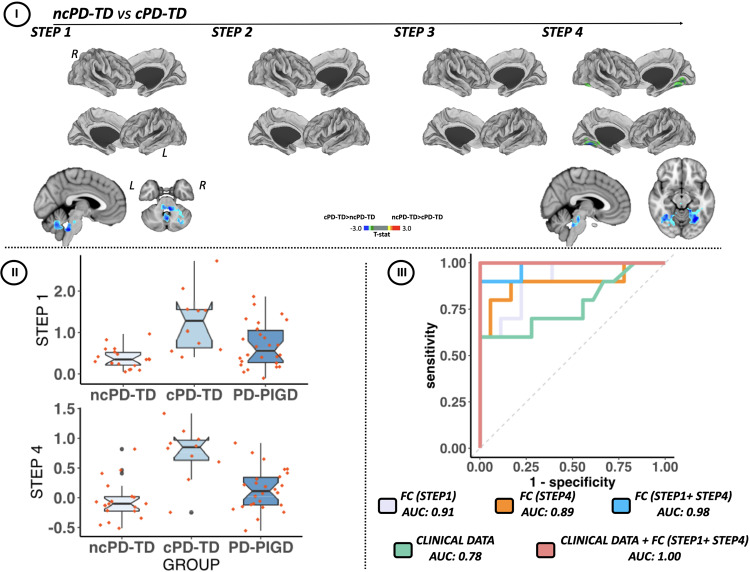
Parkinson's disease (PD) patients can be classified in tremor-dominant (TD) and postural-instability-and-gait-disorder (PIGD) motor subtypes. PIGD represents a more aggressive form of the disease that TD patients have a potentiality of converting into. This study investigated functional alterations within the cerebro-cerebellar system in PD-TD and PD-PIGD patients using stepwise functional connectivity (SFC) analysis and identified neuroimaging features that predict TD to PIGD conversion. Thirty-two PD-TD, 26 PD-PIGD patients and 60 healthy controls performed clinical/cognitive evaluations and resting-state functional MRI (fMRI). Four-year clinical follow-up data were available for 28 PD-TD patients, who were classified in 10 converters (cTD-PD) and 18 non-converters (ncTD-PD) to PIGD. The cerebellar seed-region was identified using a fMRI motor task. SFC analysis, characterizing regions that connect brain areas to the cerebellar seed at different levels of link-step distances, evaluated similar and divergent alterations in PD-TD and PD-PIGD. The discriminatory power of clinical data and/or SFC in distinguishing cPD-TD from ncPD-TD patients was assessed using ROC curve analysis. Compared to PD-TD, PD-PIGD patients showed decreased SFC in temporal lobe and occipital lobes and increased SFC in cerebellar cortex and ponto-medullary junction. Considering the subtype-conversion analysis, cPD-TD patients were characterized by increased SFC in temporal and occipital lobes and in cerebellum and ponto-medullary junction relative to ncPD-TD group. Combining clinical and SFC data, ROC curves provided the highest classification power to identify conversion to PIGD. These findings provide novel insights into the pathophysiology underlying different PD motor phenotypes and a potential tool for early characterization of PD-TD patients at risk of conversion to PIGD.
© 2022. The Author(s).
Conflict of interest statement
S.B., A.F., C.C., R.B., I.S., V.M., E.S., A.G., R.D.M., L.A., and E.S. report no disclosures. F.A. is Section Editor of NeuroImage: Clinical; has received speaker honoraria from Biogen Idec, Roche and Zambon; and receives or has received research supports from the Italian Ministry of Health, AriSLA (Fondazione Italiana di Ricerca per la SLA), Foundation Research on Alzheimer Disease and the European Research Council. T.S. has received speaker honoraria from Actavis and Alzheimer’s Association International Research Grant. V.S.K. has received speaker honoraria from Actavis and Solveo. M.F. is Editor-in-Chief of the Journal of Neurology; received compensation for consulting services and/or speaking activities from Bayer, Biogen Idec, Merck-Serono, Novartis, Roche, Sanofi Genzyme, Takeda, and Teva Pharmaceutical Industries; and receives research support from Biogen Idec, Merck-Serono, Novartis, Roche, Teva Pharmaceutical Industries, Italian Ministry of Health, Fondazione Italiana Sclerosi Multipla, and ARiSLA (Fondazione Italiana di Ricerca per la SLA).
Figures
References
Grants and funding
LinkOut - more resources
Full Text Sources
