


Subjective cognitive decline and anxious/depressive symptoms during the COVID-19 pandemic: what is the role of stress perception, stress resilience, and β-amyloid?
- PMID: 36068641
- PMCID: PMC9446623
- DOI: 10.1186/s13195-022-01068-7
Subjective cognitive decline and anxious/depressive symptoms during the COVID-19 pandemic: what is the role of stress perception, stress resilience, and β-amyloid?
Abstract
Background: The COVID-19 pandemic may worsen the mental health of people reporting subjective cognitive decline (SCD) and therefore their clinical prognosis. We aimed to investigate the association between the intensity of SCD and anxious/depressive symptoms during confinement and the underlying mechanisms.
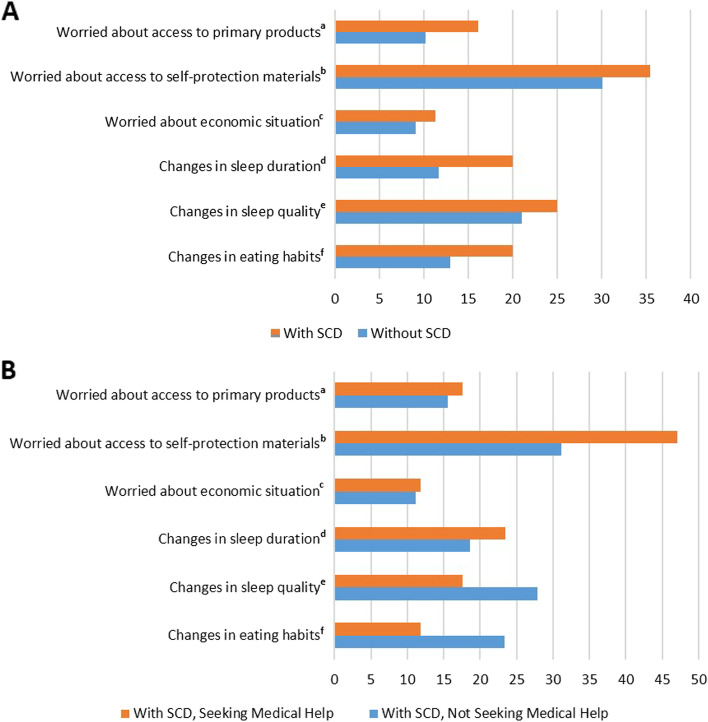
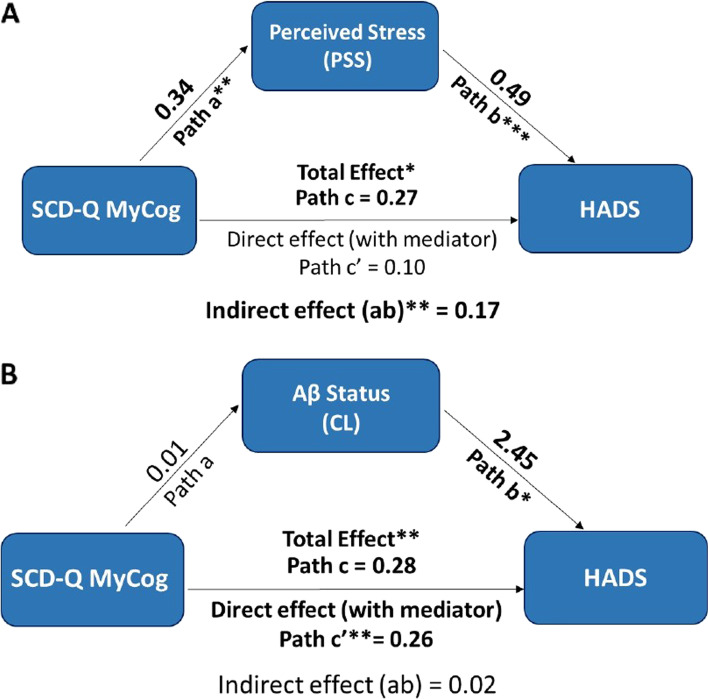
Methods: Two hundred fifty cognitively unimpaired participants completed the Hospital Anxiety and Depression Scale (HADS) and SCD-Questionnaire (SCD-Q) and underwent amyloid-β positron emission tomography imaging with [18F] flutemetamol (N = 205) on average 2.4 (± 0.8) years before the COVID-19 confinement. During the confinement, participants completed the HADS, Perceived Stress Scale (PSS), Brief Resilience Scale (BRS), and an ad hoc questionnaire on worries (access to primary products, self-protection materials, economic situation) and lifestyle changes (sleep duration, sleep quality, eating habits). We investigated stress-related measurements, worries, and lifestyle changes in relation to SCD. We then conducted an analysis of covariance to investigate the association of SCD-Q with HADS scores during the confinement while controlling for pre-confinement anxiety/depression scores and demographics. Furthermore, we introduced amyloid-β positivity, PSS, and BRS in the models and performed mediation analyses to explore the mechanisms explaining the association between SCD and anxiety/depression.
Results: In the whole sample, the average SCD-Q score was 4.1 (± 4.4); 70 (28%) participants were classified as SCD, and 26 (12.7%) were amyloid-β-positive. During the confinement, participants reporting SCD showed higher PSS (p = 0.035) but not BRS scores (p = 0.65) than those that did not report SCD. No differences in worries or lifestyle changes were observed. Higher SCD-Q scores showed an association with greater anxiety/depression scores irrespective of pre-confinement anxiety/depression levels (p = 0.002). This association was not significant after introducing amyloid-β positivity and stress-related variables in the model (p = 0.069). Amyloid-β positivity and PSS were associated with greater HADS irrespective of pre-confinement anxiety/depression scores (p = 0.023; p < 0.001). The association of SCD-Q with HADS was mediated by PSS (p = 0.01).
Conclusions: Higher intensity of SCD, amyloid-β positivity, and stress perception showed independent associations with anxious/depressive symptoms during the COVID-19 confinement irrespective of pre-confinement anxiety/depression levels. The association of SCD intensity with anxiety/depression was mediated by stress perception, suggesting stress regulation as a potential intervention to reduce affective symptomatology in the SCD population in the face of stressors.
Keywords: Alzheimer’s disease; Anxiety; COVID-19 confinement; Depression; Stress; Subjective cognitive decline.
© 2022. The Author(s).
Conflict of interest statement
MSC has served as a consultant and on advisory boards for Roche Diagnostics International Ltd. and has given lectures in symposia sponsored by Roche Diagnostics, S.L.U, and Roche Farma, S.A.
Figures
References
-
- Suárez-González A, Rajagopalan J, Livingston G, Alladi S. The effect of COVID-19 isolation measures on the cognition and mental health of people living with dementia: a rapid systematic review of one year of quantitative evidence. EClinicalMedicine. 2021;39. 10.1016/j.eclinm.2021.101047. - PMC - PubMed
Publication types
MeSH terms
Substances
LinkOut - more resources
Full Text Sources
Medical
