


Improving carboxymethyl cellulose edible coating using ZnO nanoparticles from irradiated Alternaria tenuissima
- PMID: 36070053
- PMCID: PMC9452608
- DOI: 10.1186/s13568-022-01459-x
Improving carboxymethyl cellulose edible coating using ZnO nanoparticles from irradiated Alternaria tenuissima
Erratum in
-
Correction: Improving carboxymethyl cellulose edible coating using ZnO nanoparticles from irradiated Alternaria tenuissima.AMB Express. 2024 Nov 14;14(1):127. doi: 10.1186/s13568-024-01779-0. AMB Express. 2024. PMID: 39543047 Free PMC article. No abstract available.
Abstract
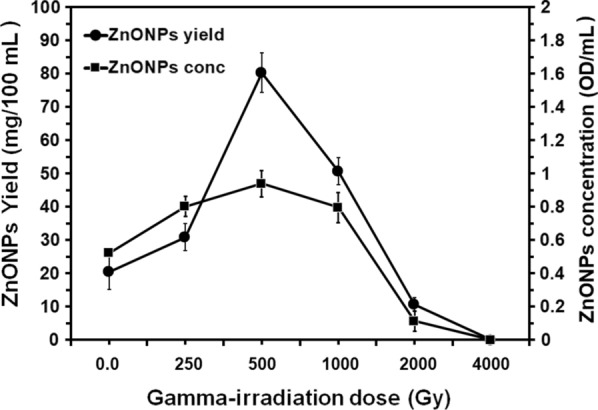
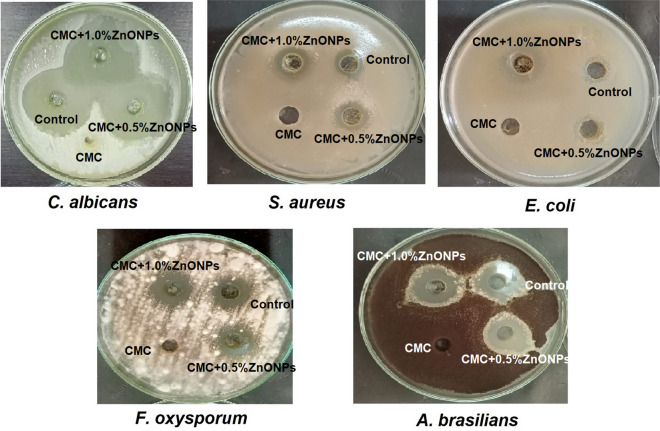
In this paper, gamma-irradiation was successfully used to intensify the yield of Zinc oxide nanoparticles (ZnONPs) produced by the fungus Alternaria tenuissima as a sustainable and green process. The obtained data showed that 500 Gy of gamma-irradiation increased ZnONPs' yield to approximately four-fold. The synthesized ZnONPs were then exploited to develop active Carboxymethyl Cellulose films by casting method at two different concentration of ZnONPs 0.5% and 1.0%. The physicochemical, mechanical, antioxidant, and antimicrobial properties of the prepared films were evaluated. The incorporation of ZnONPs in the Carboxymethyl Cellulose films had significantly decreased solubility (from 78.31% to 66.04% and 59.72%), water vapor permeability (from 0.475 g m-2 to 0.093 g m-2 and 0.026 g m-2), and oxygen transfer rate (from 24.7 × 10⁻² to 2.3 × 10⁻² and 1.8 × 10⁻²) of the respective prepared films. Meanwhile, tensile strength (from 183.2 MPa to 203.34 MPa and 235.94 MPa), elongation (from 13.0% to 62.5% and 83.7%), and Yang's modulus (from 325.344 to 1410.0 and 1814.96 MPa) of these films were increased. Moreover, the antioxidant and antimicrobial activities against several human and plant pathogens the prepared of Carboxymethyl Cellulose-ZnONPs films were significantly increased. In conclusion, the prepared Carboxymethyl Cellulose-ZnONPs films showed enhanced activities in comparison with Carboxymethyl Cellulose film without NPs. With these advantages, the fabricated Carboxymethyl Cellulose-ZnONPs films in this study could be effectively utilized as protective edible coating films of food products.
Keywords: Active food packaging; Alternaria tenuissima; Carboxymethyl cellulose; Edible coating films; Gamma irradiation; Zinc oxide nanoparticles.
© 2022. The Author(s).
Conflict of interest statement
Not applicable.
Figures




References
-
- Anugrah DSB, Alexander H, Pramitasari R, Hudiyanti D, Sagita CB (2020) A review of polysaccharide-zinc oxide nanocomposites as safe coating for fruits preservation. Coatings 10:988. 10.3390/coatings10100988 - DOI
-
- ASTM (1990) Standard practice for conditioning plastics and electrical insulating materials for testing: D618-61 (reapproved 1990). In: Annual book of American Standard Testing Methods, Vol. 8.01. (1995) Philadelphia.
LinkOut - more resources
Full Text Sources
