


ATF3 and CH25H regulate effector trogocytosis and anti-tumor activities of endogenous and immunotherapeutic cytotoxic T lymphocytes
- PMID: 36070682
- PMCID: PMC10496461
- DOI: 10.1016/j.cmet.2022.08.007
ATF3 and CH25H regulate effector trogocytosis and anti-tumor activities of endogenous and immunotherapeutic cytotoxic T lymphocytes
Erratum in
-
ATF3 and CH25H regulate effector trogocytosis and anti-tumor activities of endogenous and immunotherapeutic cytotoxic T lymphocytes.Cell Metab. 2024 May 7;36(5):1164-1167. doi: 10.1016/j.cmet.2024.04.002. Epub 2024 Apr 11. Cell Metab. 2024. PMID: 38604169 No abstract available.
Abstract
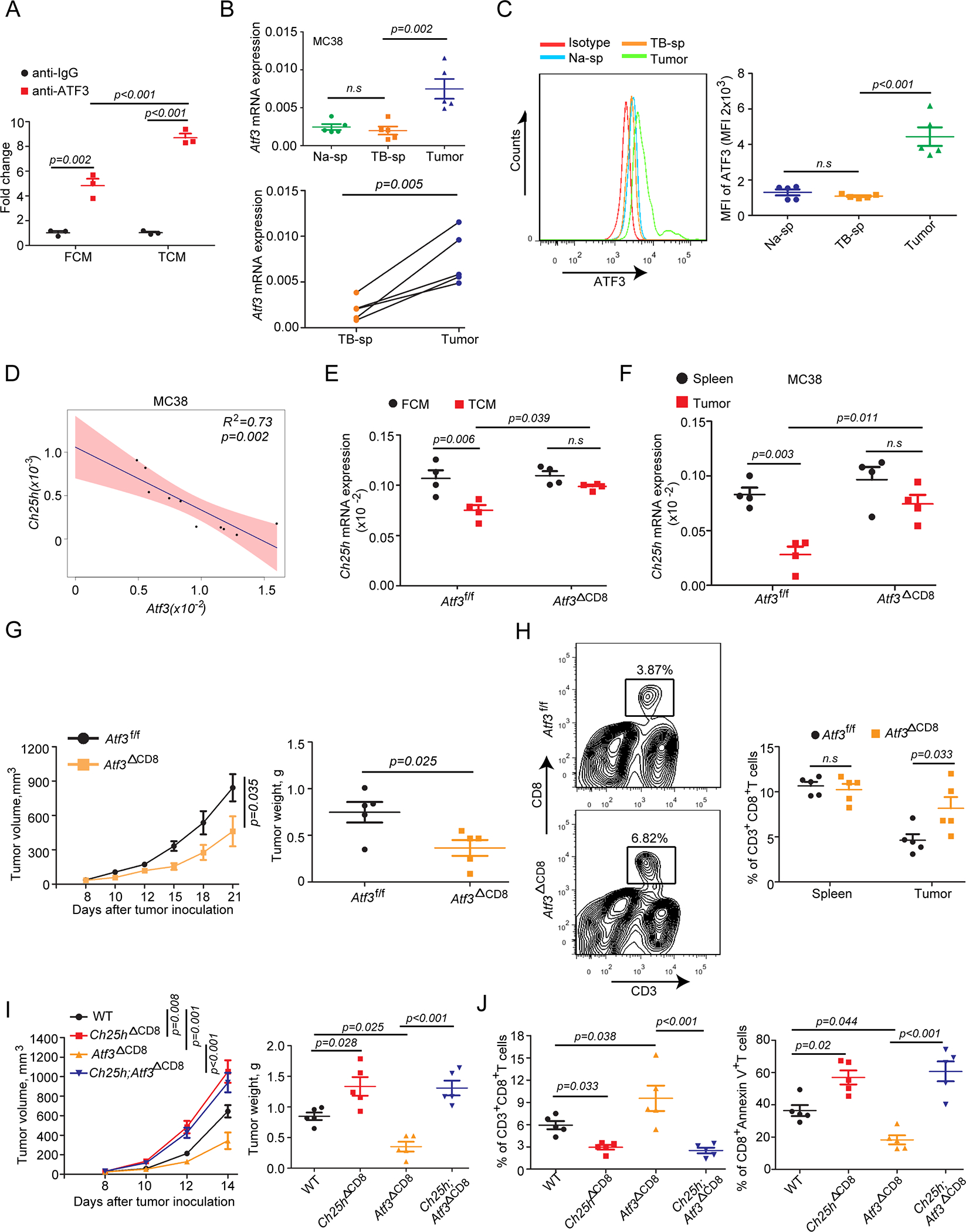
Effector trogocytosis between malignant cells and tumor-specific cytotoxic T lymphocytes (CTLs) contributes to immune evasion through antigen loss on target cells and fratricide of antigen-experienced CTLs by other CTLs. The mechanisms regulating these events in tumors remain poorly understood. Here, we demonstrate that tumor-derived factors (TDFs) stimulated effector trogocytosis and restricted CTLs' tumoricidal activity and viability in vitro. TDFs robustly altered the CTL's lipid profile, including depletion of 25-hydroxycholesterol (25HC). 25HC inhibited trogocytosis and prevented CTL's inactivation and fratricide. Mechanistically, TDFs induced ATF3 transcription factor that suppressed the expression of 25HC-regulating gene-cholesterol 25-hydroxylase (CH25H). Stimulation of trogocytosis in the intratumoral CTL by the ATF3-CH25H axis attenuated anti-tumor immunity, stimulated tumor growth, and impeded the efficacy of chimeric antigen receptor (CAR) T cell adoptive therapy. Through use of armored CAR constructs or pharmacologic agents restoring CH25H expression, we reversed these phenotypes and increased the efficacy of immunotherapies.
Keywords: ATF3; CD8(+) T lymphocytes; CH25H; cancer immunotherapy; chimeric antigen receptor; cytotoxic T lymphocytes; hydroxycholesterol; sumoylation inhibitor; trogocytosis; tumor-derived factors.
Copyright © 2022 Elsevier Inc. All rights reserved.
Conflict of interest statement
Declaration of interests A.B. and G.S. were employees of and stockholders in Millennium Pharmaceuticals, Inc., a wholly owned subsidiary of Takeda Pharmaceutical Company Limited producing TAK981, while engaged in the research project. Z.L., N.M., and S.Y.F. are listed as inventors on The University of Pennsylvania’s patent application related to the matter described in this manuscript.
Figures




References
-
- Anggakusuma Romero-Brey I, Berger C, Colpitts CC, Boldanova T, Engelmann M, Todt D, Perin PM, Behrendt P, Vondran FW, et al. (2015). Interferon-inducible cholesterol-25-hydroxylase restricts hepatitis C virus replication through blockage of membranous web formation. Hepatology 62, 702–714. 10.1002/hep.27913. - DOI - PubMed
-
- Baek AE, Yu YA, He S, Wardell SE, Chang CY, Kwon S, Pillai RV, McDowell HB, Thompson JW, Dubois LG, et al. (2017). The cholesterol metabolite 27 hydroxycholesterol facilitates breast cancer metastasis through its actions on immune cells. Nat Commun 8, 864. 10.1038/s41467-017-00910-z. - DOI - PMC - PubMed
-
- Barysch SV, Stankovic-Valentin N, Miedema T, Karaca S, Doppel J, Nait Achour T, Vasudeva A, Wolf L, Sticht C, Urlaub H, and Melchior F (2021). Transient deSUMOylation of IRF2BP proteins controls early transcription in EGFR signaling. EMBO Rep 22, e49651. 10.15252/embr.201949651. - DOI - PMC - PubMed
Publication types
MeSH terms
Substances
Grants and funding
LinkOut - more resources
Full Text Sources
Molecular Biology Databases
Research Materials
Miscellaneous
