Early Effect of 0.005% Estriol Vaginal Gel on Symptoms and Signs of Vulvovaginal Atrophy
- PMID: 36070871
- PMCID: PMC9452593
- DOI: 10.6118/jmm.21038
Early Effect of 0.005% Estriol Vaginal Gel on Symptoms and Signs of Vulvovaginal Atrophy
Abstract
Objectives: This study aims to assess the effect of ultralow dose 0.005% estriol vaginal gel in women with genitourinary syndrome of menopause (GSM).
Methods: In this prospective and multicenter single-arm study, efficacy was assessed by the evaluation of the epithelial maturation value (MV), vaginal pH, symptoms and signs of vulvovaginal atrophy. Tolerability, acceptability, and the effect on intimate relationships were also evaluated.
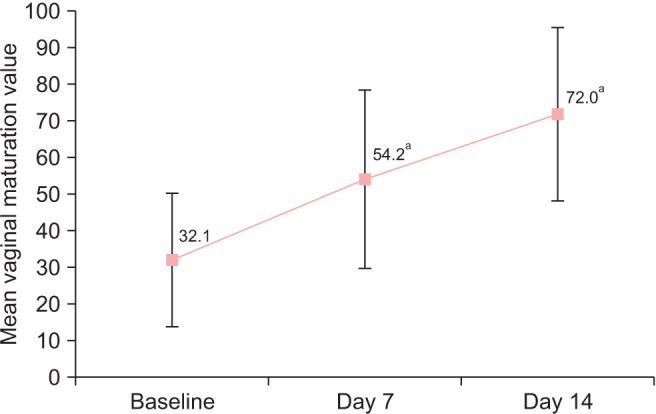
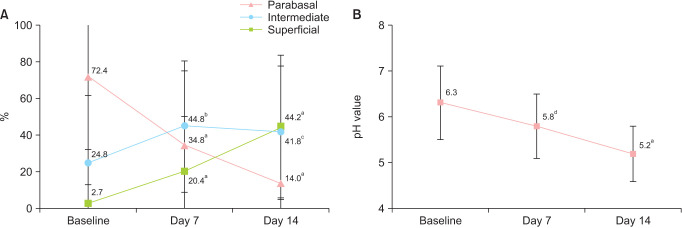
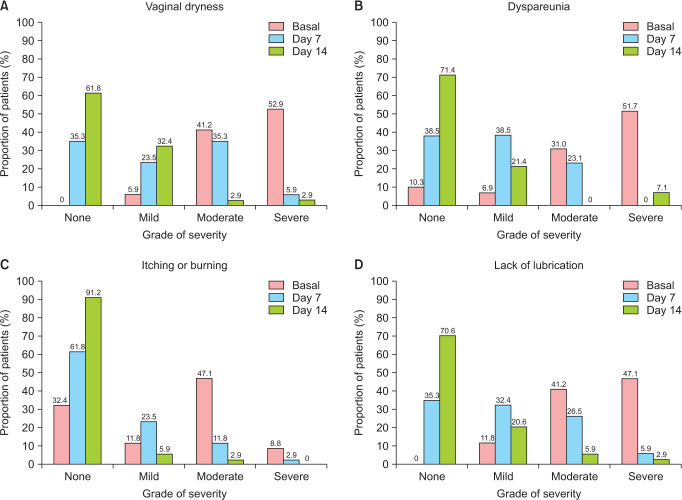
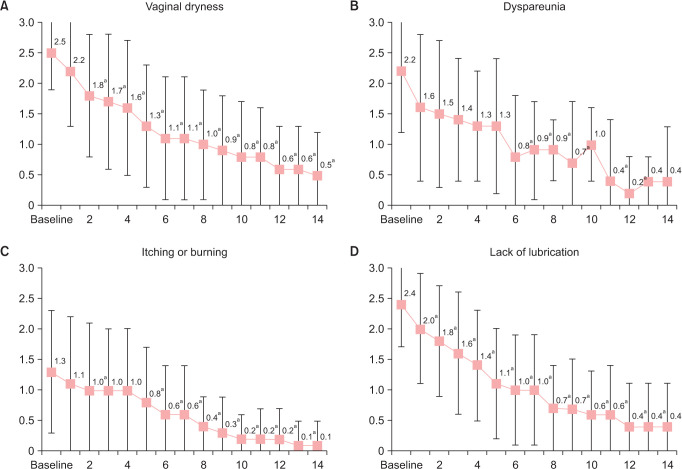
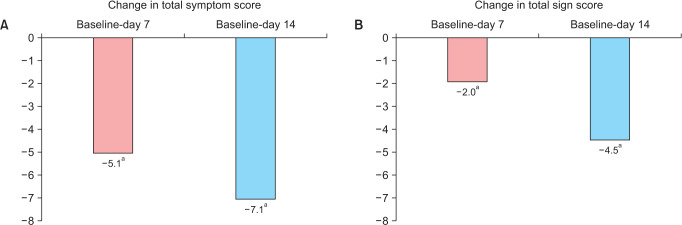
Results: We included 35 postmenopausal women with moderate-to-severe vaginal dryness. The most bothering symptom reported was vaginal dryness. The mean increase in the MV after 7 and 14 days of treatment were 22.1 (P < 0.001) and 39.9 (P < 0.001) points, with an increase in the superficial cells of 17.7 percentage points (pp) (95% confidence interval [CI], 7.9-27.4; P < 0.001) and 41.4 pp (95% CI, 28.2-54.6; P < 0.001) observed at the timepoints. Additionally, the pH decreased by 0.6 ± 0.7 (mean ± SD) at 7 days (P < 0.0001) and by 1.1± 0.8 at 14 days (P < 0.0001) from a baseline mean value of 6.3 ± 0.8. The severity of vaginal dryness (range, 0 [none] to 3 [severe]) was significantly reduced by a mean of 1.4 points (P < 0.0001) at 7 days and 2 points (P < 0.0001) at 14 days.
Conclusions: Ultralow dose 0.005% estriol vaginal gel produced a rapid improvement of most relevant symptoms and signs of GSM. This clinically meaningful response was observed from the initial days of treatment, confirming a fast onset and a progressive action.
Keywords: Atrophy; Estriol; Gels; Postmenopause; Vagina.
Copyright © by The Korean Society of Menopause.
Conflict of interest statement
J.L.-C.F., M.C.G., and J.L.D.M. report no conflicts of interest. S.G.R. reports grants for research activities, for attending conferences, as a consultant, and/or for lecturing in scientific meetings from Isdin, Pfizer, Servier, Amgen, MSD, Kern, Casen-Recordati, Sandoz, Procare Health, Bayer, Lacer, Shionogi, GSK, Bioiberica, Theramex, Gedeon Ritcher, Effik, Italfarmaco, Iprad, Seid, Ordesa, and Zambon. C.C.C. and C.N.M. are full time employees of ITF Research Pharma.
Figures
References
-
- Nappi RE, Palacios S, Bruyniks N, Particco M, Panay N. The burden of vulvovaginal atrophy on women's daily living: implications on quality of life from a face-to-face real-life survey. Menopause. 2019;26:485–491. - PubMed
-
- Moral E, Delgado JL, Carmona F, Caballero B, Guillán C, González PM, et al. Genitourinary syndrome of menopause. Prevalence and quality of life in Spanish postmenopausal women. The GENISSE study. Climacteric. 2018;21:167–173. - PubMed
-
- Kingsberg SA, Wysocki S, Magnus L, Krychman ML. Vulvar and vaginal atrophy in postmenopausal women: findings from the REVIVE (REal Women's VIews of Treatment Options for Menopausal Vaginal ChangEs) survey. J Sex Med. 2013;10:1790–1799. - PubMed
-
- Kingsberg SA, Krychman M, Graham S, Bernick B, Mirkin S. The Women's EMPOWER survey: identifying women's perceptions on vulvar and vaginal atrophy and its treatment. J Sex Med. 2017;14:413–424. - PubMed
-
- Cano A, Estévez J, Usandizaga R, Gallo JL, Guinot M, Delgado JL, et al. The therapeutic effect of a new ultra low concentration estriol gel formulation (0.005% estriol vaginal gel) on symptoms and signs of postmenopausal vaginal atrophy: results from a pivotal phase III study. Menopause. 2012;19:1130–1139. - PubMed
Grants and funding
LinkOut - more resources
Full Text Sources
Miscellaneous