. 2022 Sep 7;9(1):548.
doi: 10.1038/s41597-022-01631-9.

PLAS-5k: Dataset of Protein-Ligand Affinities from Molecular Dynamics for Machine Learning Applications

Affiliations

PLAS-5k: Dataset of Protein-Ligand Affinities from Molecular Dynamics for Machine Learning Applications

Divya B Korlepara et al. Sci Data. .

Abstract

Computational methods and recently modern machine learning methods have played a key role in structure-based drug design. Though several benchmarking datasets are available for machine learning applications in virtual screening, accurate prediction of binding affinity for a protein-ligand complex remains a major challenge. New datasets that allow for the development of models for predicting binding affinities better than the state-of-the-art scoring functions are important. For the first time, we have developed a dataset, PLAS-5k comprised of 5000 protein-ligand complexes chosen from PDB database. The dataset consists of binding affinities along with energy components like electrostatic, van der Waals, polar and non-polar solvation energy calculated from molecular dynamics simulations using MMPBSA (Molecular Mechanics Poisson-Boltzmann Surface Area) method. The calculated binding affinities outperformed docking scores and showed a good correlation with the available experimental values. The availability of energy components may enable optimization of desired components during machine learning-based drug design. Further, OnionNet model has been retrained on PLAS-5k dataset and is provided as a baseline for the prediction of binding affinities.


Conflict of interest statement

The authors declare no competing interests.

Figures
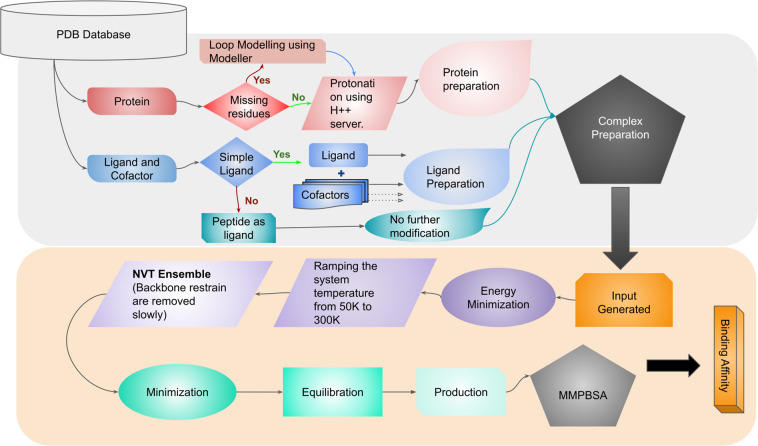
Fig. 1
Fig. 1
Protocol for input preparation and simulations.
Fig. 2
Fig. 2
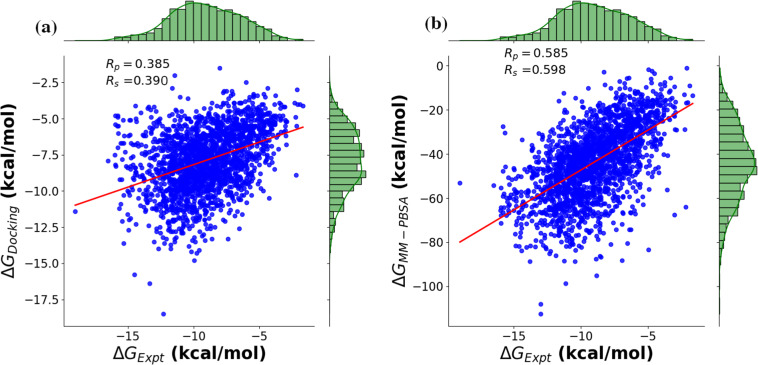
Correlation plots between the experimental and calculated binding affinities for a subset with 2000 pdbids. The binding affinities are calculated (a) using Auto-dock Vina, and (b) using MM-PBSA.
Fig. 3
Fig. 3
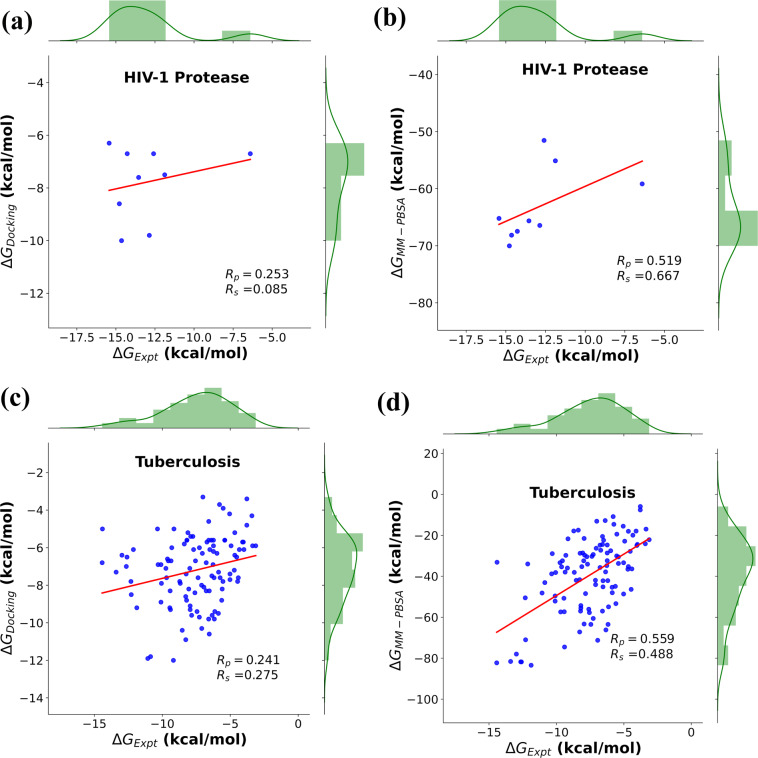
Prediction of binding affinity based on correlation with experimental data: FDA approved drugs for HIV-I protease targets (a) Experimental vs Docking, (b) Experimental vs MM-PBSA; For Tuberculosis targets - (c) Experimental vs Docking (d) Experimental vs MM-PBSA.
Fig. 4
Fig. 4
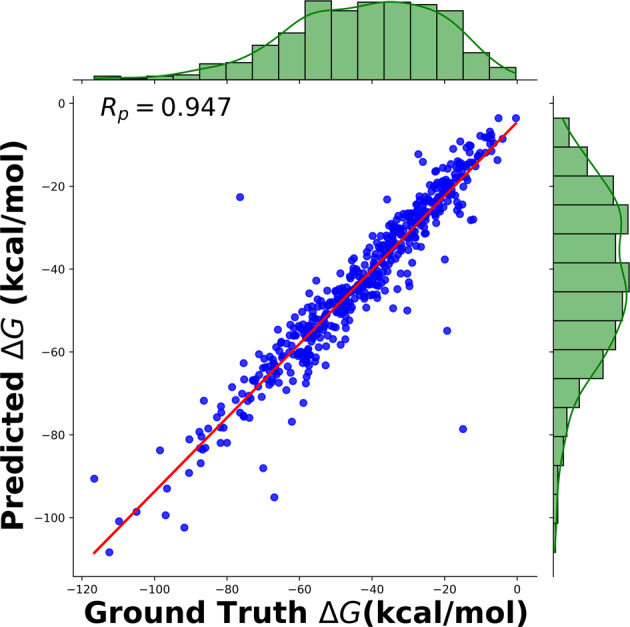
Pearson correlation coefficient after training OnionNet on PLAS-5k database.

References

    1. Kairys V, Baranauskiene L, Kazlauskiene M, Matulis D, Kazlauskas E. Binding affinity in drug design: experimental and computational techniques. Expert opinion on drug discovery. 2019;14:755–768. doi: 10.1080/17460441.2019.1623202. - DOI - PubMed
    1. Srivastava HK, Sastry GN. Molecular dynamics investigation on a series of hiv protease inhibitors: assessing the performance of mm-pbsa and mm-gbsa approaches. Journal of chemical information and modeling. 2012;52:3088–3098. doi: 10.1021/ci300385h. - DOI - PubMed
    1. Kimber TB, Chen Y, Volkamer A. Deep learning in virtual screening: Recent applications and developments. International Journal of Molecular Sciences. 2021;22:4435. doi: 10.3390/ijms22094435. - DOI - PMC - PubMed
    1. Mordalski S, Kosciolek T, Kristiansen K, Sylte I, Bojarski AJ. Protein binding site analysis by means of structural interaction fingerprint patterns. Bioorganic & medicinal chemistry letters. 2011;21:6816–6819. doi: 10.1016/j.bmcl.2011.09.027. - DOI - PubMed
    1. Da C, Kireev D. Structural protein–ligand interaction fingerprints (splif) for structure-based virtual screening: method and benchmark study. Journal of chemical information and modeling. 2014;54:2555–2561. doi: 10.1021/ci500319f. - DOI - PMC - PubMed