


Performance of diagnostic assays used to detect Cryptosporidium oocysts in faecal samples of cattle in Kuwait and genotyping of Cryptosporidium species
- PMID: 36071437
- PMCID: PMC9449277
- DOI: 10.1186/s12917-022-03435-w
Performance of diagnostic assays used to detect Cryptosporidium oocysts in faecal samples of cattle in Kuwait and genotyping of Cryptosporidium species
Abstract
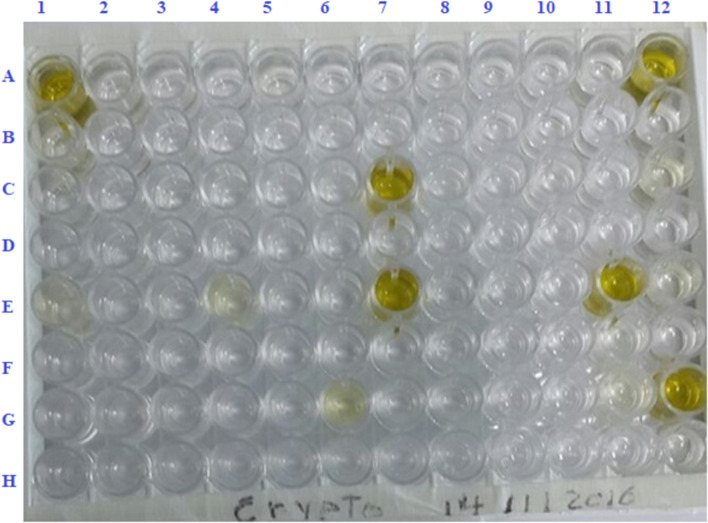
Backgroud: Cryptosporidium species are zoonotic protozoan parasites responsible for gastroenteritis in various animals and humans. The diagnosis of Cryptosporidium presents many challenges. This research attempted to match the diagnostic efficiency of the modified Ziehl-Neelsen technique (mZN), immunochromatographic assays (IC), and enzyme-linked immunosorbent assay (ELISA) for the detection of Cryptosporidium in faecal samples of cattle in Kuwait. In addition, polymerase chain reaction (PCR) was utilised to determine the predominant species infecting cattle in Kuwait and correlating the detected species with the results of different diagnostic tests used, the presence or absence of clinical signs, and the age group of the infected cattle.
Results: Of 400 analysed faecal samples, Cryptosporidium positive samples were 23%, 15.25%, and 14% using IC, ELISA, and mZN. IC had the highest sensitivity (74.07%), and mZN had the highest specificity (98.29%) using a composite reference standard (CRS) as a gold standard. The rapid IC test results in high false-positive results of cryptosporidiosis, whereas using mZN alone is insufficient to declare a negative faecal sample. Only 74.5% (35/47) of Cryptosporidium-positive samples by the three assays could be amplified by PCR. This study was the first to genotype Cryptosporidium in Kuwait. Cryptosporidium parvum (n = 26) was the dominant species detected from cattle samples, followed by C. andersoni (n = 6), C. bovis (n = 2), and C. raynae (n = 1). The findings showed a statistically relevant relationship between diarrhoea and the detection of Cryptosporidium spp. in faecal samples of cattle (p-value = 0.0003). Pre-weaned calves were the most vulnerable age group to Cryptosporidium spp. infection (p-value = 0.0007).
Conclusion: For screening of Cryptosporidium infection in faecal samples, antigen detection or PCR methods combined with one of the microscopy techniques should be used. Cryptosporidium parvum was the prepoderant Cryptosporidium spp. recovered from cattle samples in Kuwait followed by C. andersoni. Cryptosporidium parvum is a significant risk factor for diarrhoea in pre-weaned calves. However, further study is needed as many other causes of diarrhoea in calves must be ruled out before a diagnosis of Cryptosporidium diarrhoea can be made.
Keywords: Cattle; Cryptosporidium spp.; ELISA; Immunochromatography; Kuwait; PCR; mZN.
© 2022. The Author(s).
Conflict of interest statement
The authors declare no conflict of interest during the course of this study.
Figures



References
-
- Lindsay DS, Upton SJ, Owens DS, Morgan UM, Mead JR, Blagburn BL. Cryptosporidium andersoni n. sp. (Apicomplexa: Cryptosporiidae) from cattle. Bos taurus J Eukaryot Microbiol. 2000;47(1):91–5. 10.1111/j.1550-7408.2000.tb00016.x. - PubMed
MeSH terms
Grants and funding
LinkOut - more resources
Full Text Sources
Medical
Miscellaneous
