. 2022 Sep 7;22(1):1133.
doi: 10.1186/s12913-022-08496-z.

Prospective cohort study for assessment of integrated care with a triple aim approach: hospital at home as use case

Affiliations

Prospective cohort study for assessment of integrated care with a triple aim approach: hospital at home as use case

Carme Herranz et al. BMC Health Serv Res. .

Abstract

Background: Applicability of comprehensive assessment of integrated care services in real world settings is an unmet need. To this end, a Triple Aim evaluation of Hospital at Home (HaH), as use case, was done. As ancillary aim, we explored use of the approach for monitoring the impact of adoption of integrated care at health system level in Catalonia (Spain).

Methods: Prospective cohort study over one year period, 2017-2018, comparing hospital avoidance (HaH-HA) with conventional hospitalization (UC) using propensity score matching. Participants were after the first episode directly admitted to HaH-HA or the corresponding control group. Triple Aim assessment using multiple criteria decision analysis (MCDA) was done. Moreover, applicability of a Triple Aim approach at health system level was explored using registry data.

Results: HaH-HA depicted lower: i) Emergency Room Department (ER) visits (p < .001), ii) Unplanned re-admissions (p = .012); and iii) costs (p < .001) than UC. The weighted aggregation of the standardized values of each of the eight outcomes, weighted by the opinions of the stakeholder groups considered in the MCDA: i) enjoyment of life; ii) resilience; iii) physical functioning; iv) continuity of care; v) psychological wellbeing; (vi) social relationships & participation; (vii) person-centeredness; and (viii) costs, indicated better performance of HaH-HA than UC (p < .05). Actionable factors for Triple Aim assessment of the health system with a population-health approach were identified.

Conclusions: We confirmed health value generation of HaH-HA. The study identified actionable factors to enhance applicability of Triple Aim assessment at health system level for monitoring the impact of adoption of integrated care.

Registration: ClinicalTrials.gov (26/04/2017; NCT03130283).

Keywords: Chronic care; Health Delivery Assessment; Health Services Research; Hospital at Home; Implementation Science; Multiple Criteria Decision Analysis; Triple Aim.


Conflict of interest statement

All authors have disclosed no conflicts of interest.

Figures
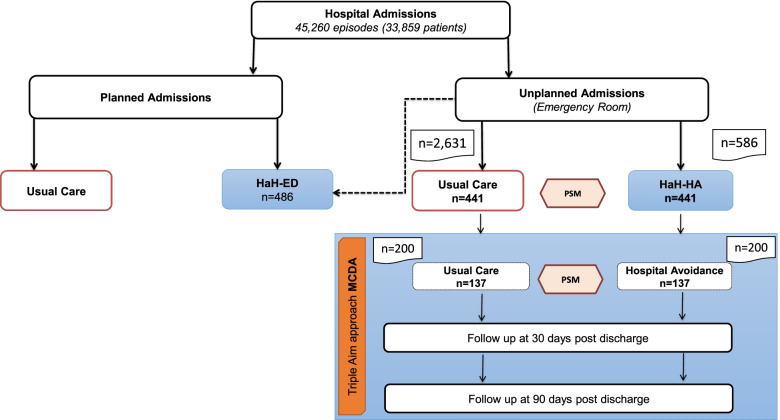
Fig. 1
Fig. 1
Distribution of hospital admissions during the study period. Five-hundred eighty-six first episodes of HaH admissions, directly from the Emergency Room (HaH-HA), were registered during the study period. A sample of 2.631 conventional hospitalizations was used to generate a usual care (UC) group, as described in the text. The entire intervention group, after propensity score matching (PSM), consisted of 441 HaH-HA patients that were compared with the corresponding matched controls (UC), as reported in (Carme H, Carme H, Erik B, Nuria S, Ruben G, Asenjo M, David N, Enric C, Fernandez J, Isaac C, Roca J. Assessment of Hospital Avoidance in a Real-World Setting: a Prospective Cohort Study, Submitted) During the study period, two-hundred consecutive HaH-HA patients were assessed with a Triple Aim approach to perform Multiple Criteria Decision Analysis (MCDA) that was finally done in 137 HaH-HA patients after PSM with a UC group. Comparisons between the entire HaH-HA population (n = 586), the CCA study (n = 441) and the current study (n = 137) are reported in Tables 1S-3S
Fig. 2
Fig. 2
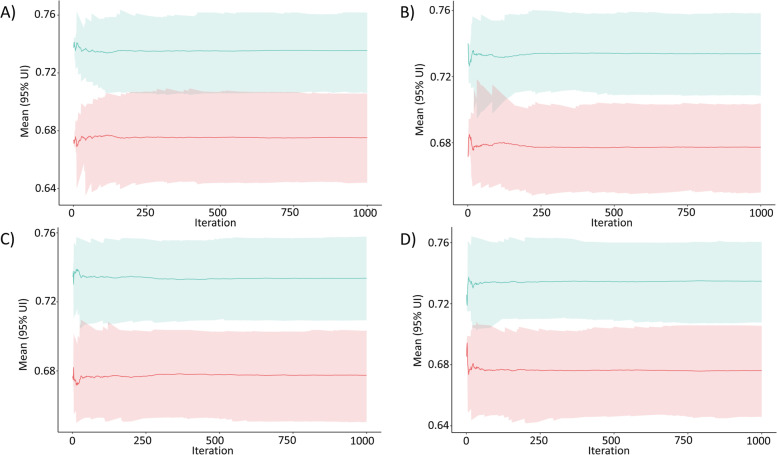
Sensitivity analysis of MCDA with DCE weights based on a Bootstrap analysis (1,000 iterations) of the MCDA overall score between hospital avoidance (HaH-HA) (green) and usual care (UC) (red) groups. In each iteration, the values of the eight outcomes considered in the MCDA were weighted according to the DCE results and subsequently summed to obtain a single overall value score. The panels show the mean overall value score across all bootstrap iterations (set to 1000) and their 95% Uncertainty Intervals (UI) for HaH-HA and UC and for each stakeholder group: A) Patients; B) Carers; C) Professionals; D) Payers + Policy Makers. The four panels show no overlap between intervention and control groups along the bootstrap replications
Fig. 3
Fig. 3
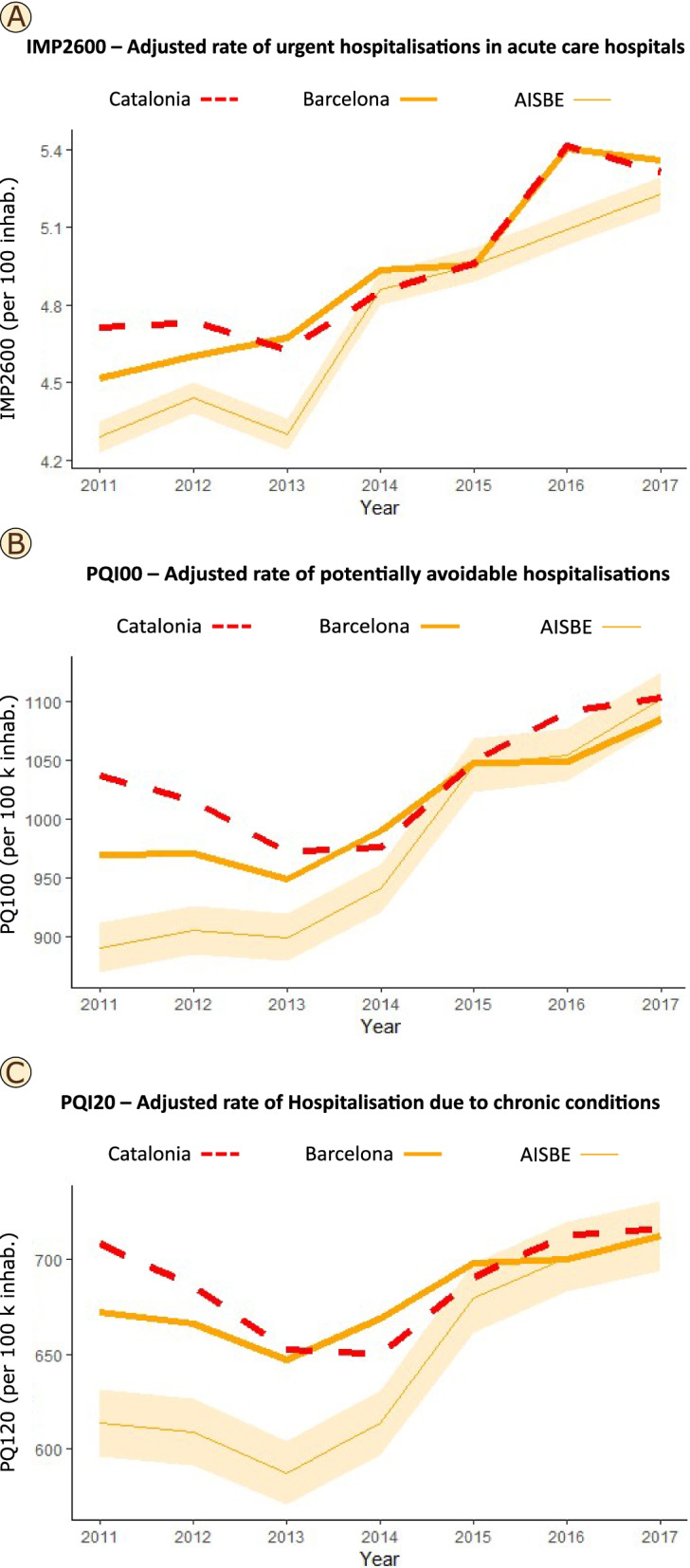
Quality of chronic care in the study areas

References

    1. Pinnock H, Barwick M, Carpenter CR, Eldridge S, Grandes G, Griffiths CJ, et al. Standards for Reporting Implementation Studies (StaRI): explanation and elaboration document. Open. 2017;7:13318. doi: 10.1136/bmjopen-2016-013318. - DOI - PMC - PubMed
    1. Peters DH, Adam T, Alonge O, Agyepong IA, Tran N. Republished research: Implementation research: What it is and how to do it. Br J Sports Med. 2014;48(8):731–6. doi: 10.1136/bmj.f6753. - DOI - PubMed
    1. Struckmann V, Leijten FRM, van Ginneken E, Kraus M, Reiss M, Spranger A, et al. Relevant models and elements of integrated care for multi-morbidity: Results of a scoping review. Health Policy (New York) 2018;122(1):23–35. doi: 10.1016/j.healthpol.2017.08.008. - DOI - PubMed
    1. Low L-F, Fletcher J. Models of home care services for persons with dementia: a narrative review. Int Psychogeriatrics. 2015;27(10):1593–600. doi: 10.1017/S1041610215000137. - DOI - PubMed
    1. World Health Organization. Integrated care models: an overview [Internet]. Health Services Delivery Programme. 2016. Available from: http://www.euro.who.int/pubrequest%0Ahttp://www.euro.who.int/__data/asse...

Associated data