. 2022 Sep 7;10(1):68.
doi: 10.1186/s40364-022-00414-z.

METTL1 promotes neuroblastoma development through m7G tRNA modification and selective oncogenic gene translation

Affiliations

METTL1 promotes neuroblastoma development through m7G tRNA modification and selective oncogenic gene translation

Ying Huang et al. Biomark Res. .

Abstract

Background: Neuroblastoma (NBL) is the most common extra-cranial solid tumour in childhood, with prognosis ranging from spontaneous remission to high risk for rapid and fatal progression. Despite existing therapy approaches, the 5-year event-free survival (EFS) for patients with advanced NBL remains below 30%, emphasizing urgent necessary for novel therapeutic strategies. Studies have shown that epigenetic disorders play an essential role in the pathogenesis of NBL. However, the function and mechanism of N7-methylguanosine (m7G) methyltransferase in NBL remains unknown.

Methods: The expression levels of m7G tRNA methyltransferase Methyltransferase-like 1 (METTL1) were analyzed by querying the Gene Expression Omnibus (GEO) database and further confirmed by immunohistochemistry (IHC) assay. Kaplan-Meier, univariate and multivariate cox hazard analysis were performed to reveal the prognostic role of METTL1. Cell function assays were performed to evaluate how METTL1 works in proliferation, apoptosis and migration in cell lines and xenograft mouse models. The role of METTL1 on mRNA translation activity of NBL cells was measured using puromycin intake assay and polysome profiling assay. The m7G modified tRNAs were identified by tRNA reduction and cleavage sequencing (TRAC-seq). Ribosome nascent-chain complex-bound mRNA sequencing (RNC-seq) was utilized to identify the variation of gene translation efficiency (TE). Analyzed the codon frequency decoded by m7G tRNA to clarify the translation regulation and mechanism of m7G modification in NBL.

Results: This study found that METTL1 were significantly up-regulated in advanced NBL, which acted as an independent risk factor and predicted poor prognosis. Further in NBL cell lines and BALB/c-nu female mice, we found METTL1 played a crucial role in promoting NBL progression. Furthermore, m7G profiling and translation analysis revealed downregulation of METTL1 would inhibit puromycin intake efficiency of NBL cells, indicating that METTL1 did count crucially in regulation of NBL cell translation. With all tRNAs with m7G modification identified in NBL cells, knockdown of METTL1 would significantly reduce the levels of both m7G modification and m7G tRNAs expressions. Result of RNC-seq shew there were 339 overlapped genes with impaired translation in NBL cells upon METTL1 knockdown. Further analysis revealed these genes contained higher frequency of codons decoded by m7G-modified tRNAs and were enriched in oncogenic pathways.

Conclusion: This study revealed the critical role and mechanism of METTL1-mediated tRNA m7G modification in regulating NBL progression, providing new insights for developing therapeutic approaches for NBL patients.

Keywords: Epigenetics; N7-methylguanosine; Neuroblastoma.


Conflict of interest statement

All authors declare that they have no conflict of interests.

Figures
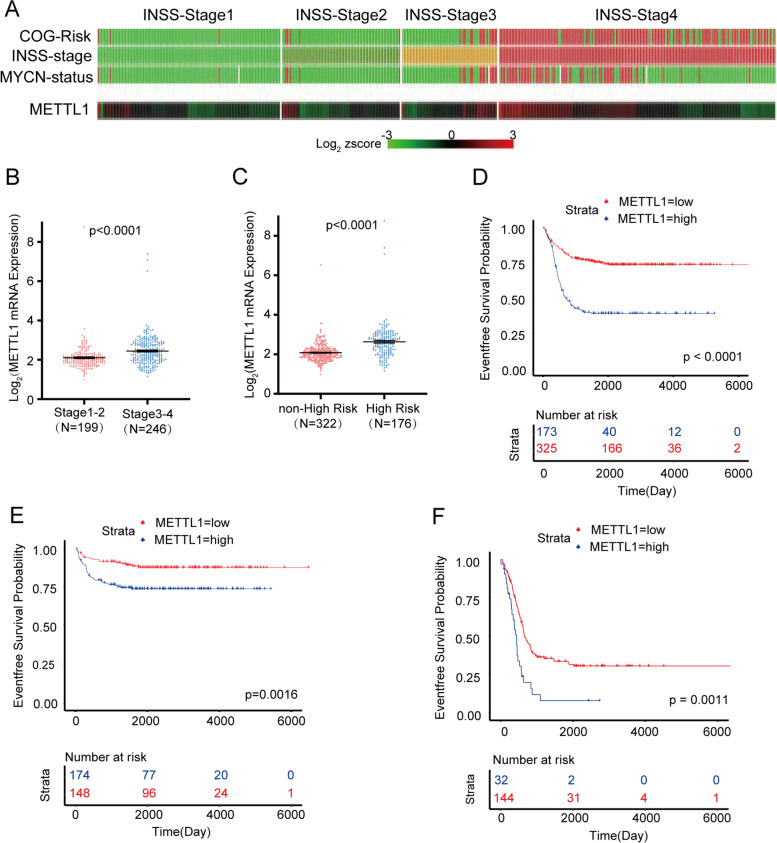
Fig. 1
Fig. 1
METTL1 is elevated in advanced NBLs and is associated with poor prognosis in NBL patients in the GEO database (GSE62564). A The R2 genomics analysis and visualization platform showed a heatmap of correlations between METTL1 mRNA levels, COG risk, INSS stage, and MYCN status in NBL samples from the GEO database. B The GEO database showed the mRNA level of METTL1 in NBL samples at different stages (except stage4S, N = 53). C GEO database showed METTL1 mRNA levels in high-risk NBL samples and non-high-risk NBL samples. D Kaplan-Meier analysis of the event-free survival of patients grouped by METTL1 expression (N = 498). EF Event-free survival based on METTL1 expression in the non-high risk cohort (E, N = 322) and high risk cohort (F, N = 176). Data are presented as Mean ± SEM. P values were calculated by two-tailed Student’s test for (BC) and Log-rank test for (D-F)
Fig. 2
Fig. 2
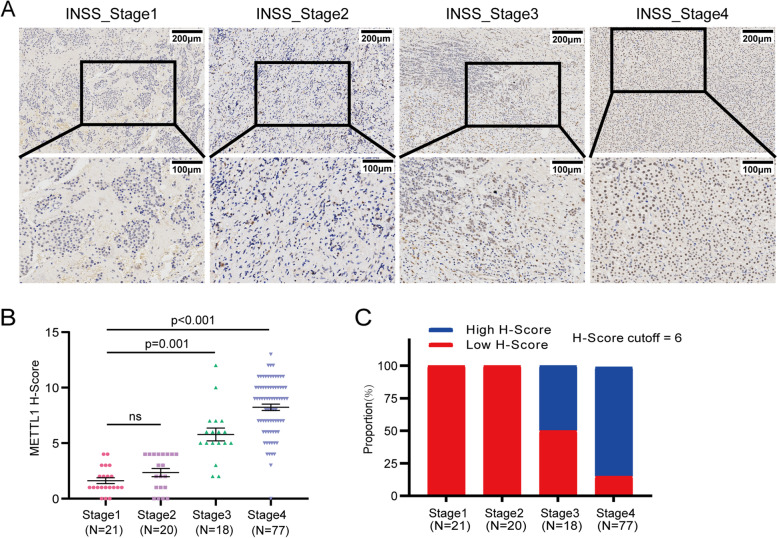
METTL1 is elevated in advanced NBLs and is associated with poor prognosis in patients with clinical NBL. A Representative images of METTL1 IHC staining with different staining intensities in clinical NBL tumors. B Quantification of METTL1 IHC scores in different INSS stages of clinical NBL tumors. C Proportion of METTL1expression cases at different stages of clinical NBL tumors. Data are presented as Mean ± SEM. P values were calculated by Kruskal-Wallis test with Dunnett’s multiple comparisons test
Fig. 3
Fig. 3
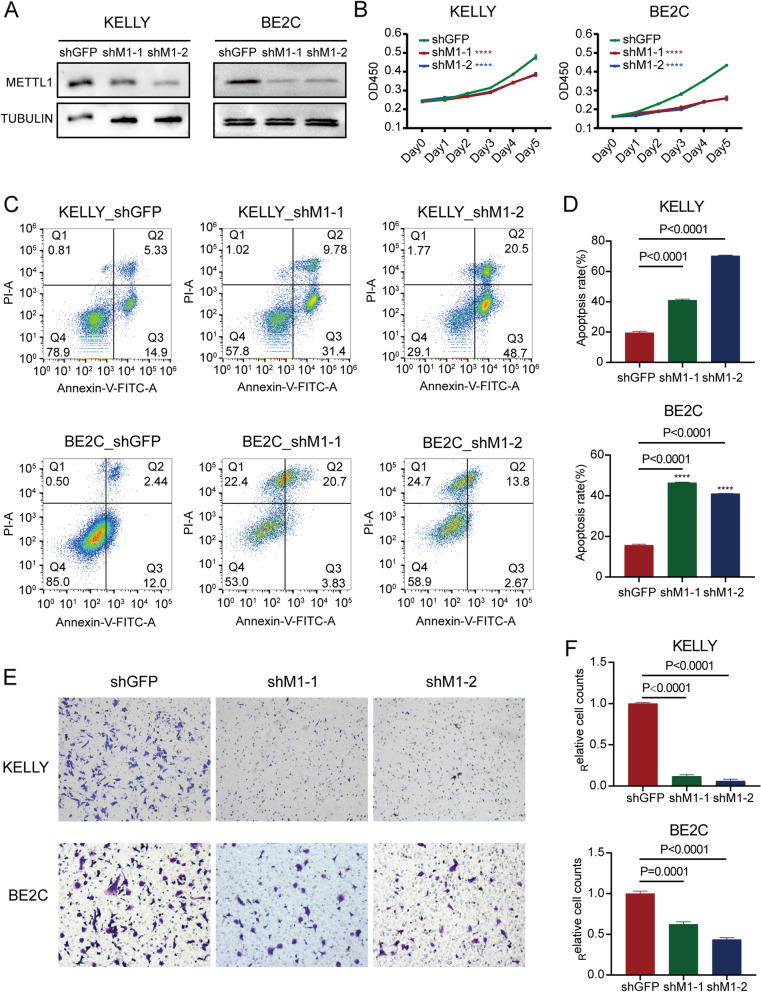
METTL1 knockdown inhibits NBL progression in vitro. A Western blot confirmed stable knockdown of METTL1 in KELLY and BE2C cells. B The CCK-8 assay (N = 3 per group) determined the proliferation of METTL1 knockdown and control NBL cells. C-D Flow cytometry assay (C) and quantitative analysis (D) of apoptosis rates in METTL1 knockdown and control NBL cells. E-F Migration assay (E) and quantitative analysis (F) of METTL1 knockdown and control NBL cells. Data are presented as Mean ± SEM. P values were calculated by One-way ANOVA with Dunnett’s multiple comparisons test
Fig. 4
Fig. 4
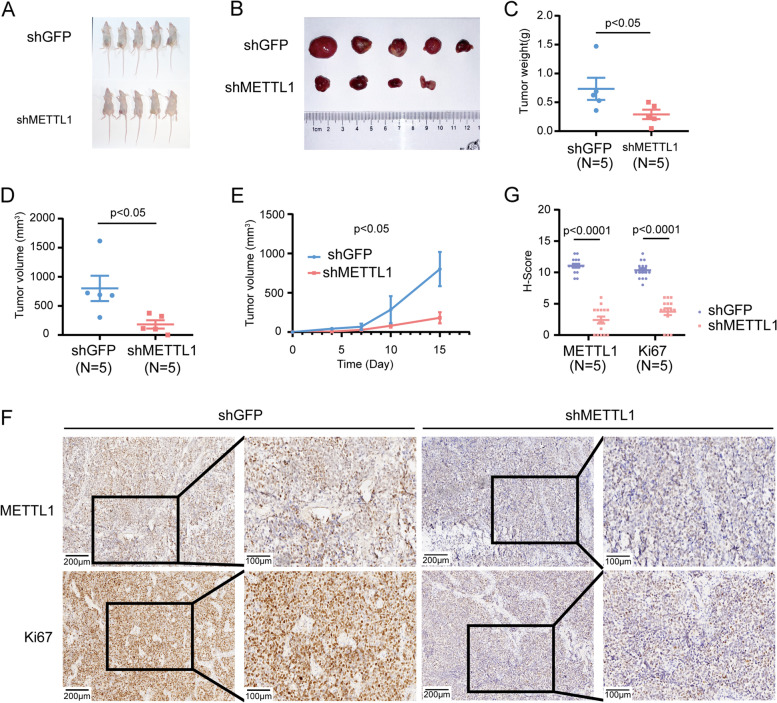
Inhibition of METTL1 reduces the tumorigenicity of NBL cells in vivo. AB Tumor profiles of mice implanted with METTL1 knockdown and control NBL cells (N = 5). CD Quantification of tumor weight (C) and size (D) at endpoints. E Growth curves of tumor volumes in the METTL1 knockdown and control groups. F Representative images of METTL1 and Ki67 IHC staining. G Quantitative analysis of IHC scores for METTL1 and Ki67. Data are presented as Mean ± SEM. P values were calculated by Mann-Whitney U test
Fig. 5
Fig. 5
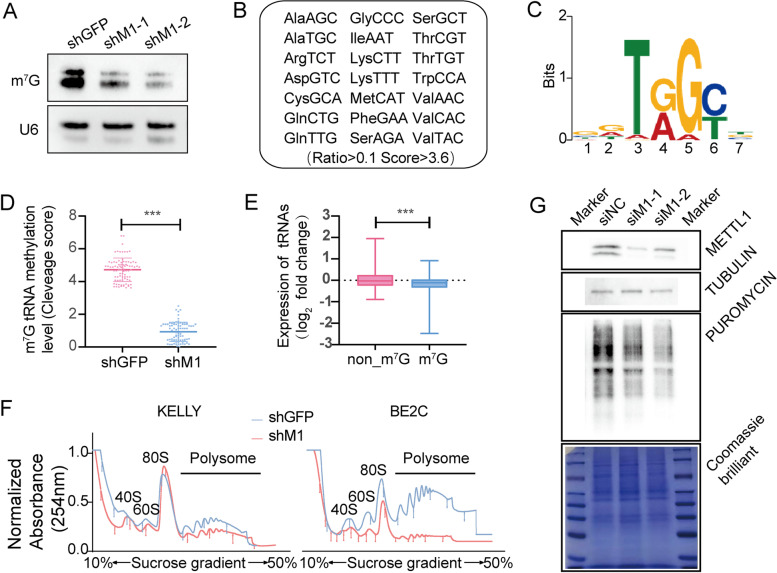
METTL1 regulates tRNA m7G modification, tRNA expression and global mRNA translation in NBL cells. A Northwestern blot confirmed decreased levels of m7G modification in METTL1-knockdown NBL cells (KELLY shM1–1). U6 snRNA was used as a loading control. B A total of 21 m7G -modified tRNAs were identified by TRAC-seq. C Motif sequences at the tRNA m7G site. D Quantification of m7G-modified tRNAs in METTL1 knockdown and control cells (KELLY shM1–1 and KELLY shNC). E Knockdown of METTL1 in NBL cells resulted in reduced expression of m7G -modified tRNAs. F Polysome profiling of METTL1 knockdown and control NBL cells. G Puromycin intake assay of METTL1-inhibited and control KELLY cells. Data are expressed as Mean ± SD. P values were calculated by Mann-Whitney U test
Fig. 6
Fig. 6
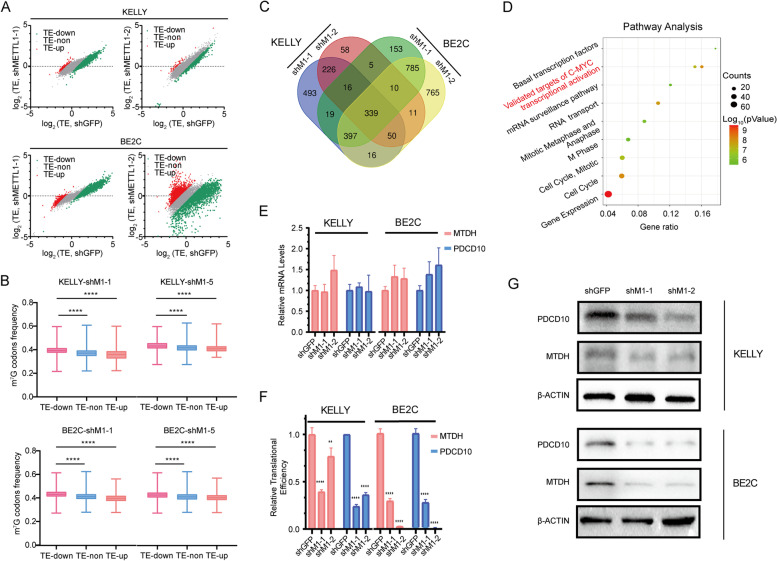
Knockdown of METTL1 selectively inhibits translation of oncogenic mRNAs. A TE Scatter plot in METTL1 knockdown and control NBL cells. B Frequency of m7G tRNA decoding codons for increased TEs (TE-up), decreased TEs (TE-downdown), and unaltered TEs (TE-non). C Venn diagram of genes with decreased TEs in KELLY and BE2C cells. D Pathway enrichment of TE-down genes. E mRNA levels of MTDH and PDCD10. F RNC-qPCR confirmed translational downregulation of MTDH and PDCD10 after METTL1 knockdown. G Western blot confirmed the decreased protein levels of MTDH and PDCD10 in METTL1 knockdown NBL cells. Data are presented as Mean ± SD. P values were calculated by One-way ANOVA with Dunnett’s multiple comparisons test for (B, compared to TE-Down group), (E-F, compared to the shGFP group). **p < 0.01, ****p < 0.0001

References

    1. Maris JM, Hogarty MD, Bagatell R, et al. Neuroblastoma. Lancet. 2007;369(9579):2106–2120. doi: 10.1016/S0140-6736(07)60983-0. - DOI - PubMed
    1. Shohet J, Foster J. Neuroblastoma BMJ. 2017;357:j1863. doi: 10.1136/bmj.j1863. - DOI - PubMed
    1. Du HM, Zhu XK. Genomic imprinting of neuroblastoma. Chinese J Pediatr Surg. 2019;40(4):374–377.
    1. Decock A, Ongenaert M, Hoebeeck J, et al. Genome-wide promoter methylation analysis in neuroblastoma identifies prognostic methylation biomarkers. Genome Biol. 2012;13(10):R95. doi: 10.1186/gb-2012-13-10-r95. - DOI - PMC - PubMed
    1. Djos A, Martinsson T, Kogner P, et al. The RASSF gene family members RASSF5, RASSF6 and RASSF7 show frequent DNA methylation in neuroblastoma. Mol Cancer. 2012;11:40. doi: 10.1186/1476-4598-11-40. - DOI - PMC - PubMed