Clinical outcomes of pre-attached reinforced stapler reloads in thoracic surgery: a prospective case series
- PMID: 36071754
- PMCID: PMC9442509
- DOI: 10.21037/jtd-22-220
Clinical outcomes of pre-attached reinforced stapler reloads in thoracic surgery: a prospective case series
Abstract
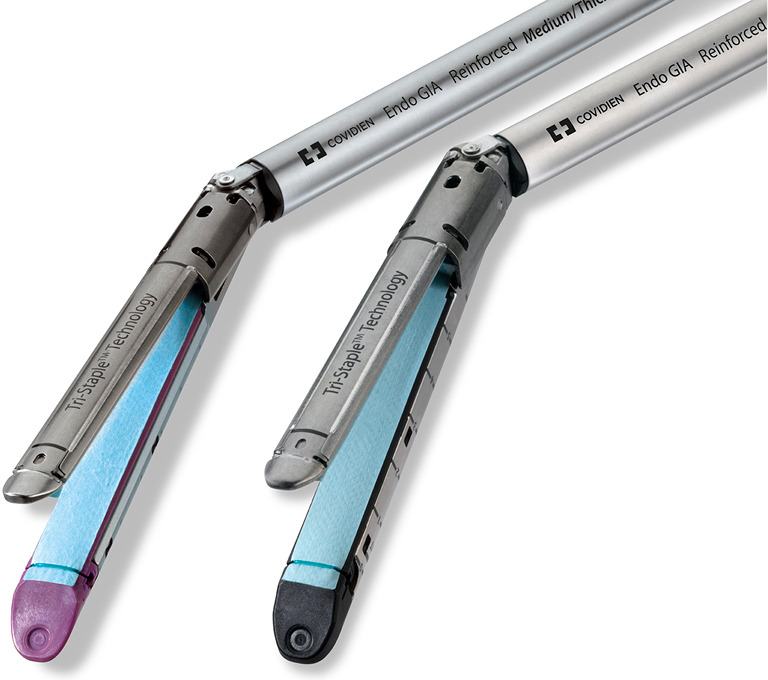
Background: Reinforced staple lines are less susceptible to leaks or bleeding and may consequently reduce morbidity and complications during or after surgery. However, their safety and benefits as well as the best form of reinforcement are still under debate. This study evaluates the safety of a stapler with pre-attached buttressing material based on adverse events (AEs) in thoracic surgery.
Methods: A multi-center prospective study was conducted to assess the use of stapler reloads with pre-attached staple line reinforcement material in thoracic surgery. The primary endpoint was the rate of device-related AEs reported within 30 days of lung cancer thoracic surgery. AEs, bleeding ≥50 mL, leaks, and 30-day readmissions were reported as additional outcomes.
Results: A total of 40 patients underwent lobectomy (n=22), wedge resection (n=10), or other thoracic surgery (n=8). Access was open (n=9) or by video-assisted thoracoscopic surgery (VATS, n=31). One patient was lost to follow-up. Intraoperatively, there were no cases of bleeding ≥50 mL requiring staple line intervention, and three cases (8%) experienced minor leaks that were treated conservatively. Bleeding unrelated to the staple line occurred in 20 patients intraoperatively (50%) and 21 patients postoperatively (54%). Three patients were readmitted (8%) for procedure-related causes and deemed unrelated to the investigational device. Of the AEs reported, one device-related event occurred intraoperatively, associated with minor bleeding. The other 33 AEs were related to infection (15%), bleeding (12%), or leak (9%). There were no deaths during the follow-up period.
Conclusions: This study demonstrates that AEs related to the use of reinforced reloads and occurring during or within 30 days of lung cancer surgery pose minimal safety concerns.
Keywords: Surgical stapler; adverse events (AEs); prospective studies; staple line reinforcement; thoracic surgery.
2022 Journal of Thoracic Disease. All rights reserved.
Conflict of interest statement
Conflicts of Interest: All authors have completed the ICMJE uniform disclosure form (available at https://jtd.amegroups.com/article/view/10.21037/jtd-22-220/coif). All authors (or their institutions) received study sponsorship, support for data analysis, medical writing support, and research support provided by Covidien (now owned by Medtronic PLC; Mansfield, MA). EL reports grants from AstraZeneca, grants from Boehringer Ingelheim, grants and personal fees from Medela, grants from Lily Oncology, personal fees from Beigene, personal fees from Roche, personal fees from BMS, outside the submitted work; In addition, EL has a patent P52435GB pending to Imperial Innovations, and a patent P57988GB pending to Imperial Innovations and is the founder of My Cancer Companion, a mobile phone application with the aims of improving health, wellbeing and length of life with cancer. JMB reports other from Medtronic, other from Intuitive Surgery, outside the submitted work. The authors have no other conflicts of interest to declare.
Figures
Comment in
-
Procedures to avoid postoperative prolonged air leak in thoracic surgery.J Thorac Dis. 2022 Nov;14(11):4220-4222. doi: 10.21037/jtd-22-1001. J Thorac Dis. 2022. PMID: 36524086 Free PMC article. No abstract available.
References
LinkOut - more resources
Full Text Sources