


Respiratory syncytial virus, recurrent wheeze and asthma: A narrative review of pathophysiology, prevention and future directions
- PMID: 36073299
- PMCID: PMC9826513
- DOI: 10.1111/jpc.16197
Respiratory syncytial virus, recurrent wheeze and asthma: A narrative review of pathophysiology, prevention and future directions
Abstract
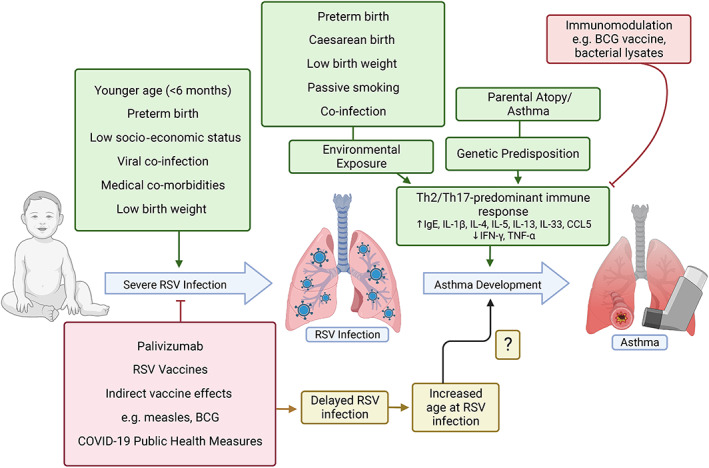
Globally, respiratory syncytial virus (RSV) is the leading cause of bronchiolitis and pneumonia in young children, and the association between severe RSV disease and later recurrent wheeze and asthma is well established. Whilst a causal link between RSV and wheeze/asthma is not yet proven, immunological evidence suggests skewing towards a Th2-type response, and dampening of IFN-γ antiviral immunity during RSV infection underpins airway hyper-reactivity in a subset of susceptible children after RSV infection. Age at primary RSV infection, viral co-infection and genetic influences may act as effect-modifiers. Despite the significant morbidity and mortality burden of RSV disease in children, there is currently no licensed vaccine. Recent advancements in RSV preventatives, including long-acting monoclonal antibodies and maternal vaccinations, show significant promise and we are on the cusp of a new era in RSV prevention. However, the potential impact of RSV preventatives on subsequent wheeze and asthma remains unclear. The ongoing COVID-19 pandemic and associated public health measures have disrupted the usual seasonality of RSV. Whilst this has posed challenges for health-care services it has also enhanced our understanding of RSV transmission. The near absence of RSV cases during the first year of the pandemic in the context of strict public health measures has provided a rare opportunity to study the impact of delayed age of primary RSV infection on asthma prevalence. In this review, we summarise current understanding of the association between RSV, recurrent wheeze and asthma with a focus on pathophysiology, preventative strategies and future research priorities.
Keywords: COVID-19; asthma; palivizumab; respiratory syncytial virus; wheeze.
© 2022 The Authors. Journal of Paediatrics and Child Health published by John Wiley & Sons Australia, Ltd on behalf of Paediatrics and Child Health Division (The Royal Australasian College of Physicians).
Figures
References
-
- Driscoll AJ, Arshad SH, Bont L et al. Does respiratory syncytial virus lower respiratory illness in early life cause recurrent wheeze of early childhood and asthma? Critical review of the evidence and guidance for future studies from a World Health Organization‐sponsored meeting. Vaccine 2020; 38: 2435–48. - PMC - PubMed
-
- Anderson J, Oeum M, Verkolf E et al. Factors associated with severe respiratory syncytial virus disease in hospitalised children: A retrospective analysis. Arch. Dis. Child. 2021; 107: 359–64. - PubMed
