. 2022 Oct 1;182(10):1071-1081.
doi: 10.1001/jamainternmed.2022.4299.

COVID-19-Associated Hospitalizations Among Vaccinated and Unvaccinated Adults 18 Years or Older in 13 US States, January 2021 to April 2022

Affiliations

COVID-19-Associated Hospitalizations Among Vaccinated and Unvaccinated Adults 18 Years or Older in 13 US States, January 2021 to April 2022

Fiona P Havers et al. JAMA Intern Med. .

Abstract

Importance: Understanding risk factors for hospitalization in vaccinated persons and the association of COVID-19 vaccines with hospitalization rates is critical for public health efforts to control COVID-19.

Objective: To determine characteristics of COVID-19-associated hospitalizations among vaccinated persons and comparative hospitalization rates in unvaccinated and vaccinated persons.

Design, setting, and participants: From January 1, 2021, to April 30, 2022, patients 18 years or older with laboratory-confirmed SARS-CoV-2 infection were identified from more than 250 hospitals in the population-based COVID-19-Associated Hospitalization Surveillance Network. State immunization information system data were linked to cases, and the vaccination coverage data of the defined catchment population were used to compare hospitalization rates in unvaccinated and vaccinated individuals. Vaccinated and unvaccinated patient characteristics were compared in a representative sample with detailed medical record review; unweighted case counts and weighted percentages were calculated.

Exposures: Laboratory-confirmed COVID-19-associated hospitalization, defined as a positive SARS-CoV-2 test result within 14 days before or during hospitalization.

Main outcomes and measures: COVID-19-associated hospitalization rates among vaccinated vs unvaccinated persons and factors associated with COVID-19-associated hospitalization in vaccinated persons were assessed.

Results: Using representative data from 192 509 hospitalizations (see Table 1 for demographic information), monthly COVID-19-associated hospitalization rates ranged from 3.5 times to 17.7 times higher in unvaccinated persons than vaccinated persons regardless of booster dose status. From January to April 2022, when the Omicron variant was predominant, hospitalization rates were 10.5 times higher in unvaccinated persons and 2.5 times higher in vaccinated persons with no booster dose, respectively, compared with those who had received a booster dose. Among sampled cases, vaccinated hospitalized patients with COVID-19 were older than those who were unvaccinated (median [IQR] age, 70 [58-80] years vs 58 [46-70] years, respectively; P < .001) and more likely to have 3 or more underlying medical conditions (1926 [77.8%] vs 4124 [51.6%], respectively; P < .001).

Conclusions and relevance: In this cross-sectional study of US adults hospitalized with COVID-19, unvaccinated adults were more likely to be hospitalized compared with vaccinated adults; hospitalization rates were lowest in those who had received a booster dose. Hospitalized vaccinated persons were older and more likely to have 3 or more underlying medical conditions and be long-term care facility residents compared with hospitalized unvaccinated persons. The study results suggest that clinicians and public health practitioners should continue to promote vaccination with all recommended doses for eligible persons.


Conflict of interest statement

Conflict of Interest Disclosures: Drs Yousey-Hindes, Lynfield, Sutton, Talbot, and Meek reported grants from US Centers for Disease Control and Prevention (CDC) during the conduct of the study. Dr Anderson reported grants from Pfizer, Sanofi, GSK, Janssen, MedImmune, Regeneron, PaxVax, Micron, and Merck as well as personal fees from Moderna, Pfizer, Sanofi, GSK, Janssen, Medscape, Kentucky BioProcessing Inc, and WCG and ACI outside the submitted work; additionally, his institution has also received funding from the National Institutes of Health to conduct clinical trials of COVID-19 vaccines. Drs Reeg and Kohrman reported grants from the Michigan Department of Health and Human Services during the conduct of the study. Drs Billing and Shiltz reported grants from the Council of State and Territorial Epidemiologists (CTSTE) and the CDC Dr Schaffner reported grants from CDC during the conduct of the study as well as personal fees from VBI Vaccines outside the submitted work. Drs Hill and George reported grants from CSTE during the conduct of the study. No other disclosures were reported.

Figures

Figure 1.
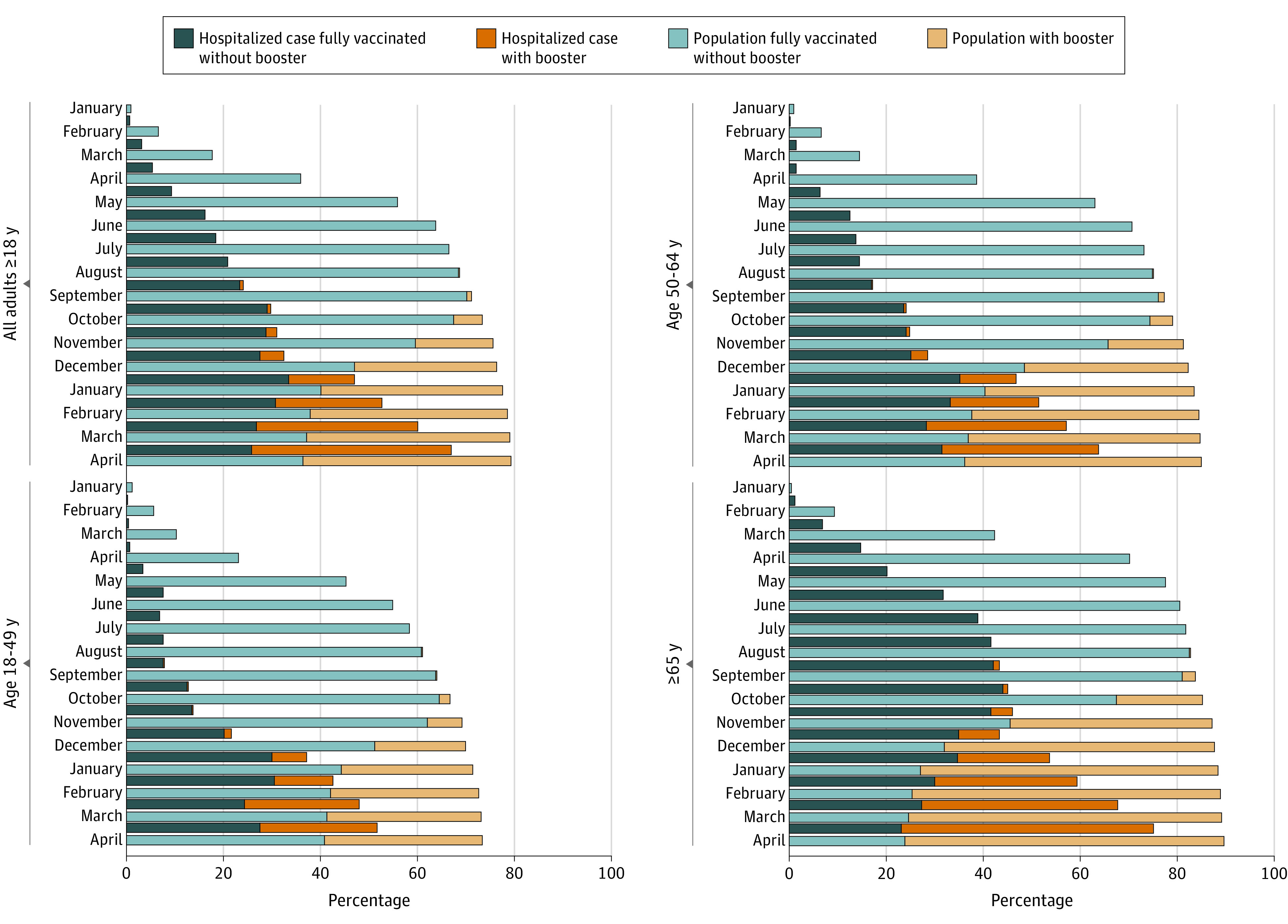
Figure 1.. Proportion of Adults in the COVID-19–Associated Hospitalization Surveillance Network (COVID-NET) Catchment Area and Adults 18 Years or Older With COVID-19–Associated Hospitalizations Admitted January 1, 2021, to April 30, 2022, Vaccinated With a Primary Series, With and Without a Booster Dose,a by Age Group and Month of Admission, COVID-NET, 13 Statesb
aBecause the immune status of all cases was not known, an additional dose (recommended for persons with a weakened immune system) cannot be distinguished from a booster dose. This is a relevant consideration because vaccines can be less effective in persons with a weakened immune system. Additional doses described as booster doses in the figure became available to the general public on August 13th. bCalifornia, Colorado, Connecticut, Georgia, Maryland (data excluded beginning December 4, 2021), Michigan, Minnesota, New Mexico, New York, Ohio, Oregon, Tennessee, and Utah.
Figure 2.
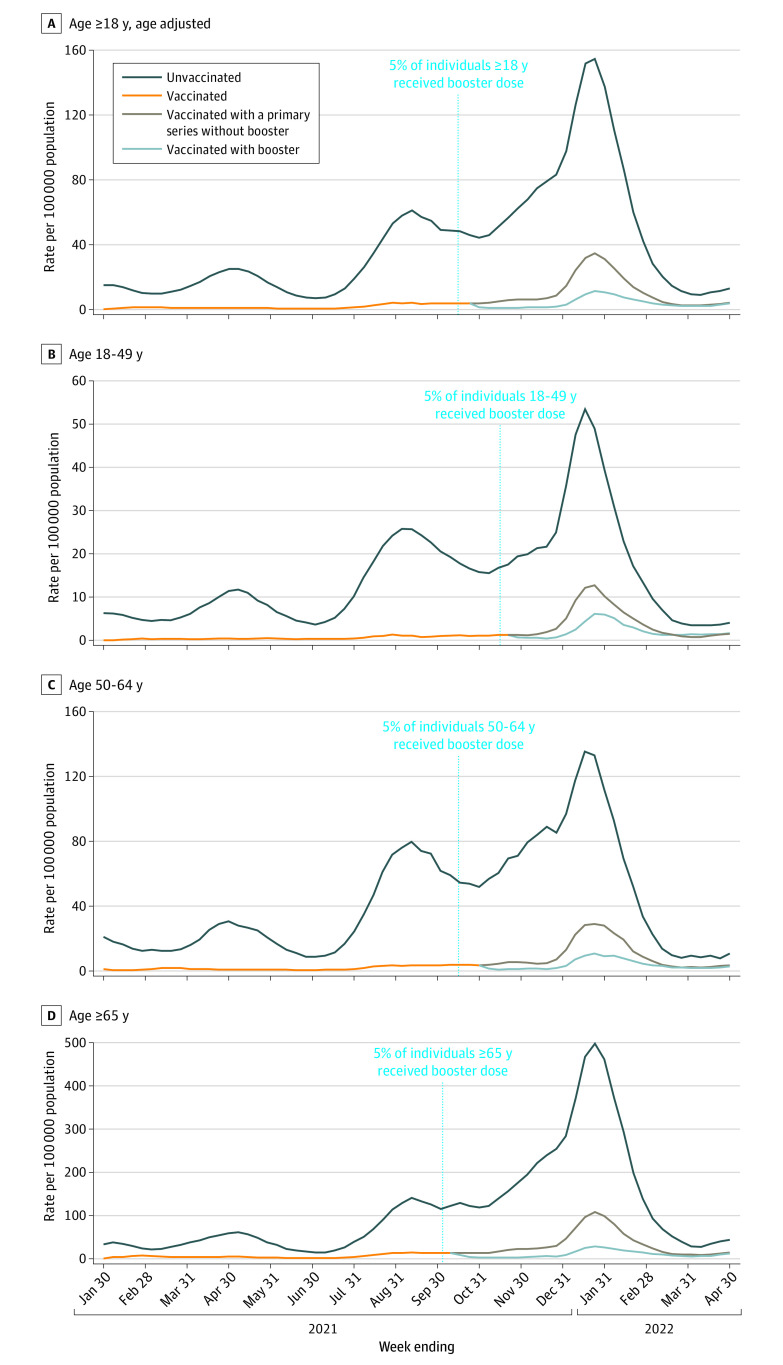
Figure 2.. Three-Week Moving Average Population-Based Ratesa of COVID-19–Associated Hospitalizations Among Unvaccinated and Vaccinated (With and Without a Booster Dose)b Adults 18 Years or Older Admitted January 30, 2021,c to April 30, 2022, by Week of Admission, COVID-19–Associated Hospitalization Surveillance Network (COVID-NET), 13 Statesd
Data shown for individuals vaccinated with a booster for the following dates: adults 18 years and older (age adjusted), October 30, 2021, to April 30, 2022 (A), age 18 to 49 years, November 27, 2021, to April 30, 2022 (B), age 50 to 64 years, November 6, 2021, to April 30, 2022 (C), and 65 years or older, October 16 to April 30, 2022 (D).e aPatients with laboratory-confirmed COVID-19–associated hospitalizations per 100 000 population. bUnvaccinated: persons with a positive SARS-CoV-2 test who had no record of receiving any COVID-19 vaccine. Vaccinated: persons with a positive SARS-CoV-2 test collected 14 days or more after vaccination with a primary series, defined as either the second dose of a 2-dose vaccine series or after 1 dose of a single-dose vaccine. When not otherwise specified, vaccinated persons include those who may have received additional or booster doses. Vaccinated without a booster dose: persons who have received a primary series and who have not received an additional or booster dose. This includes those eligible and not yet eligible for an additional or booster dose. Vaccinated with a booster dose: persons vaccinated with a primary series and an additional or booster dose on or after August 13, 2021, with a positive SARS-CoV-2 test collected 14 days or more after receipt of an additional or booster dose. Because the immune status of all cases is not known, an additional dose (recommended for persons with a weakened immune system) cannot be distinguished from a booster dose. cThe week ending January 30, 2021, is the earliest an individual could be considered to have completed a primary series based on the approval of the first COVID-19 vaccines in December 2020. dCalifornia, Colorado, Connecticut, Georgia, Maryland (data excluded beginning December 4, 2021), Michigan, Minnesota, New Mexico, New York, Ohio, Oregon, Tennessee, and Utah. ePeriod of data based on when 14 days have passed because at least 5% of the age group-specific population of the COVID-NET surveillance catchment area had received an additional or booster dose.

References

    1. US Centers for Diseases Control and Prevention . CDC COVID data tracker. Accessed May 15, 2022. https://covid.cdc.gov/covid-data-tracker/#vaccinations_vacc-total-admin-...
    1. Mbaeyi S, Oliver SE, Collins JP, et al. The Advisory Committee on Immunization Practices’ interim recommendations for additional primary and booster doses of COVID-19 vaccines—United States, 2021. MMWR Morb Mortal Wkly Rep. 2021;70(44):1545-1552. doi: 10.15585/mmwr.mm7044e2 - DOI - PMC - PubMed
    1. Butt AA, Talisa VB, Shaikh OS, Omer SB, Mayr FB. Relative vaccine effectiveness of a SARS-CoV-2 mRNA vaccine booster dose against the Omicron variant. Clin Infect Dis. Published online May 3, 2022. - PMC - PubMed
    1. Adams K, Rhoads JP, Surie D, et al. Vaccine effectiveness of primary series and booster doses against Omicron variant COVID-19–associated hospitalization in the United States. medRxiv. Posted online June 14, 2022. . doi: 10.1101/2022.06.09.22276228 - DOI
    1. Bajema KL, Dahl RM, Prill MM, et al. ; Surveillance Platform for Enteric and Respiratory Infectious Organisms at the VA COVID-19 Surveillance Group . Effectiveness of COVID-19 mRNA vaccines against COVID-19–associated hospitalization—five Veterans Affairs medical centers, United States, February 1-August 6, 2021. MMWR Morb Mortal Wkly Rep. 2021;70(37):1294-1299. doi: 10.15585/mmwr.mm7037e3 - DOI - PMC - PubMed

Publication types

Supplementary concepts