


Exploring healthcare provider and patient perspectives on current outpatient care of venous leg ulcers and potential interventions to improve their treatment: a mixed methods study in the ulcus cruris care project
- PMID: 36076159
- PMCID: PMC9453712
- DOI: 10.1186/s12875-022-01841-5
Exploring healthcare provider and patient perspectives on current outpatient care of venous leg ulcers and potential interventions to improve their treatment: a mixed methods study in the ulcus cruris care project
Abstract
Background: The project "Ulcus Cruris Care" aims to improve primary care for patients with venous leg ulcer (VLU) in General Practitioner (GP) practices using a complex intervention comprised of educational components, standardized treatment recommendations, computer-assisted documentation, and case management by non-physician medical assistants (MAs). Prior to implementing and testing the intervention components in general practices, in-depth exploration of current outpatient treatment of VLU patients and relevant implementation determinants was pursued.
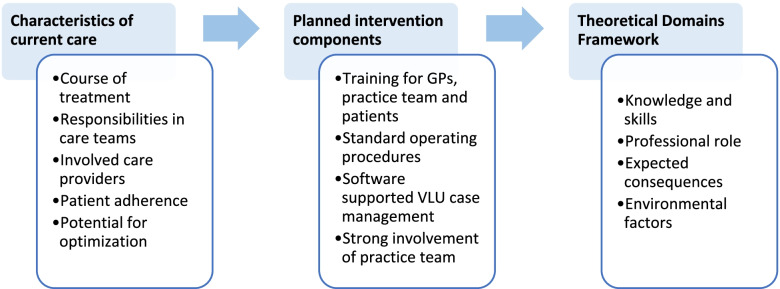
Methods: A mixed-methods study explored views of GPs, MAs, and patients regarding current VLU outpatient care and the planned intervention components to identify potential implementation determinants. Data were collected through semi-structured guide-based telephone interviews (n = 29) and a survey questionnaire (n = 28). Interviews were transcribed verbatim. Analysis was inductive initially and finalized in a deductive-inductive approach based on domains of the Theoretical Domains Framework to support structuring of relevant implementation determinants. Survey data were analyzed descriptively.
Results: Current VLU outpatient care was described as frequently tailored to individual wounds and gradient. In general, workload was shared by GPs (diagnostics, counselling) and MAs (wound care). All care providers were aware of compression therapy, yet not all of them considered it essential for VLU care. Standardized operating procedures and educational components including e-learning were considered supportive. Stronger involvement of non-physician assistants was seen as opportunity to optimize VLU care. Concerns were identified regarding integration of software-supported case management into daily practice routines and regarding potential limitations in decision-making autonomy when using standard operating procedures.
Conclusions: Findings in this study emphasize a need for educational interventions addressing VLU care providers as well as patients, particularly with regards to compression therapy. The conception of the planned intervention appears to be adequate and a structured guideline-based case management might be a promising approach for optimization of VLU treatment.
Keywords: Disease management; Mixed methods study; Standard operating procedure; Venous leg ulcer.
© 2022. The Author(s).
Conflict of interest statement
The authors declare that they have no competing interests.
Figures
References
-
- Diener H, Debus E, Herberger SK, Heyer K, Augustin M, Tigges W, Karl T, Storck M. Versorgungssituation gefäßmedizinischer Wunden in Deutschland. Gefässchirurgie. 2017;22(8):548–557. doi: 10.1007/s00772-017-0326-z. - DOI
-
- Heyer AK. Versorgungsepidemiologie des Ulcus cruris in Deutschland: Erkrankungshäufigkeit. Versorgungsqualität und Prädiktoren der Wundheilung: Springer-Verlag; 2016.
Publication types
MeSH terms
LinkOut - more resources
Full Text Sources