Review
. 2022 Aug 23;23(17):9521.
doi: 10.3390/ijms23179521.

Advances of Epigenetic Biomarkers and Epigenome Editing for Early Diagnosis in Breast Cancer

Affiliations
Review

Advances of Epigenetic Biomarkers and Epigenome Editing for Early Diagnosis in Breast Cancer

Pourya Sarvari et al. Int J Mol Sci. .

Abstract

Epigenetic modifications are known to regulate cell phenotype during cancer progression, including breast cancer. Unlike genetic alterations, changes in the epigenome are reversible, thus potentially reversed by epi-drugs. Breast cancer, the most common cause of cancer death worldwide in women, encompasses multiple histopathological and molecular subtypes. Several lines of evidence demonstrated distortion of the epigenetic landscape in breast cancer. Interestingly, mammary cells isolated from breast cancer patients and cultured ex vivo maintained the tumorigenic phenotype and exhibited aberrant epigenetic modifications. Recent studies indicated that the therapeutic efficiency for breast cancer regimens has increased over time, resulting in reduced mortality. Future medical treatment for breast cancer patients, however, will likely depend upon a better understanding of epigenetic modifications. The present review aims to outline different epigenetic mechanisms including DNA methylation, histone modifications, and ncRNAs with their impact on breast cancer, as well as to discuss studies highlighting the central role of epigenetic mechanisms in breast cancer pathogenesis. We propose new research areas that may facilitate locus-specific epigenome editing as breast cancer therapeutics.

Keywords: breast cancer; epi-drugs; epigenetic editing; epigenome.


Conflict of interest statement

The authors declare no conflict of interest.

Figures
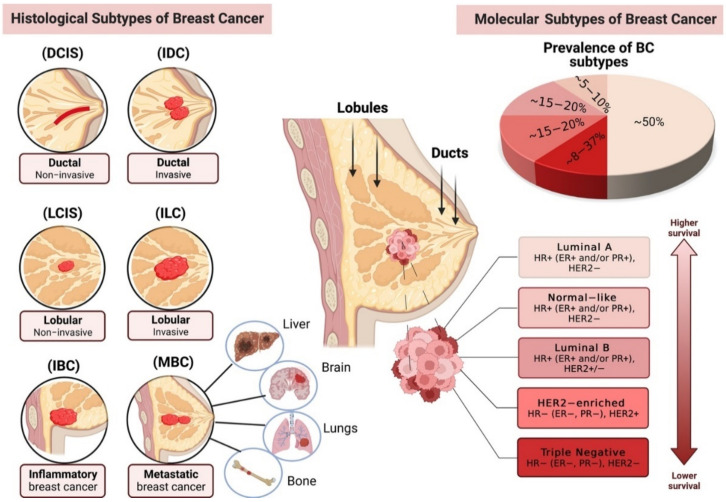
Figure 1
Figure 1
Main histopathological (left) and molecular (right) subtypes of breast cancer (BC). (DCIS—ductal carcinoma in situ, IDCS—invasive ductal carcinoma, LCIS—lobular carcinoma in situ, ILC—invasive lobular carcinoma, IBC—inflammatory breast cancer, MBC—metastatic breast cancer, HR—hormone receptors, ER—estrogen receptor, PG—progesterone receptor, HER2—human epidermal growth factor receptor) [3,17,22,25]. Figure created using BioRENDER.com. Accessed on 13 March 2022.
Figure 2
Figure 2
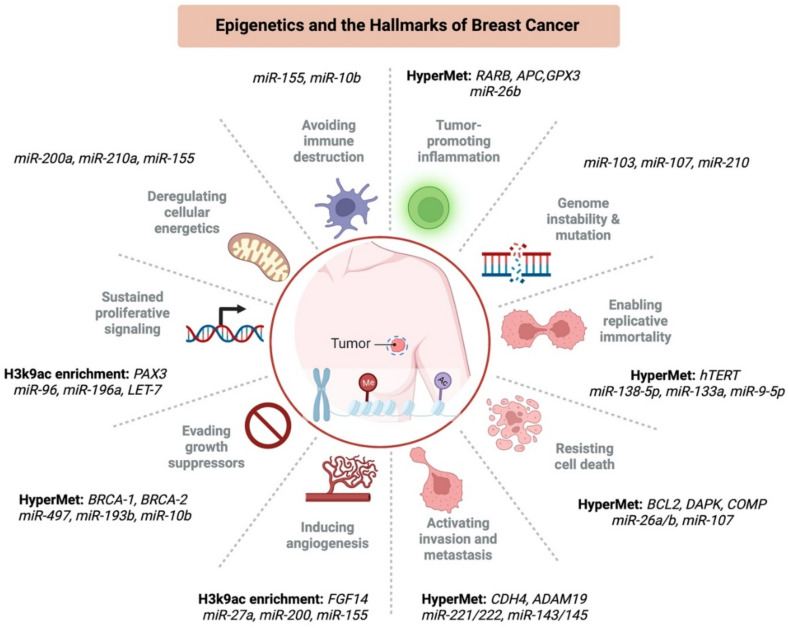
A collection of breast cancer hallmarks that characterizes the breast cancer phenotype with the central role for epigenetic modifications shaping the tumor outcome. Disruption of epigenetic processes modulates signaling pathways promoting breast tumorigenesis. Epigenetic alterations which are attributed to specific breast cancer hallmarks are depicted. (HyperMet; promoter hypermethylation) [6,34,35,36,37]. Figure created using BioRENDER.com. Accessed on 25 July 2022.
Figure 3
Figure 3
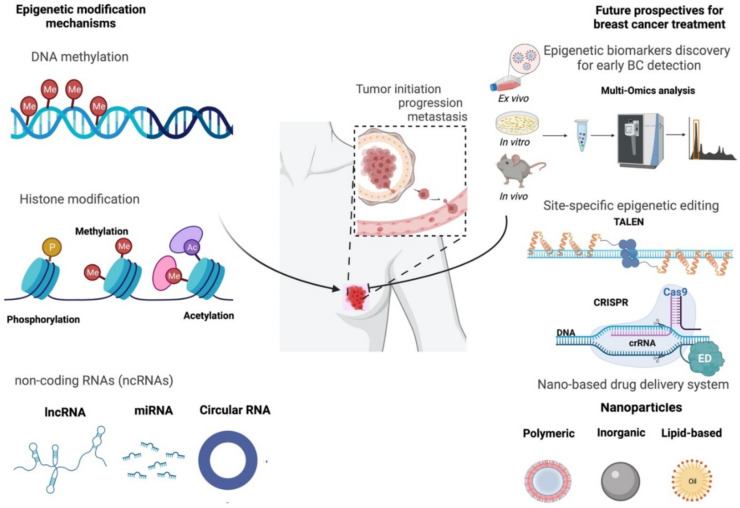
Epigenetic modifications detection and novel strategies for epigenetic editing in the therapeutic approaches for breast cancer. The aberrant changes of the epigenetic mechanisms, such as DNA methylation, histone modifications, and ncRNAs led to the activation of oncogenes and/or silencing of tumor suppressor genes affecting signaling pathways pivotal for cell maintenance, repair, and homeostasis. These epigenetic modifications regulate and contribute to every single cancer hallmark discussed (Figure 2), and eventually trigger breast cancer initiation, progression, and metastasis. The specific type of epigenetic modifications can be detected using solid and liquid biopsy sampling and the application of integrative analysis of multi-omics (genomics, proteomics, transcriptomics, epigenomics, metabolomics) approaches. The multi-omics data derived from human and mouse models of BC can help for the identification of aberrant epigenetic profiles, providing insights into cancer biology and rendering novel tumor epigenetic diagnostic, prognostic biomarkers, and epigenetic therapeutic tools with an important clinical value. Strategies for epigenetic corrections in BC patients are depicted. In site-specific epigenetic editing, CRISPR-Cas9 fused to the effector domain (ED) for epigenetic corrections, and TALEN strategies integrated with cell-specific promoters can be used to restore normal chromatin structure and correct specific epigenetic aberration localized to specific cell types. In addition, the application of a nano-based drug delivery systems (NDDs) increases the uptake rate of target cells or tissues and reduces enzyme degradation, hence improving the safety and effectiveness of drugs. Me—methylated DNA or methylated histone, P—phosphorylated histone, Ac—acetylated histone, ncRNAs—noncoding RNAs, miRNA—micro RNAs, BC—breast cancer, ED—effector domain. Figure created using BioRENDER.com. Accessed on 17 April 2022.

References

    1. Sung H., Ferlay J., Siegel R.L., Laversanne M., Soerjomataram I., Jemal A., Bray F. Global Cancer Statistics 2020: GLOBOCAN Estimates of Incidence and Mortality Worldwide for 36 Cancers in 185 Countries. CA Cancer J. Clin. 2021;71:209–249. doi: 10.3322/caac.21660. - DOI - PubMed
    1. Olopade O.I., Grushko T.A., Nanda R., Huo D. Advances in Breast Cancer: Pathways to Personalized Medicine. Clin. Cancer Res. 2008;14:7988–7999. doi: 10.1158/1078-0432.CCR-08-1211. - DOI - PMC - PubMed
    1. Makki J.J. Diversity of breast carcinoma: Histological subtypes and clinical relevance. Clin. Med. Insights Pathol. 2015;8:CPath-S31563. doi: 10.4137/CPath.S31563. - DOI - PMC - PubMed
    1. Abbas A., Gupta S. The role of histone deacetylases in prostate cancer. Epigenetics. 2008;3:300–309. doi: 10.4161/epi.3.6.7273. - DOI - PMC - PubMed
    1. Vizoso M., Ferreira H.J., Lopez-Serra P., Carmona F.J., Martínez-Cardús A., Girotti M.R., Villanueva A., Guil S., Moutinho C., Liz J., et al. Epigenetic activation of a cryptic TBC1D16 transcript enhances melanoma progression by targeting EGFR. Nat. Med. 2015;21:741–750. doi: 10.1038/nm.3863. - DOI - PMC - PubMed