Review
. 2022 Aug 31;23(17):9892.
doi: 10.3390/ijms23179892.

Apolipoprotein E in Cardiometabolic and Neurological Health and Diseases

Affiliations
Review

Apolipoprotein E in Cardiometabolic and Neurological Health and Diseases

Jeyashree Alagarsamy et al. Int J Mol Sci. .

Abstract

A preponderance of evidence obtained from genetically modified mice and human population studies reveals the association of apolipoprotein E (apoE) deficiency and polymorphisms with pathogenesis of numerous chronic diseases, including atherosclerosis, obesity/diabetes, and Alzheimer's disease. The human APOE gene is polymorphic with three major alleles, ε2, ε3 and ε4, encoding apoE2, apoE3, and apoE4, respectively. The APOE gene is expressed in many cell types, including hepatocytes, adipocytes, immune cells of the myeloid lineage, vascular smooth muscle cells, and in the brain. ApoE is present in subclasses of plasma lipoproteins, and it mediates the clearance of atherogenic lipoproteins from plasma circulation via its interaction with LDL receptor family proteins and heparan sulfate proteoglycans. Extracellular apoE also interacts with cell surface receptors and confers signaling events for cell regulation, while apoE expressed endogenously in various cell types regulates cell functions via autocrine and paracrine mechanisms. This review article focuses on lipoprotein transport-dependent and -independent mechanisms by which apoE deficiency or polymorphisms contribute to cardiovascular disease, metabolic disease, and neurological disorders.

Keywords: Alzheimer’s disease; apolipoprotein E (apoE); atherosclerosis; inflammatory response; lipoprotein receptors; signal transduction.


Conflict of interest statement

The authors declare no conflict of interest.

Figures

Figure 1
Figure 1
Schematic diagram depicting the influence of various apoE isoforms on antigen presentation. (A) ApoE2 enhances intracellular cholesterol accumulation after dendritic cell uptake of LDL/modified LDL to enhance MHC-II expression, thereby promoting antigen presentation to CD4+ T lymphocytes for their activation. The defective apoE2 binding to the LDL receptor in B lymphocytes also impairs CD1d-mediated antigen presentation and iNKT cell activation. (B) ApoE3 limits intracellular cholesterol levels in dendritic cells, thereby reduces MHC-II expression and T lymphocyte activation. ApoE3 also interacts with the LDL receptor on B lymphocytes to enhance CD1d-mediated antigen presentation to iNKT cells. (C) ApoE4 enhances intracellular cholesterol accumulation in dendritic cells to enhance MHC-II expression and antigen presentation for T lymphocyte activation. ApoE4 also interacts with the LDL receptor on B lymphocytes to enhance CD1d-mediated antigen presentation to activate iNKT cells.
Figure 2
Figure 2
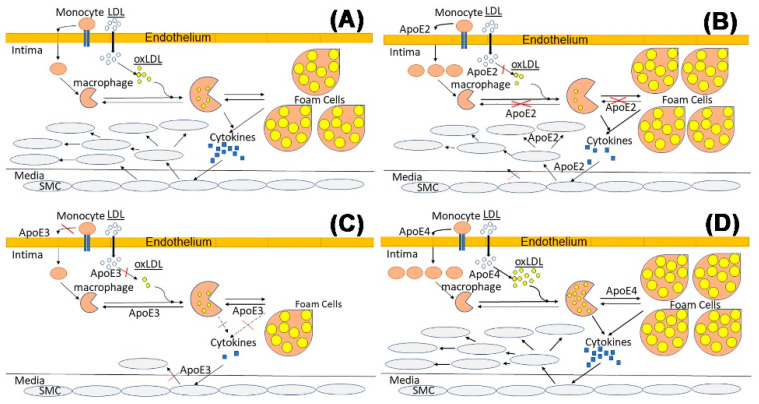
Schematic diagrams on the influence of apoE in atherosclerosis. (A) General schematics of the atherosclerosis process. (B) Mechanisms underlying the influence of apoE2 in accelerating atherosclerosis. (C) Mechanisms underlying the protective roles of apoE3 on atherosclerosis development. (D) Mechanisms underlying the influence of apoE4 in accelerating atherosclerosis.

References

    1. Dolgin E. The most popular genes in the human genome. Nature. 2017;551:427–431. doi: 10.1038/d41586-017-07291-9. - DOI - PubMed
    1. Song Y., Stampfer M.J., Liu S. Meta-analysis: Apolipoprotein E genotypes and risk for coronary heart disease. Ann. Intern. Med. 2004;141:137–147. doi: 10.7326/0003-4819-141-2-200407200-00013. - DOI - PubMed
    1. Couderc R., Mahieux F., Bailleul S., Fenelon G., Mary R., Fermanian J. Prevalence of apolipoprotein E phenotypes in ischemic cerebrovascular disease. A case-control study. Stroke. 1993;24:661–664. doi: 10.1161/01.STR.24.5.661. - DOI - PubMed
    1. Senti M., Nogues X., Pedro-Botet J., Rubies-Prat J., Vidal-Barraquer F. Lipoprotein profile in men with peripheral vascular disease. Role of intermediate density lipoproteins and apoprotein E phenotypes. Circulation. 1992;85:30–36. doi: 10.1161/01.CIR.85.1.30. - DOI - PubMed
    1. de Andrade M., Thandi I., Brown S., Gotto A., Jr., Patsch W., Boerwinkle E. Relationship of the apolipoprotein E polymorphism with carotid artery atherosclerosis. Am. J. Hum. Genet. 1995;56:1379–1390. - PMC - PubMed