


Sources of Cancer Neoantigens beyond Single-Nucleotide Variants
- PMID: 36077528
- PMCID: PMC9455963
- DOI: 10.3390/ijms231710131
Sources of Cancer Neoantigens beyond Single-Nucleotide Variants
Abstract
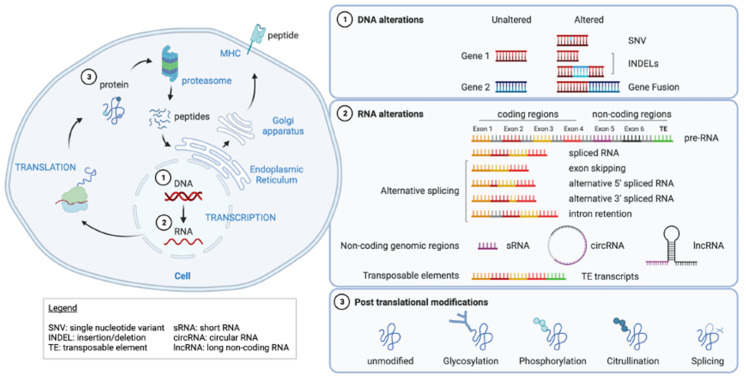
The success of checkpoint blockade therapy against cancer has unequivocally shown that cancer cells can be effectively recognized by the immune system and eliminated. However, the identity of the cancer antigens that elicit protective immunity remains to be fully explored. Over the last decade, most of the focus has been on somatic mutations derived from non-synonymous single-nucleotide variants (SNVs) and small insertion/deletion mutations (indels) that accumulate during cancer progression. Mutated peptides can be presented on MHC molecules and give rise to novel antigens or neoantigens, which have been shown to induce potent anti-tumor immune responses. A limitation with SNV-neoantigens is that they are patient-specific and their accurate prediction is critical for the development of effective immunotherapies. In addition, cancer types with low mutation burden may not display sufficient high-quality [SNV/small indels] neoantigens to alone stimulate effective T cell responses. Accumulating evidence suggests the existence of alternative sources of cancer neoantigens, such as gene fusions, alternative splicing variants, post-translational modifications, and transposable elements, which may be attractive novel targets for immunotherapy. In this review, we describe the recent technological advances in the identification of these novel sources of neoantigens, the experimental evidence for their presentation on MHC molecules and their immunogenicity, as well as the current clinical development stage of immunotherapy targeting these neoantigens.
Keywords: RNA splicing; alternative source of neoantigen; cancer; dark matter; frameshift; gene fusion.
Conflict of interest statement
The authors are employee of Genentech and declare no conflict of interest.
Figures
References
-
- Cohen C.J., Gartner J.J., Horovitz-Fried M., Shamalov K., Trebska-McGowan K., Bliskovsky V.V., Parkhurst M.R., Ankri C., Prickett T.D., Crystal J.S., et al. Isolation of Neoantigen-Specific T Cells from Tumor and Peripheral Lymphocytes. J. Clin. Investig. 2015;125:3981–3991. doi: 10.1172/JCI82416. - DOI - PMC - PubMed
-
- Nielsen M., Lundegaard C., Blicher T., Lamberth K., Harndahl M., Justesen S., Røder G., Peters B., Sette A., Lund O., et al. NetMHCpan, a Method for Quantitative Predictions of Peptide Binding to Any HLA-A and -B Locus Protein of Known Sequence. PLoS ONE. 2007;2:e796. doi: 10.1371/journal.pone.0000796. - DOI - PMC - PubMed
Publication types
MeSH terms
Substances
LinkOut - more resources
Full Text Sources
Medical
Research Materials
