


Obesity Surgery Improves Hypogonadism and Sexual Function in Men without Effects in Sperm Quality
- PMID: 36079056
- PMCID: PMC9457146
- DOI: 10.3390/jcm11175126
Obesity Surgery Improves Hypogonadism and Sexual Function in Men without Effects in Sperm Quality
Abstract
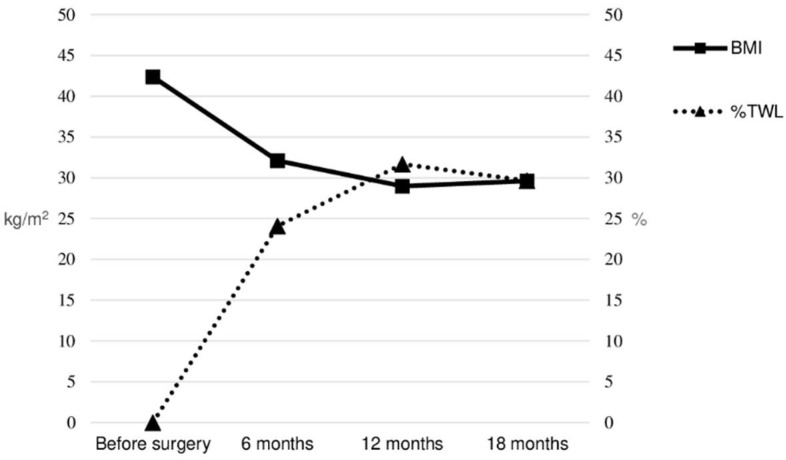
(1) Background: Obesity is associated with hypogonadism, sexual dysfunction, and impaired fertility in men. However, its effects on semen parameters or sexual function remain debatable. (2) Methods: This paper involves a longitudinal study in men submitted for obesity surgery at a university tertiary hospital. Patients were studied at baseline and at 6, 12, and 18 months after obesity surgery. At each visit, anthropometry measures were collected and hormonal and semen parameters were studied. Sexual function was evaluated with the International Index of Erectile Function (IIEF). (3) Results: A total of 12 patients were included. The average body mass index of patients decreased from 42.37 ± 4.44 to 29.6 ± 3.77 kg/m2 at 18 months after surgery (p < 0.05). Hormonal parameters improved after obesity surgery. The proportion of sperm cells with normal morphology tended to decrease from baseline and became most significant at 18 months (5.83 ± 4.50 vs. 2.82 ± 2.08). No significant changes were found in the remaining semen parameters. Erectile function improved significantly at six months after surgery. (4) Conclusions: The authors believe that, in general, the effects of obesity surgery on fertility may be limited or even deleterious (at least in the short and midterm follow-up).
Keywords: fertility; hypogonadism; obesity; obesity surgery; sperm.
Conflict of interest statement
The authors declare no conflict of interest.
Figures
References
-
- Garvey W.T., Mechanick J.I., Brett E.M., Garber A.J., Hurley D.L., Jastreboff A.M., Nadolsky K., Pessah-Pollack R., Plodkowski R. American Association of Clinical Endocrinologists and American College of Endocrinology Comprehensive Clinical Practice Guidelines for Medical Care of Patients with Obesity. Endocr. Pract. 2016;22:842–884. doi: 10.4158/EP161356.ESGL. - DOI - PubMed
-
- Escobar-Morreale H.F., Santacruz E., Luque-Ramírez M., Botella Carretero J.I. Prevalence of ‘Obesity-Associated Gonadal Dysfunction’ in Severely Obese Men and Women and Its Resolution after Bariatric Surgery: A Systematic Review and Meta-Analysis. Hum. Reprod. Update. 2017;23:390–408. doi: 10.1093/humupd/dmx012. - DOI - PubMed
Grants and funding
LinkOut - more resources
Full Text Sources
