. 2022 Aug 25;11(17):2198.
doi: 10.3390/plants11172198.

Physiological Changes of Arabica Coffee under Different Intensities and Durations of Water Stress in the Brazilian Cerrado

Affiliations

Physiological Changes of Arabica Coffee under Different Intensities and Durations of Water Stress in the Brazilian Cerrado

Patrícia Carvalho da Silva et al. Plants (Basel). .

Abstract

Coffee farmers have faced problems due to drought periods, with irrigation being necessary. In this sense, this study aimed to evaluate the responses to different levels and durations of water deficit in arabica coffee genotypes in the Cerrado region. The experiment consisted of three Coffea arabica genotypes and five water regimes: full irrigation (FI 100 and FI 50-full irrigation with 100% and 50% replacement of evapotranspiration, respectively), water deficit (WD 100 and WD 50-water deficit from June to September, with 100% and 50% replacement of evapotranspiration, respectively) and rainfed (without irrigation). The variables evaluated were gas exchange, relative water content (RWC) and productivity. The results showed that during stress, plants under the FI water regime showed higher gas exchange and RWC, differently from what occurred in the WD and rainfed treatments; however, after irrigation, coffee plants under WDs regained their photosynthetic potential. Rainfed and WD 50 plants had more than 50% reduction in RWC compared to FIs. The Iapar 59 cultivar was the most productive genotype and the E237 the lowest. Most importantly, under rainfed conditions, the plants showed lower physiological and productive potential, indicating the importance of irrigation in Coffea arabica in the Brazilian Cerrado.

Keywords: Coffea arabica; coffee physiology; drought; genotypes.


Conflict of interest statement

The authors declare no conflict of interest.

Figures
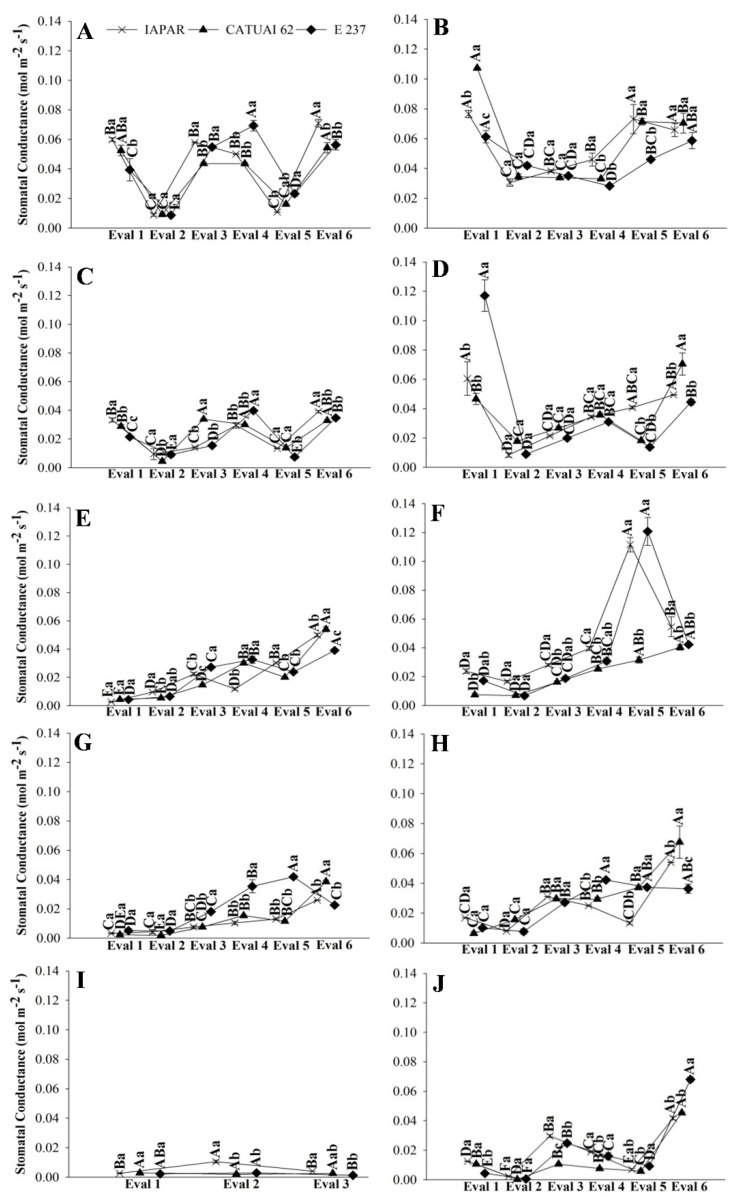
Figure 1
Figure 1
Stomatal conductance of coffee leaves under water stress (Eval 1) and after the return of irrigations (Eval 2 to 6), in 2019 and 2020, of three genotypes of arabica coffee (Iapar 59, Catuaí 62 and E237) subjected to five water regimes (FI 100 (A,B), FI 50 (C,D), WD 100 (E,F), WD 50 (G,H) and rainfed (I,J)). Capital letters compare the water regimes for each cultivar and lowercase letters compare the cultivars of each water regime. Means followed by the same letter do not differ according to the Tukey test at 5% probability. FI 100 and 50 (full irrigation with 100% and 50% replacement of evapotranspiration); WD 100 and 50 (water deficit with the suspension of irrigation from June to September, with replacement of 100% and 50% of evapotranspiration, respectively); rainfed (without irrigation).
Figure 2
Figure 2
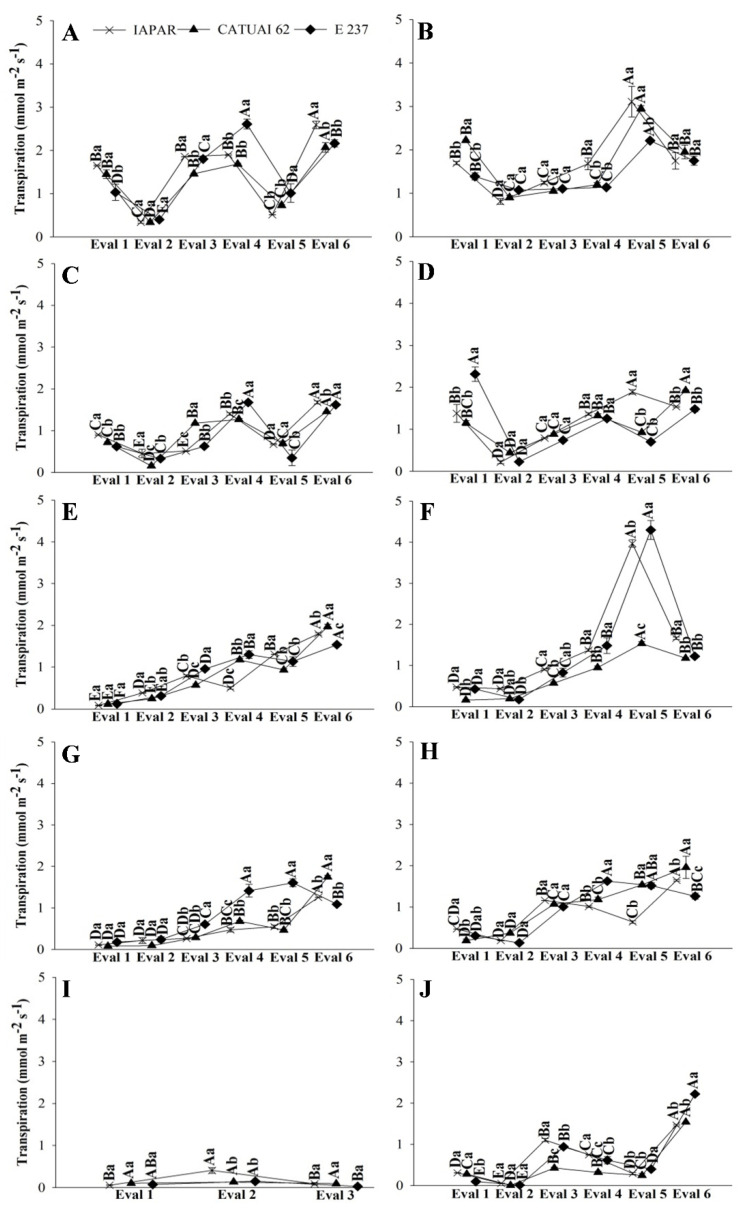
Transpiration of coffee leaves under water stress (Eval 1) and after the return of irrigation (Eval 2 to 6), in 2019 and 2020, of three genotypes of arabica coffee (Iapar 59, Catuaí 62 and E237) subjected to five water regimes (FI 100 (A,B), FI 50 (C,D), WD 100 (E,F), WD 50 (G,H) and rainfed (I,J)). Capital letters compare the water regimes for each cultivar and lowercase letters compare the cultivars of each water regime. Means followed by the same letter do not differ according to the Tukey test at 5% probability. FI 100 and 50 (full irrigation with 100% and 50% replacement of evapotranspiration); WD 100 and 50 (water deficit with the suspension of irrigation from June to September, with replacement of 100% and 50% of evapotranspiration, respectively); rainfed (without irrigation).
Figure 3
Figure 3
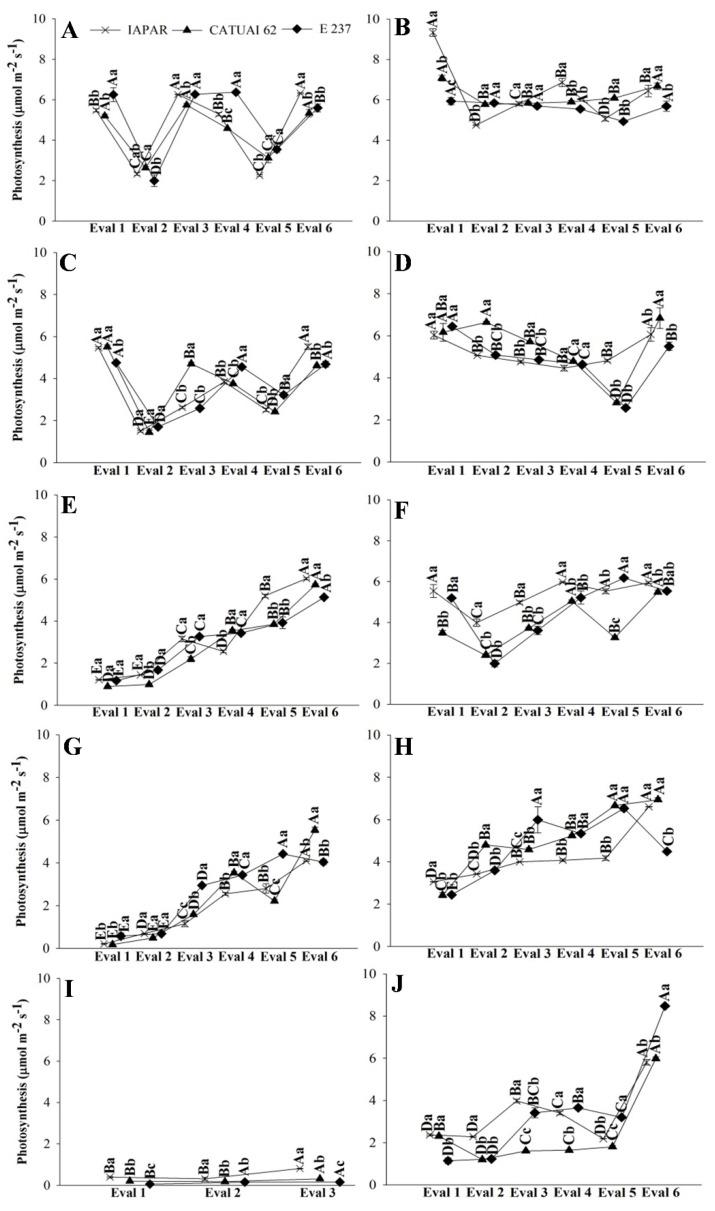
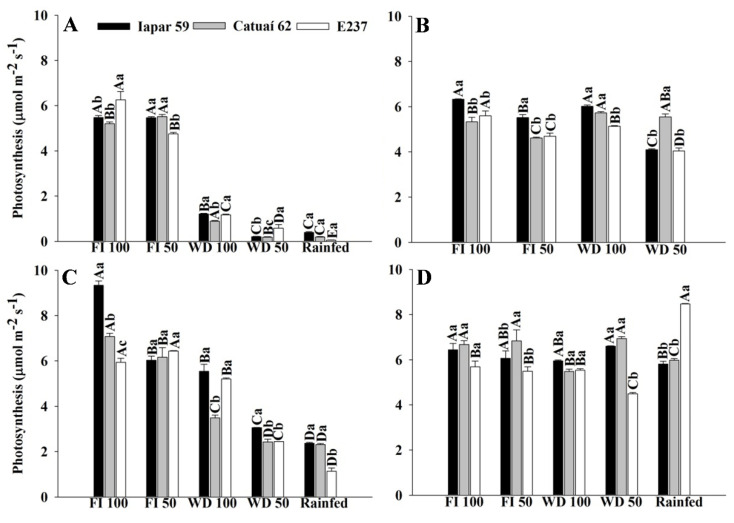
Photosynthetic rate of coffee leaves under water stress (Eval 1) and after the return of irrigation (Eval 2 to 6), in 2019 and 2020, of three genotypes of arabica coffee (Iapar 59, Catuaí 62 and E237) subjected to five water regimes (FI 100 (A,B), FI 50 (C,D), WD 100 (E,F), WD 50 (G,H) and rainfed (I,J)). Capital letters compare the water regimes for each cultivar and lowercase letters compare the cultivars of each water regime. Means followed by the same letter do not differ according to the Tukey test at 5% probability. FI 100 and 50 (full irrigation with 100% and 50% replacement of evapotranspiration); WD 100 and 50 (water deficit with the suspension of irrigation from June to September, with replacement of 100% and 50% of evapotranspiration, respectively); rainfed (without irrigation).
Figure 4
Figure 4
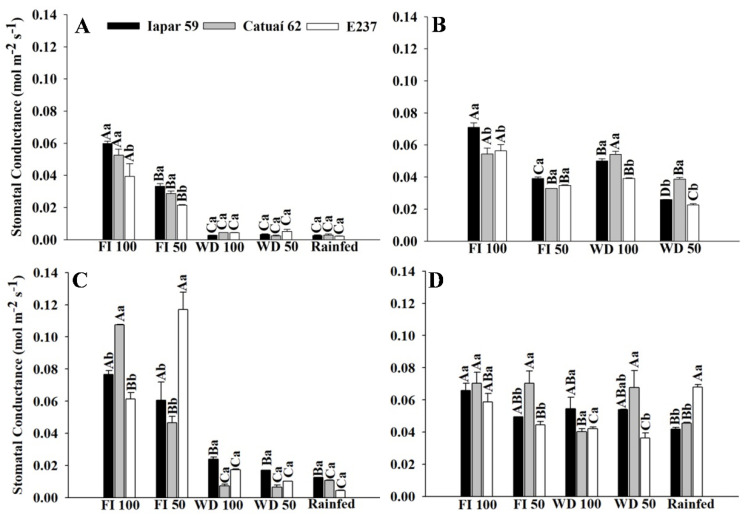
Stomatal conductance of coffee leaves under water stress (A,C) and after irrigation (B,D), in 2019 (A,B) and 2020 (C,D), of three arabica coffee genotypes (Iapar 59, Catuaí 62 and E237) under five water regimes (FI 100, FI 50, WD 100 WD 50 and rainfed). Capital letters compare the water regimes for each cultivar and lowercase letters compare the cultivars of each water regime. Means followed by the same letter do not differ according to the Tukey test at 5% probability. FI 100 and 50 (full irrigation with 100% and 50% replacement of evapotranspiration); WD 100 and 50 (water deficit with the suspension of irrigation from June to September, with replacement of 100% and 50% of evapotranspiration, respectively); rainfed (without irrigation).
Figure 5
Figure 5
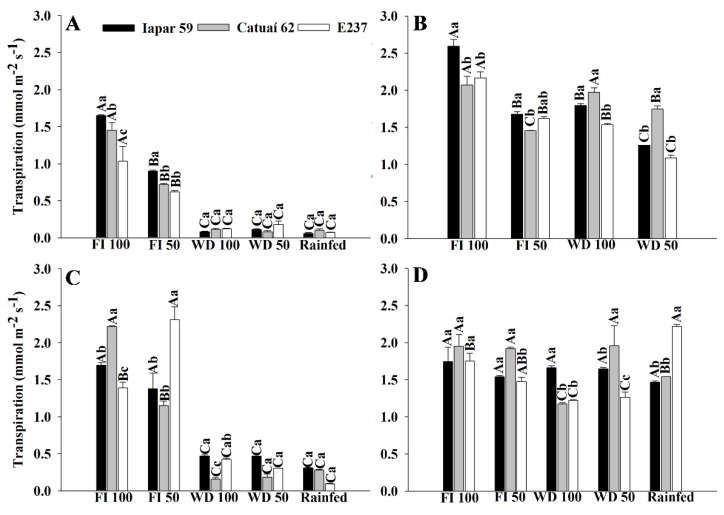
Transpiration of coffee leaves under water stress (A,C) and after irrigation (B,D), in 2019 (A,B) and 2020 (C,D), of three arabica coffee genotypes (Iapar 59, Catuaí 62 and E237) under five water regimes (FI 100, FI 50, WD 100, WD 50 and rainfed). Capital letters compare the water regimes for each cultivar and lowercase letters compare the cultivars of each water regime. Means followed by the same letter do not differ according to the Tukey test at 5% probability. FI 100 and 50 (full irrigation with 100% and 50% replacement of evapotranspiration); WD 100 and 50 (water deficit with the suspension of irrigation from June to September, with replacement of 100% and 50% of evapotranspiration, respectively); rainfed (without irrigation).
Figure 6
Figure 6
Photosynthetic rates of coffee leaves under water stress (A,C) and after irrigation (B,D), in 2019 (A,B) and 2020 (C,D), of three arabica coffee genotypes (Iapar 59, Catuaí 62 and E237) under five water regimes (FI 100, FI 50, WD 100, WD 50 and rainfed). Capital letters compare the water regimes for each cultivar and lowercase letters compare the cultivars of each water regime. Means followed by the same letter do not differ according to the Tukey test at 5% probability. FI 100 and 50 (full irrigation with 100% and 50% replacement of evapotranspiration); WD 100 and 50 (water deficit with the suspension of irrigation from June to September, with replacement of 100% and 50% of evapotranspiration, respectively); rainfed (without irrigation).
Figure 7
Figure 7
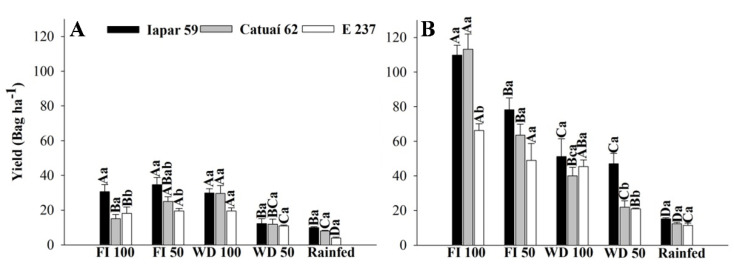
Productivity (bag ha−1) of three arabica coffee genotypes (E237, Iapar 59 and Catuaí 62) under five water regimes (FI 100, FI 50, WD 100, WD 50 and rainfed), in 2019 (A) and 2020 (B). Capital letters compare the water regimes for each cultivar and lowercase letters compare the cultivars of each water regime. Means followed by the same letter do not differ according to the Tukey test at 5% probability. FI 100 and 50 (full irrigation with 100% and 50% replacement of evapotranspiration); WD 100 and 50 (water deficit with the suspension of irrigation from June to September, with replacement of 100% and 50% of evapotranspiration, respectively); rainfed (without irrigation). Bag = 60 kg.
Figure 8
Figure 8
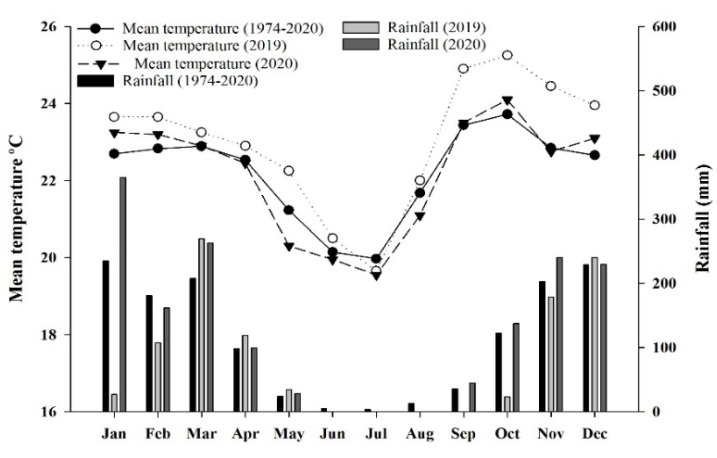
Climatic data of precipitation and mean temperature from 1974 to 2020 in the experimental area.
Figure 9
Figure 9
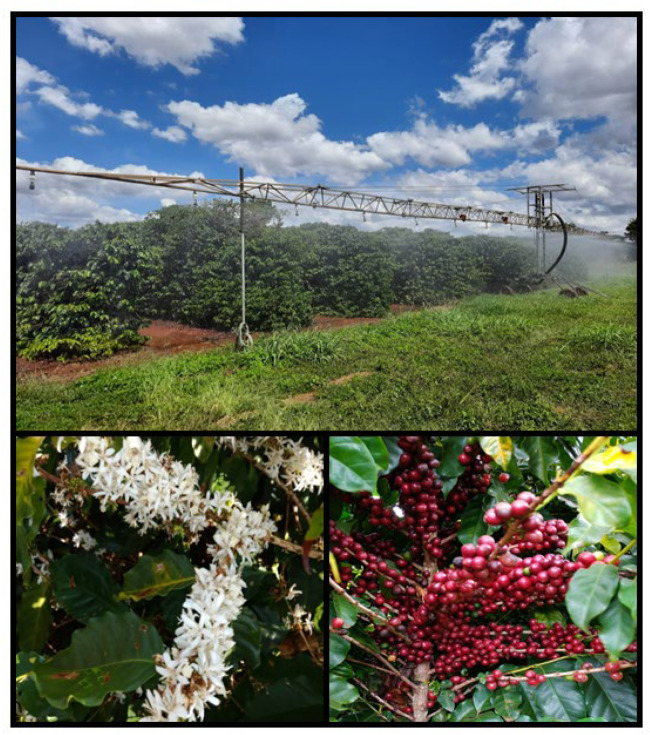
Irrigation system with controlled stress, uniform flowering and cherry grains.

References

    1. DaMatta F.M., Avila R.T., Cardoso A.A., Martins S.C., Ramalho J.C. Physiological and agronomic performance of the coffee crop in the context of climate change and global warming: A review. J. Agric Food Chem. 2018;66:5264–5274. doi: 10.1021/acs.jafc.7b04537. - DOI - PubMed
    1. Wintgens J.N. Coffee: Growing, Processing, Sustainable Production: A Guidebook for Growers, Processors, Traders, and Researchers. 1st ed. Wiley-VCH Verlag GmbH & Co. KGaA; Weinheim, Germany: 2004. pp. 1–24.
    1. Veiga A.D., Rodrigues G.C., Rocha O.C., Bartholo G.F., Guerra A.F., Silva T.P.D. Arabica coffee cultivars in different water regimes in the central cerrado region. Coffee Sci. 2019;14:349–358. doi: 10.25186/cs.v14i3.1586. - DOI
    1. Zullo J., Pinto H.S., Assad E.D. Impact assessment study of climate change on agricultural zoning. Meteorol. Appl. 2006;13:69–80.
    1. Magrach A., Ghazoul J. Climate and pest-driven geographic shifts in global coffee production: Implications for forest cover, biodiversity and carbon storage. PLoS ONE. 2015;10:e0133071. doi: 10.1371/journal.pone.0133071. - DOI - PMC - PubMed

LinkOut - more resources