


Current State of Ammophila arenaria (Marram Grass) Distribution in the Eastern Cape, South Africa, and the Possible Effect of the Grass on the Dune System Dynamics
- PMID: 36079641
- PMCID: PMC9460503
- DOI: 10.3390/plants11172260
Current State of Ammophila arenaria (Marram Grass) Distribution in the Eastern Cape, South Africa, and the Possible Effect of the Grass on the Dune System Dynamics
Abstract
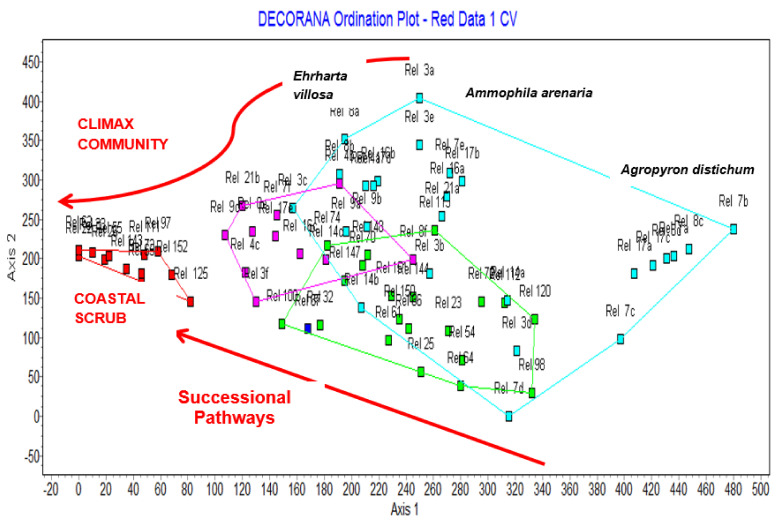
The principal aim of this paper is to show that marram grass is not an invasive alien in South Africa although it affects the dune dynamics as a useful pioneer species in the dune successional process. The historical perspective of marram introduction as a dune stabiliser and the studies and conclusions reached from our European Union funded project, INVASS, in the 1990s and early 2000s is presented. Although these studies showed that marram was non-invasive, this was not clearly carried through to the authorities, and the use of the grass as a dune stabiliser was limited without a special permit. This prompted a survey of the current situation of marram on dune sites in the Eastern Cape. Along with earlier (1980s) data on the dunes, 69 relevés with 66 species abundance from sites along the Eastern Cape shoreline were assembled. These data were analysed with Detrended Correspondence Analysis to show the relationships of the samples (relevés) and species in a 2-dimensional scatter diagram. The survey showed that there are four dune sites where marram grass is no longer present, due to either marram being out of its climatic range, erosion of sand under storm conditions which made the habitat unsuitable, or in one case where marram simply disappeared. Marram often remains in other sites where three to five dune pioneer species were recorded. On some dunes, although marram is the most abundant dune pioneer, it is never dominant in the dune environment but has a presence of as much as 75% at any site. The eight pioneer species are widely dispersed on the DCA scatter diagram, while the shrub species characterising the Coastal Scrub are tightly clustered, showing that all the pioneer dune communities behave similarly in the dune successional series. The conclusion from these studies is that marram grass does not always persist in the dune systems. If marram does persist, it does not compete and behaves identically to the indigenous species as a dune pioneer. These studies show that marram grass is a non-invasive species that can be successfully used in dune stabilisation on Cape dunes.
Keywords: coastal management; dune systems; invasive alien plants; marram grass.
Conflict of interest statement
The author declares no conflict of interest.
Figures





References
-
- Hertling U.M. Ph.D. Thesis. Rhodes University; Grahamstown, South Africa: 1997. An Autecological Study of Ammophila arenaria and Alternative Indigenous Species Used in Dune Stabilisation on the Cape Coast. Unpublished.
-
- Shaughnessy G.L. Ph.D. Thesis. University of Cape Town (School of Environmental Studies Report No. 23); Cape Town, South Africa: 1980. Historical ecology of alien woody plants in the vicinity of Cape Town.421p
-
- Cobby J.E. Management policy of the Directorate of Forestry in respect of diverse ecological types. In: Bruton M.N., Gess F.W., editors. Towards an Environmental Plan for the Eastern Cape. Rhodes University; Grahamstown, South Africa: 1988.
-
- Avis A.M. A review of coastal dune stabilisation in the Cape Province of South Africa. Landsc. Urban Plan. 1989;18:55–68.
-
- Van der Putten W.H. Impacts of soil microbial communities on exotic plant invasions. Trends Ecol. Evol. 2010;25:512–519. - PubMed
Grants and funding
LinkOut - more resources
Full Text Sources
