


Predictors of Minimum Acceptable Diet among Children Aged 6-23 Months in Nepal: A Multilevel Analysis of Nepal Multiple Indicator Cluster Survey 2019
- PMID: 36079926
- PMCID: PMC9460334
- DOI: 10.3390/nu14173669
Predictors of Minimum Acceptable Diet among Children Aged 6-23 Months in Nepal: A Multilevel Analysis of Nepal Multiple Indicator Cluster Survey 2019
Abstract
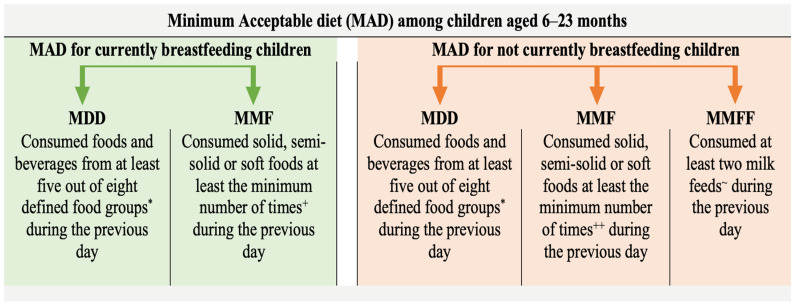
Background: Minimum Acceptable Diet (MAD), developed by the WHO and UNICEF, is a binary indicator of infant and young child feeding practice that assesses the quality and sufficiency of a child's diet between the ages of 6 and 23 months. Identifying factors associated with MAD among children can inform policymakers to improve children's nutritional status.
Methods: We extracted data of 1930 children aged 6-23 months from the Nepal Multiple Indicator Cluster Survey 2019. Multilevel analysis was performed to identify factors associated with MAD.
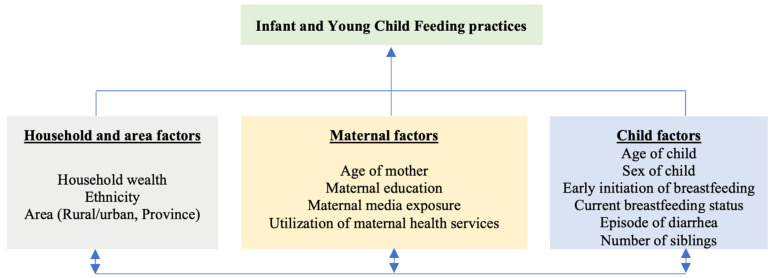
Results: Only 30.1% of the children received MAD. Children aged 13-18 months [aOR (Adjusted odds ratio): 2.37, 95% CI (95% Confidence Interval): 1.77, 3.17] and 19-23 months (aOR: 2.6, 95% CI: 1.95, 3.47) were more likely to receive MAD than children aged 6-12 months. Early breastfed children (aOR: 1.34, 95% CI: 1.05, 1.72), those currently breastfeeding (aOR: 4.13, 95% CI: 2.21, 7.69) and children without siblings aged under five (aOR: 1.33, 95% CI: 1.03, 1.73) were more likely to receive MAD. Younger maternal age (aOR: 0.97, 95% CI: 0.95-1.0), higher level of mother's education (aOR: 1.04, 95% CI: 1.0-1.08) and more media exposure among mothers (aOR: 1.66, 95% CI: 1.24, 2.21) were positive predictors of MAD. Relatively disadvantaged ethnicity/caste (aOR: 0.71, 95% CI: 0.53, 0.94), rural residence (aOR: 1.45, 95% CI: 1.06, 2.00) and residing in Madhesh province (aOR: 0.61, 95% CI: 0.37, 1.0) were also significant predictors of MAD.
Conclusions: Children aged 6-12 months, without appropriate breastfeeding, having under-five years siblings, with older mother or mother without media exposure or low education, from relatively disadvantaged ethnicity/caste, from urban areas and residing in Madhesh Province were less likely to receive MAD. Our findings can inform infant and young child feeding policies and practices in Nepal.
Keywords: Nepal; children under 2 years of age; infant and young child feeding (IYCF); minimum acceptable diet (MAD); nutrition.
Conflict of interest statement
The authors declare no conflict of interest.
Figures
References
-
- UNICEF. WHO. World Bank Group Levels and Trends in Child Malnutrition. 2021. [(accessed on 5 July 2022)]. Available online: https://www.who.int/publications/i/item/9789240025257.
-
- Black R.E., Victora C.G., Walker S.P., Bhutta Z.A., Christian P., de Onis M., Ezzati M., Grantham-Mcgregor S., Katz J., Martorell R., et al. Maternal and child undernutrition and overweight in low-income and middle-income countries. Lancet. 2013;382:427–451. doi: 10.1016/S0140-6736(13)60937-X. - DOI - PubMed
-
- Karn S., Adhikari D.P., Paudyal N., Aryal B., Adhikari R.K., Steffen M.M. Child undernutrition and feeding practices in Nepal: Trends, inequities, and determinants. DHS Furth. Anal. Rep. 2019;122
-
- Cental Bureau of Statistics . Nepal Multiple Indicator Cluster Survey 2019, Survey Findings Report. Cental Bureau of Statistics; Kathmandu, Nepal: 2020.
MeSH terms
LinkOut - more resources
Full Text Sources
Medical
