


Development of Ag-Doped ZnO Thin Films and Thermoluminescence (TLD) Characteristics for Radiation Technology
- PMID: 36080105
- PMCID: PMC9459964
- DOI: 10.3390/nano12173068
Development of Ag-Doped ZnO Thin Films and Thermoluminescence (TLD) Characteristics for Radiation Technology
Abstract
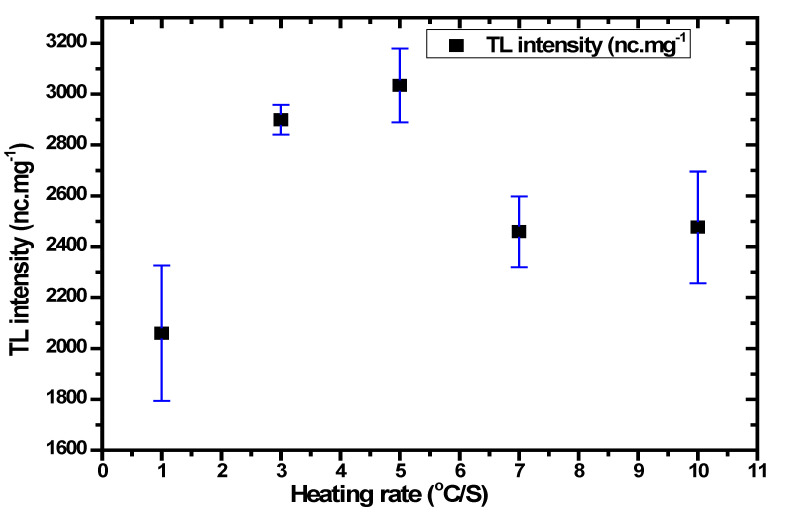
This work examined the thermoluminescence dosimetry characteristics of Ag-doped ZnO thin films. The hydrothermal method was employed to synthesize Ag-doped ZnO thin films with variant molarity of Ag (0, 0.5, 1.0, 3.0, and 5.0 mol%). The structure, morphology, and optical characteristics were investigated using X-ray diffraction (XRD), scanning electron microscope (SEM), energy-dispersive X-ray spectroscopy (EDX), photoluminescence (PL), and UV-vis spectrophotometers. The thermoluminescence characteristics were examined by exposing the samples to X-ray radiation. It was obtained that the highest TL intensity for Ag-doped ZnO thin films appeared to correspond to 0.5 mol% of Ag, when the films were exposed to X-ray radiation. The results further showed that the glow curve has a single peak at 240-325 °C, with its maximum at 270 °C, which corresponded to the heating rate of 5 °C/s. The results of the annealing procedures showed the best TL response was found at 400 °C and 30 min. The dose-response revealed a good linear up to 4 Gy. The proposed sensitivity was 1.8 times higher than the TLD 100 chips. The thermal fading was recorded at 8% for 1 Gy and 20% for 4 Gy in the first hour. After 45 days of irradiation, the signal loss was recorded at 32% and 40% for the cases of 1 Gy and 4 Gy, respectively. The obtained optical fading results confirmed that all samples' stored signals were affected by the exposure to sunlight, which decreased up to 70% after 6 h. This new dosimeter exhibits good properties for radiation measurement, given its overgrowth (in terms of the glow curve) within 30 s (similar to the TLD 100 case), simple annealing procedure, and high sensitivity (two times that of the TLD 100).
Keywords: Ag; ZnO; dosimetry; fading; linear response doses; sensitivity; thermoluminescence.
Conflict of interest statement
The authors declare no conflict of interest.
Figures






References
-
- Sinclair S., Pech-Canul M. Development feasibility of TLD phosphors and thermoluminescent composite materials for potential applications in dosimetry: A review. Chem. Eng. J. 2022;443:136522. doi: 10.1016/j.cej.2022.136522. - DOI
-
- Bhatt B.C., Kulkarni M. Defect and Diffusion Forum. Trans Tech Publishing; Geneva, Switzerland: 2014. Thermoluminescent phosphors for radiation dosimetry; pp. 179–227.
-
- Omanwar S., Koparkar K., Virk H.S. Defect and Diffusion Forum. Trans Tech Publishing; Geneva, Switzerland: 2014. Recent advances and opportunities in tld materials: A review; pp. 75–110.
-
- Salah N. Nanocrystalline materials for the dosimetry of heavy charged particles: A review. Radiat. Phys. Chem. 2011;80:1–10. doi: 10.1016/j.radphyschem.2010.08.003. - DOI
Grants and funding
LinkOut - more resources
Full Text Sources
