Review
. 2022 Aug 26;27(17):5481.
doi: 10.3390/molecules27175481.

Lipopolysaccharide-Induced Model of Neuroinflammation: Mechanisms of Action, Research Application and Future Directions for Its Use

Affiliations
Review

Lipopolysaccharide-Induced Model of Neuroinflammation: Mechanisms of Action, Research Application and Future Directions for Its Use

Anna Skrzypczak-Wiercioch et al. Molecules. .

Abstract

Despite advances in antimicrobial and anti-inflammatory therapies, inflammation and its consequences still remain a significant problem in medicine. Acute inflammatory responses are responsible for directly life-threating conditions such as septic shock; on the other hand, chronic inflammation can cause degeneration of body tissues leading to severe impairment of their function. Neuroinflammation is defined as an inflammatory response in the central nervous system involving microglia, astrocytes, and cytokines including chemokines. It is considered an important cause of neurodegerative diseases, such as Alzheimer's disease, Parkinson's disease and amyotrophic lateral sclerosis. Lipopolysaccharide (LPS) is a strong immunogenic particle present in the outer membrane of Gram-negative bacteria. It is a major triggering factor for the inflammatory cascade in response to a Gram-negative bacteria infection. The use of LPS as a strong pro-inflammatory agent is a well-known model of inflammation applied in both in vivo and in vitro studies. This review offers a summary of the pathogenesis associated with LPS exposure, especially in the field of neuroinflammation. Moreover, we analyzed different in vivo LPS models utilized in the area of neuroscience. This paper presents recent knowledge and is focused on new insights in the LPS experimental model.

Keywords: Alzheimer’s disease; Toll-like receptor 4; lipopolysaccharide; neurodegenerative diseases; neuroinflammation.


Conflict of interest statement

The authors declare no conflict of interest.

Figures
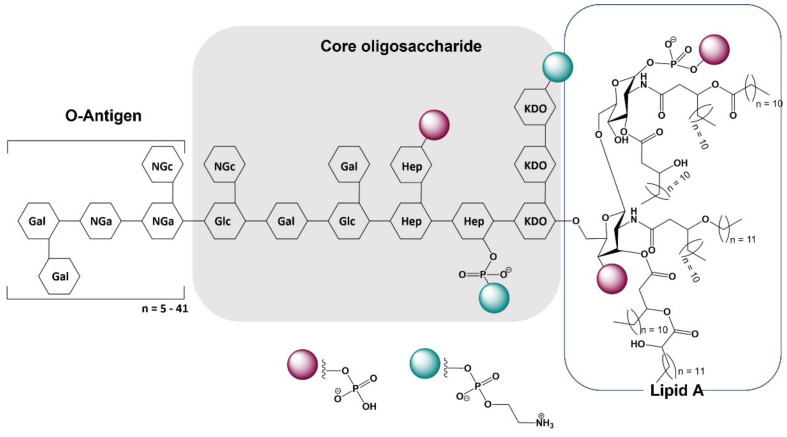
Figure 1
Figure 1
General structure of lipopolysaccharide from E. coli O111:B4. Abbreviations: Gal-galactose; Glc-glucose; Hep-L-glycerol-D-manno-heptose; KDO-2-keto-3-deoxyoctonic acid; Nga-N-acetyl-galactosamine; NGc-N-acetyl-glucosamine.
Figure 2
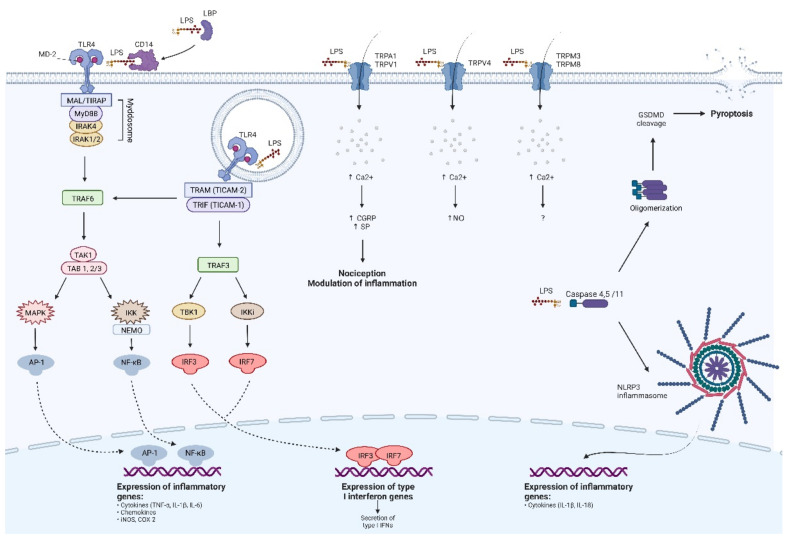
Figure 2
Mechanisms of molecular response to LPS. A detailed description can be found in the section ‘Cellular recognition of LPS’. Abbreviations: AP-1—activator protein-1; CD14—cluster of differentiation-14; CGRP—calcitonin gene-related peptide; COX-2—cyclooxygenase-2; GSDMD— gasdermin-D; IFN—interferon; IKK—Iκβ kinase complex; IKKi—IKK inducible kinase; IL—interleukin; iNOS—inducible nitric oxide synthase; IRAK—interleukin-1 receptor associated kinase; IRF—interferon regulatory factor; LBP—lipopolysaccharide-binding protein; LPS—lipopolysaccharide; MAL—MyD88—adopter-like protein; MAPK—mitogen-activated protein kinase; MD-2—accessory protein MD-2; MyD88—myeloid differentiation primary response protein; NLRP3—NLR family pyrin domain containing 3; NEMO—NF-κB essential modulator; NF-κB—nuclear factor-κB; NO—nitric oxide; SP—substance P; TAB—TAK1 binding protein; TAK1—transforming growth factor β-activated kinase 1; TBK1—TANK-binding kinase 1; TIR—Toll/IL-1 receptor domain; TIRAP—TIR domain containing adaptor protein; TNF-α—tumor necrosis factor-α; TLR4 —Toll-like receptor 4; TRAF—TNF-receptor associated factor; TRAM—TRIF-related adaptor molecule; TRIF—Toll/interleukin-1-receptor domain-containing adaptor inducing interferon β; TRPA1—transient receptor potential ankyrin 1; TRPM3—transient receptor potential melastatin 3; TRPM8—transient receptor potential melastatin 8; TRPV1—transient receptor potential cation channel subfamily V member 1; TRPV4 - transient receptor potential vanilloid 4. Adapted from ‘TLR Signaling Pathway’, by BioRender.com (2022). Retrieved from https://app.biorender.com/biorender-templates (accessed on 15 July 2022).

References

    1. Zhao J., Bi W., Xiao S., Lan X., Cheng X., Zhang J., Lu D., Wei W., Wang Y., Li H., et al. Neuroinflammation Induced by Lipopolysaccharide Causes Cognitive Impairment in Mice. Sci. Rep. 2019;9:5790. doi: 10.1038/s41598-019-42286-8. - DOI - PMC - PubMed
    1. Vandenbark A.A., Offner H., Matejuk S., Matejuk A. Microglia and Astrocyte Involvement in Neurodegeneration and Brain Cancer. J. Neuroinflammation. 2021;18:298. doi: 10.1186/s12974-021-02355-0. - DOI - PMC - PubMed
    1. Sudwarts A., Ramesha S., Gao T., Ponnusamy M., Wang S., Hansen M., Kozlova A., Bitarafan S., Kumar P., Beaulieu-Abdelahad D., et al. BIN1 Is a Key Regulator of Proinflammatory and Neurodegeneration-Related Activation in Microglia. Mol. Neurodegener. 2022;17:33. doi: 10.1186/s13024-022-00535-x. - DOI - PMC - PubMed
    1. Booth H.D.E., Hirst W.D., Wade-Martins R. The Role of Astrocyte Dysfunction in Parkinson’s Disease Pathogenesis. Trends Neurosci. 2017;40:358–370. doi: 10.1016/j.tins.2017.04.001. - DOI - PMC - PubMed
    1. Novianti E., Katsuura G., Kawamura N., Asakawa A., Inui A. Atractylenolide-III Suppresses Lipopolysaccharide-Induced Inflammation via Downregulation of Toll-like Receptor 4 in Mouse Microglia. Heliyon. 2021;7:e08269. doi: 10.1016/j.heliyon.2021.e08269. - DOI - PMC - PubMed

LinkOut - more resources