. 2022 Sep 2;27(17):5672.
doi: 10.3390/molecules27175672.

Structure-Activity Relationship Development Efforts towards Peripherally Selective Analogs of the Cannabinoid Receptor Partial Agonist BAY 59-3074

Affiliations

Structure-Activity Relationship Development Efforts towards Peripherally Selective Analogs of the Cannabinoid Receptor Partial Agonist BAY 59-3074

George Amato et al. Molecules. .

Abstract

Selective modulation of peripheral cannabinoid receptors (CBRs) has potential therapeutic applications in medical conditions, including obesity, diabetes, liver diseases, GI disorders and pain. While there have been considerable efforts to produce selective antagonists or full agonists of CBRs, there has been limited reports on the development of partial agonists. Partial agonists targeting peripheral CBRs may have desirable pharmacological profiles while not producing centrally mediated dissociative effects. Bayer reported that BAY 59-3074 is a CNS penetrant partial agonist of both CB1 and CB2 receptors with efficacy in rat models of neuropathic and inflammatory pain. In this report, we demonstrate our efforts to synthesize analogs that would favor peripheral selectivity, while maintaining partial agonism of CB1. Our efforts led to the identification of a novel compound, which is a partial agonist of the human CB1 (hCB1) receptor with vastly diminished brain exposure compared to BAY 59-3074.

Keywords: CB1; CB2; agonist; cannabinoid; ligand; partial; peripheral.


Conflict of interest statement

The authors do not have known conflict of interest.

Figures
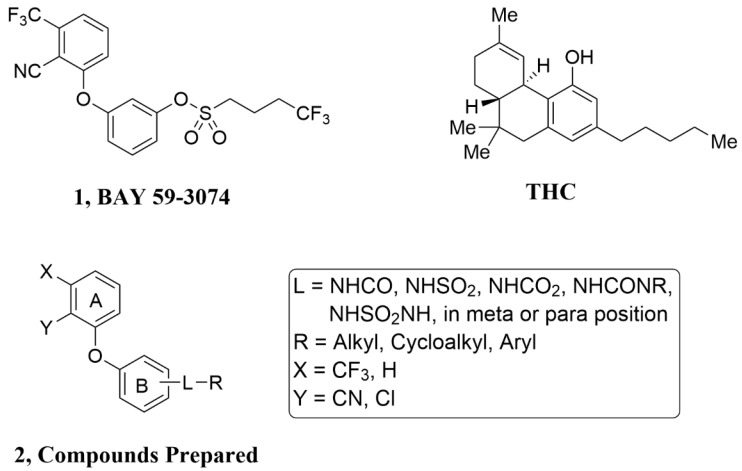
Figure 1
Figure 1
THC, BAY 59-3074 (1) and Compounds Prepared (2). To make (1) less CNS penetrating, the sulfonate linker (L) was swapped with a H-bond donating linker (amide, sulfonamide, carbamate, urea, and sulfamide. Changes to the trifluoromethyl (X), cyano (Y), and the trifluorobutyl group (R) of (1) were made to develop SAR with regard to potency and efficacy as described in Section 2.2.
Figure 2
Figure 2
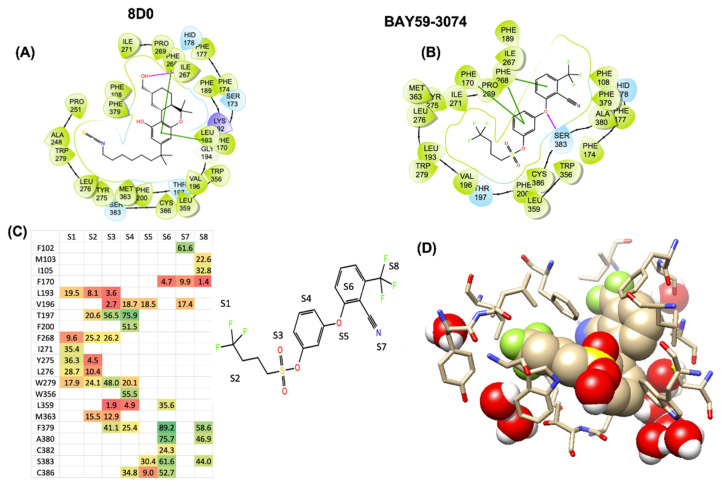
The LIGPLOT representations for the best Emodel scored induced-fit/GLIDE-XP docking poses of (A) agonist 8D0(AM841), and (B) compound 1 shows that they thread the largely hydrophobic CB1 binding site in a similar manner. The top MMGBSA-scored docking poses from Schrodinger’s induced fit/GLIDE-XP and Autodock VINA show π-stacking with F268ECL2 and F1702.57 (C) The color-coded heat-map contact-analysis for the 850 ns molecular dynamic simulation reveals that while the sulfonyl (S3-region) of 1 spends significant percentages of total simulation time (heatmap) proximate to T1973.33 and W2795.43, direct H-bond/polar interactions with these polar residues is not persistent. Instead, bridged polar-residue—water H-bond stabilization is observed between these residues and the ligand sulfonyl. The heat-map spectrum is coded from green (high percentages) to red (low percentages). Panel (D) shows a 840 ns snapshot of 1 CB1 in DOPC/KCL/TIPS3P water from the 850 ns simulation highlighting these water bridging interactions.
Scheme 1
Scheme 1
Reagents and conditions: (a) K2CO3, DMF, 80 °C; (b) K2CO3, DMA, 70 °C; (c) SnCl2·2H2O, EtOH, 50 °C.
Scheme 2
Scheme 2
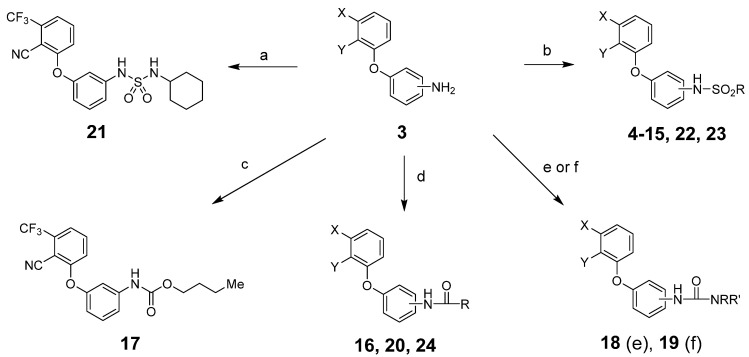
Reagents and conditions: (a) RNHSO2Cl, NEt3, THF, room temperature (rt); (b) RSO2Cl, NEt3, THF, rt; (c) RO2CCl, NEt3, THF, rt; (d) RCOCl, NEt3, THF, rt; (e) RNCO, NEt3, THF, rt; (f) (1) triphosgene, NaHCO3, CH2Cl2, water, rt; (2) RR’NH, NEt3, THF, rt. See Table 1 and Table 2 below for exact structures and in vitro data.
Figure 3
Figure 3
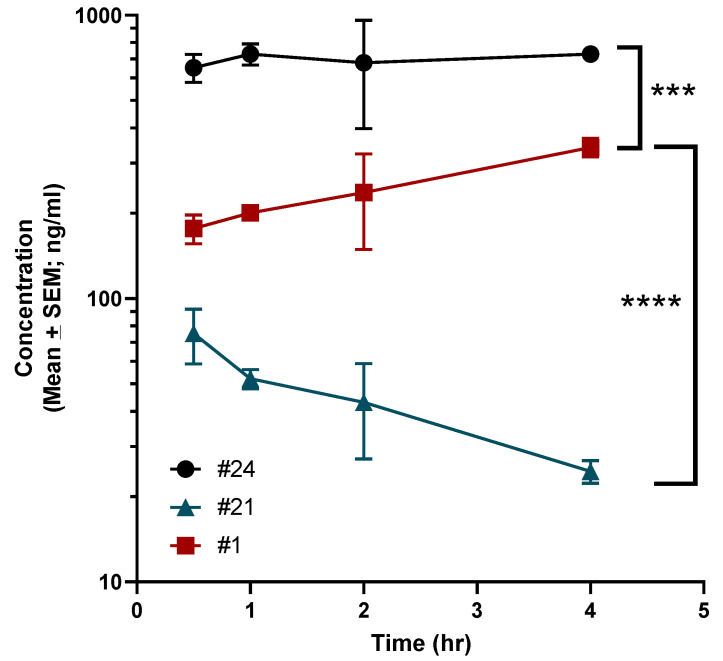
Pharmacokinetic evaluation of compounds 1, 21 and 24 in mice. Mice were administered 3 mg/kg of each compound by IP injection as has been described in the Methods. The concentration of each compound in the brain was calculated using LC-MS at various time points. Data are presented as mean ± standard error. Statistical significance was determined using ANOVA with Dunnett’s multiple comparisons test. Significance indicated as **** p < 0.00001; *** p < 0.0001.

Similar articles

Cited by

References

    1. Klumpers L.E., Thacker D.L. A Brief Background on Cannabis: From Plant to Medical Indications. J. AOAC Int. 2019;102:412–420. doi: 10.5740/jaoacint.18-0208. - DOI - PubMed
    1. Buisseret B., Alhouayek M., Guillemot-Legris O., Muccioli G.G. Endocannabinoid and Prostanoid Crosstalk in Pain. Trends Mol. Med. 2019;25:882–896. doi: 10.1016/j.molmed.2019.04.009. - DOI - PubMed
    1. Lu Y., Anderson H.D. Cannabinoid signaling in health and disease. Can. J. Physiol. Pharmacol. 2017;95:311–327. doi: 10.1139/cjpp-2016-0346. - DOI - PubMed
    1. Pertwee R.G. Emerging strategies for exploiting cannabinoid receptor agonists as medicines. J. Cereb. Blood Flow Metab. 2009;156:397–411. doi: 10.1111/j.1476-5381.2008.00048.x. - DOI - PMC - PubMed
    1. Järbe T.U.C., LeMay B.J., Halikhedkar A., Wood J., Vadivel S.K., Zvonok A., Makriyannis A. Differentiation between low- and high-efficacy CB1 receptor agonists using a drug discrimination protocol for rats. Psychopharmacology. 2014;231:489–500. doi: 10.1007/s00213-013-3257-8. - DOI - PMC - PubMed

Substances