


Electrophysiological Features to Aid in the Construction of Predictive Models of Human-Agent Collaboration in Smart Environments
- PMID: 36080985
- PMCID: PMC9460739
- DOI: 10.3390/s22176526
Electrophysiological Features to Aid in the Construction of Predictive Models of Human-Agent Collaboration in Smart Environments
Abstract
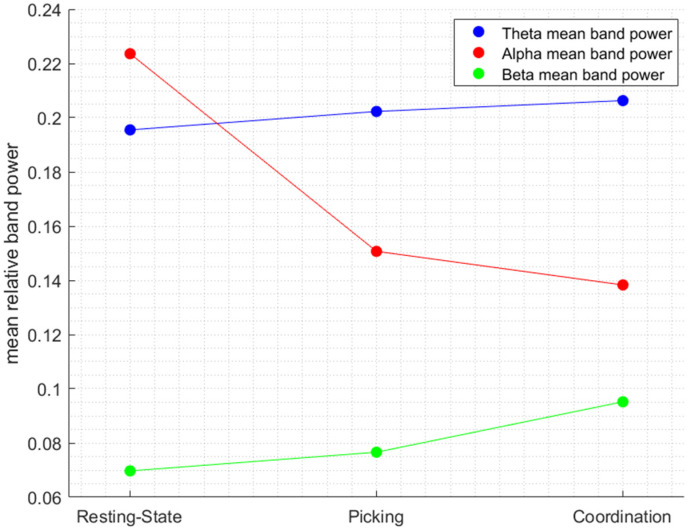
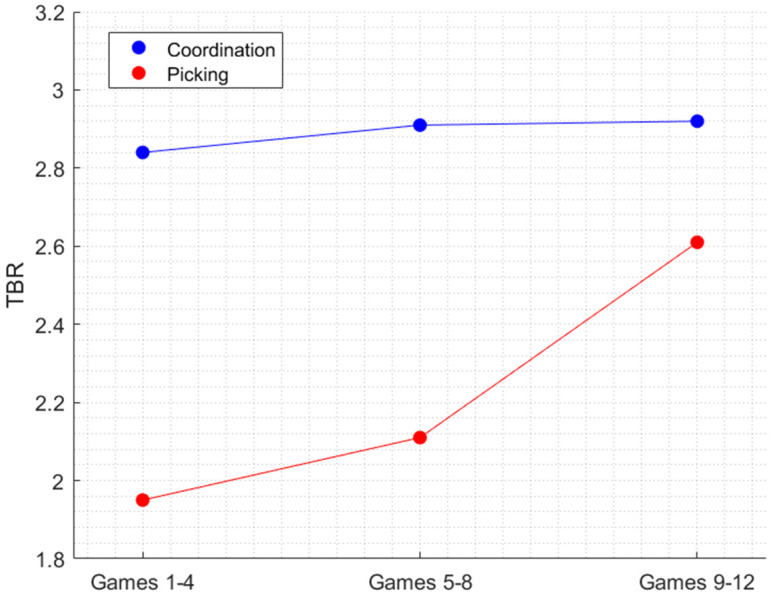
Achieving successful human-agent collaboration in the context of smart environments requires the modeling of human behavior for predicting people's decisions. The goal of the current study was to utilize the TBR and the Alpha band as electrophysiological features that will discriminate between different tasks, each associated with a different depth of reasoning. To that end, we monitored the modulations of the TBR and Alpha, while participants were engaged in performing two cognitive tasks: picking and coordination. In the picking condition (low depth of processing), participants were requested to freely choose a single word out of a string of four words. In the coordination condition (high depth of processing), participants were asked to try and select the same word as an unknown partner that was assigned to them. We performed two types of analyses, one that considers the time factor (i.e., observing dynamic changes across trials) and the other that does not. When the temporal factor was not considered, only Beta was sensitive to the difference between picking and coordination. However, when the temporal factor was included, a transition occurred between cognitive effort and fatigue in the middle stage of the experiment. These results highlight the importance of monitoring the electrophysiological indices, as different factors such as fatigue might affect the instantaneous relative weight of intuitive and deliberate modes of reasoning. Thus, monitoring the response of the human-agent across time in human-agent interactions might turn out to be crucial for smooth coordination in the context of human-computer interaction.
Keywords: EEG; Theta/Beta ratio; coordination; mental workload; smart environments.
Conflict of interest statement
The authors declare no conflict of interest.
Figures


References
-
- Jan’t Hoen P., Tuyls K., Panait L., Luke S., La Poutré J.A. An overview of cooperative and competitive multiagent learning; Proceedings of the International Workshop on Learning and Adaption in Multi-Agent Systems; Utrecht, The Netherlands. 25 July 2005; pp. 1–46.
-
- Rosenfeld A., Zuckerman I., Azaria A., Kraus S. Combining psychological models with machine learning to better predict people’s decisions. Synthese. 2012;189:81–93. doi: 10.1007/s11229-012-0182-z. - DOI
-
- Kraus S. Predicting human decision-making: From prediction to action; Proceedings of the 6th International Conference on Human-Agent Interaction; Southampton, UK. 15–18 December 2018; p. 1.
-
- Rosenfeld A., Bareket Z., Goldman C.V., Kraus S., LeBlanc D.J., Tsimoni O. Learning Driver’s Behavior to Improve the Acceptance of Adaptive Cruise Control; Proceedings of the IAAI; Toronto, ON, Canada. 22–26 July 2012.
-
- Azaria A., Rabinovich Z., Kraus S., Goldman C.V., Tsimoni O. Giving Advice to People in Path Selection Problems; Proceedings of the AAMAS; Valencia, Spain. 4–8 June 2012; pp. 459–466.
MeSH terms
LinkOut - more resources
Full Text Sources
Medical
