


Broken Promises? On the Continued Challenges Faced in Catalytic Hydrophosphination
- PMID: 36082053
- PMCID: PMC9442583
- DOI: 10.1021/acscatal.2c03144
Broken Promises? On the Continued Challenges Faced in Catalytic Hydrophosphination
Abstract
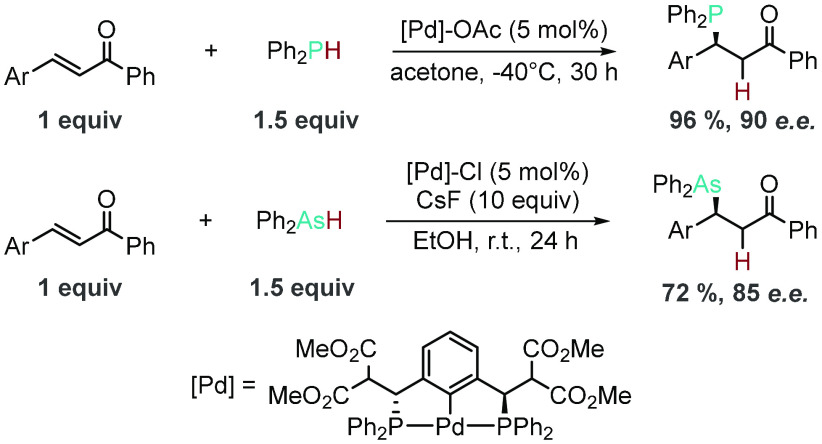
In this Perspective, we discuss what we perceive to be the continued challenges faced in catalytic hydrophosphination chemistry. Currently the literature is dominated by catalysts, many of which are highly effective, that generate the same phosphorus architectures, e.g., anti-Markovnikov products from the reaction of activated alkenes and alkynes with diarylphosphines. We highlight the state of the art in stereoselective hydrophosphination and the scope and limitations of chemoselective hydrophosphination with primary phosphines and PH3. We also highlight the progress in the chemistry of the heavier homologues. In general, we have tried to emphasize what is missing from our hydrophosphination armament, with the aim of guiding future research targets.
© 2022 The Authors. Published by American Chemical Society.
Conflict of interest statement
The authors declare no competing financial interest.
Figures



References
-
- Hartwig J. F.Organotransition Metal Chemistry: From Bonding to Catalysis; University Science Books, 2009.
-
- Li W.; Zhang X.. Chiral Phosphines and Diphosphines. In Phosphorus(III) Ligands in Homogeneous Catalysis: Design and Synthesis; Kamer P. C. J., van Leeuwen P. W. N. M., Eds.; Wiley, 2012; pp 27–80. 10.1002/9781118299715.ch2. - DOI
-
- Phosphorus-Based Polymers: From Synthesis to Applications; The Royal Society of Chemistry: 2014; pp P001–P004.
-
- Stec W. J.Phosphorus Chemistry Directed Towards Biology; Lectures presented at the International Symposium on Phosphorus Chemistry Directed Towards Biology, Burzenin, Poland, September 25–28, 1979; Elsevier, 2016.
Publication types
LinkOut - more resources
Full Text Sources