


Temperature-Controlled Mechanochemistry for the Nickel-Catalyzed Suzuki-Miyaura-Type Coupling of Aryl Sulfamates via Ball Milling and Twin-Screw Extrusion
- PMID: 36082766
- PMCID: PMC9828252
- DOI: 10.1002/anie.202210508
Temperature-Controlled Mechanochemistry for the Nickel-Catalyzed Suzuki-Miyaura-Type Coupling of Aryl Sulfamates via Ball Milling and Twin-Screw Extrusion
Abstract
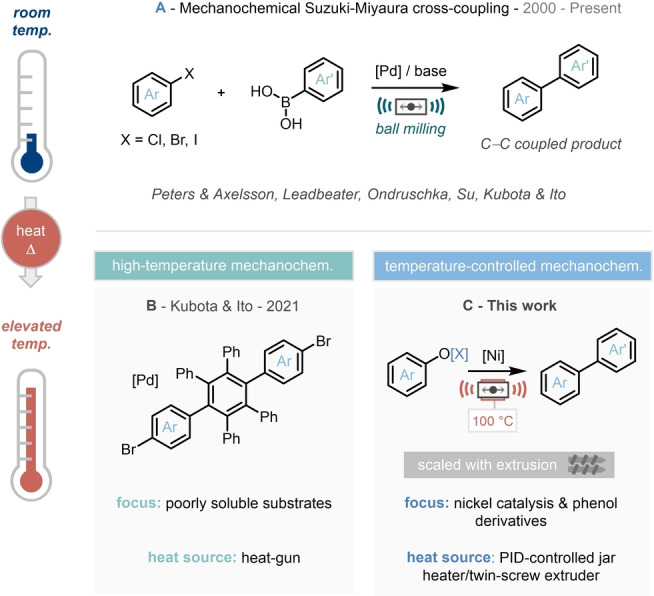
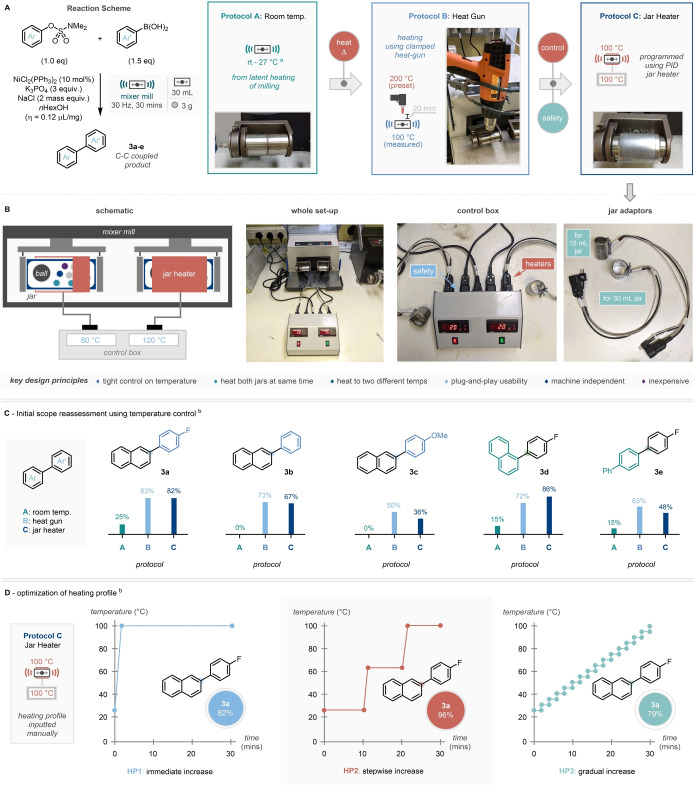
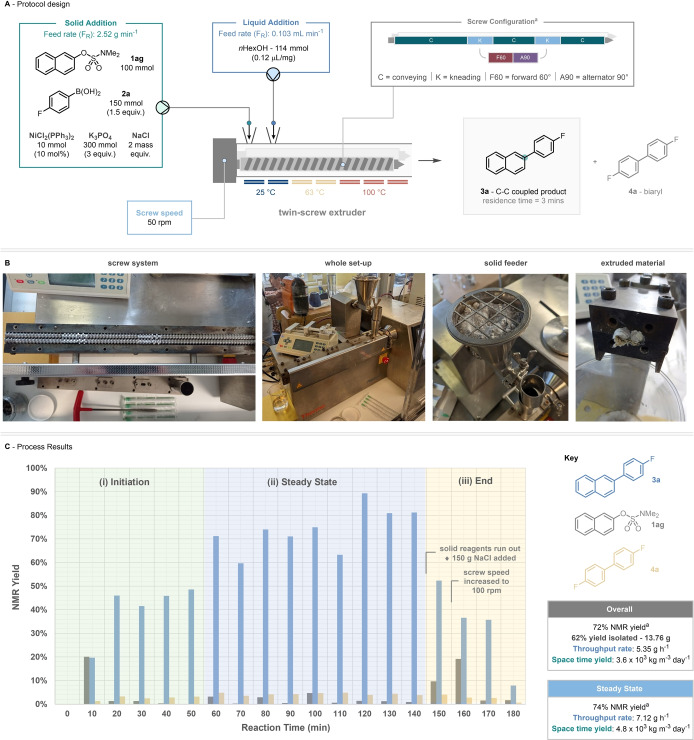
The nickel catalyzed Suzuki-Miyaura-type coupling of aryl sulfamates and boronic acid derivatives enabled by temperature-controlled mechanochemistry via the development of a programmable PID-controlled jar heater is reported. This base-metal-catalyzed, solvent-free, all-under-air protocol was also scaled 200-fold using twin-screw extrusion technology affording decagram quantities of material.
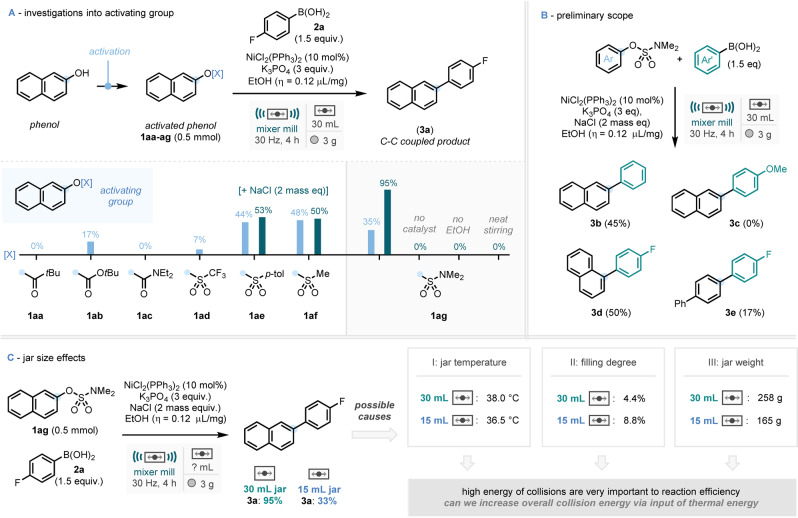
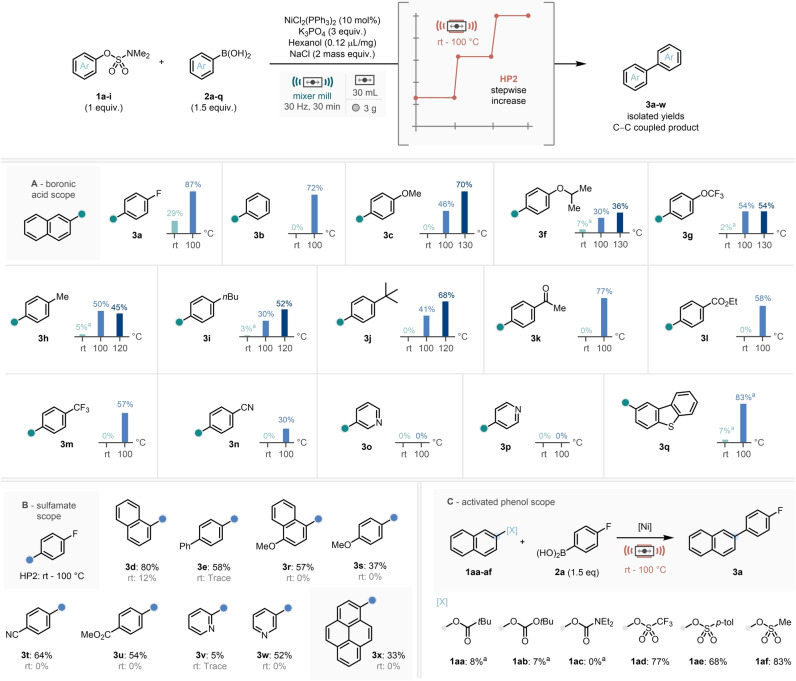
The use of temperature-controlled mechanochemistry to enable the mechanochemical nickel-catalyzed Suzuki-Miyaura coupling is herein described. Transitioning from a capricious room-temperature protocol, through to a heated, PID-controlled programmable jar heater manifold was required to deliver an efficient method for the coupling of aryl sulfamates (derived from ubiquitous phenols) and aryl boronic acid species. Furthermore, this process is conducted using a base-metal nickel catalyst, in the absence of bulk solvent, and in the absence of air/moisture sensitive reaction set-ups. This methodology is showcased through translation to large-scale twin-screw extrusion methodology enabling 200-fold scale increase, producing decagram quantities of C−C coupled material.
Keywords: Cross-Coupling; Mechanochemistry; Nickel Catalysis; Twin-Screw Extrusion.
© 2022 The Authors. Angewandte Chemie International Edition published by Wiley-VCH GmbH.
Conflict of interest statement
The authors declare no conflict of interest.
Figures
References
-
- None
-
- Suzuki A., Angew. Chem. Int. Ed. 2011, 50, 6722–6737; - PubMed
- Angew. Chem. 2011, 123, 6854–6869;
-
- Miyaura N., Suzuki A., Chem. Rev. 1995, 95, 2457–2483.
-
- None
-
- “Suzuki–Miyaura Coupling”: Blakemore D. C. in Synthetic Methods in Drug Discovery, Vol. 1 (Eds.: Blakemore D. C., Doyle P., Fobian Y. M.), Royal Society of Chemistry, London, 2016, chap. 1, pp. 1–69;
Grants and funding
LinkOut - more resources
Full Text Sources
