


COVID-19 vaccine for people who live and work in prisons worldwide: A scoping review
- PMID: 36084037
- PMCID: PMC9462803
- DOI: 10.1371/journal.pone.0267070
COVID-19 vaccine for people who live and work in prisons worldwide: A scoping review
Abstract
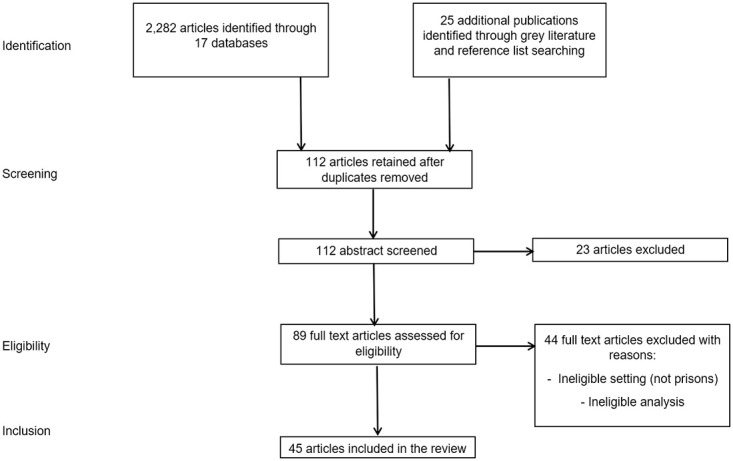
Overcrowding, poor conditions, and high population turnover make prisons highly susceptible to COVID-19. Vaccination is key to controlling COVID-19, yet there is disagreement regarding whether people who live and work in prisons should be prioritised in national vaccination programmes. To help resolve this, we critically examine the extent, nature, and quality of extant literature regarding prioritisation of COVID-19 vaccinations for people who live and work in prisons. Using a scoping review as our methodological framework, we conducted a systematic literature search of 17 databases. From 2,307 potentially eligible articles, we removed duplicates and screened titles and abstracts to retain 45 articles for review and quality appraisal. Findings indicated that while most countries recognise that prisons are at risk of high levels of COVID-19 transmission, only a minority have explicitly prioritised people who live and work in prisons for COVID-19 vaccination. Even among those that have, prioritisation criteria vary considerably. This is set against a backdrop of political barriers, such as politicians questioning the moral deservingness of people in prison; policy barriers, such as the absence of a unified international framework of how vaccine prioritisation should proceed in prisons; logistical barriers regarding vaccine administration in prisons; and behavioural barriers including vaccine hesitancy. We outline five strategies to prioritise people who live and work in prisons in COVID-19 vaccination plans: (1) improving data collection on COVID-19 vaccination, (2) reducing the number of people imprisoned, (3) tackling vaccine populism through advocacy, (4) challenging arbitrary prioritisation processes via legal processes, and (5) conducting more empirical research on COVID-19 vaccination planning, delivery, and acceptability. Implementing these strategies would help to reduce the impact of COVID-19 on the prison population, prevent community transmission, improve vaccine uptake in prisons beyond the current pandemic, foster political accountability, and inform future decision-making.
Conflict of interest statement
The authors have declared that no competing interests exist.
Figures
References
-
- World Health Organization. WHO coronavirus (COVID-19) dashboard 2022. https://covid19.who.int/
-
- Fair H, Walmsley R. World prison population list: thirteenth edition 2021. https://www.prisonstudies.org/sites/default/files/resources/downloads/wo....
Publication types
MeSH terms
Substances
LinkOut - more resources
Full Text Sources
Medical
