


Epidural abscess formation with an atypical pathogen following epidural steroid injection: A case report
- PMID: 36086689
- PMCID: PMC10980402
- DOI: 10.1097/MD.0000000000030495
Epidural abscess formation with an atypical pathogen following epidural steroid injection: A case report
Abstract
Rationale: Subcutaneous and epidural abscesses following epidural injection are a serious but rare complication. Epidural abscesses are typically caused by Staphylococcus aureus bacterial infection. In this case presented here, the causative bacterium was Enterococcus faecalis.
Patient concerns: A 67-year-old woman having chronic lower back and right leg pain with past history of 20 years of rheumatoid arthritis, diabetes mellitus, and osteoporosis (T-score: -2.7) visited the outpatient pain clinic. Magnetic resonance imaging (MRI) revealed L4-5 right central disc extrusion with inferior migration. We performed a continuous epidural block for 7 days without complications. After 10 days, she presented with worsened low back pain, erythematous skin change on the lower back, chilling, and elevated serum acute phase reactants.
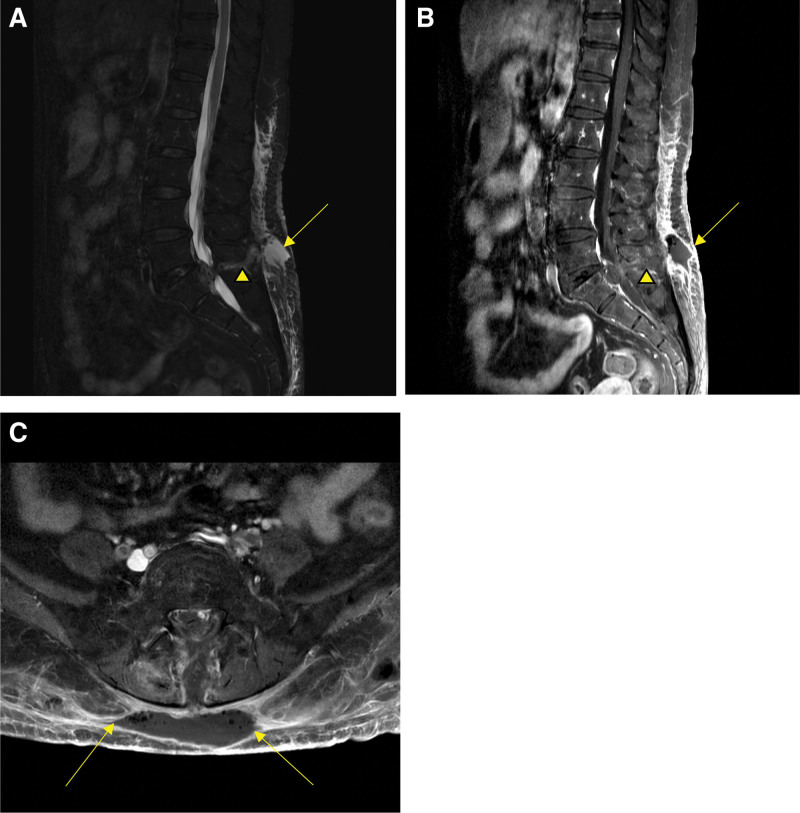
Diagnosis: The diagnosis was subsequently confirmed by MRI suggesting subcutaneous and epidural abscess. Blood and pus cultures showed the growth of E. faecalis.
Interventions: Pigtail catheter drainage was performed and intravenous antibiotics (ampicillin-sulbactam) targeting E. faecalis were applied for 3 weeks. Oral antibiotics (amoxicillin/potassium clavulanate) were applied for 6 weeks after discharge.
Outcomes: At the 2-month follow-up, improvement in both the clinical condition and serum acute phase reactants levels were noted.
Lessons: Epidural injection can lead to a subcutaneous abscess that is further extended into the epidural space. One of the key factors is the presence of comorbid conditions, including diabetes mellitus and prolonged steroid usage due to rheumatoid arthritis.
Copyright © 2022 the Author(s). Published by Wolters Kluwer Health, Inc.
Conflict of interest statement
The authors have no funding or conflicts of interest to disclose.
Figures



References
-
- Sendi P, Bregenzer T, Zimmerli W. Spinal epidural abscess in clinical practice. QJM. 2008;101:1–12. - PubMed
-
- Maitra S, Aftab S, Agarwal A, Vasudevan B. Subcutaneous abscess at epidural catheter insertion site in a patient with intestinal tuberculosis. J Clin Anesth. 2015;27:694. - PubMed
-
- Davenport TE, Terk MR. Subcutaneous abscess in a patient referred to physical therapy following spinal epidural injection for lumbar radiculopathy. J Orthop Sports Phys Ther. 2008;38:287. - PubMed
-
- Schwab JH, Shah AA. Spinal epidural abscess: diagnosis, management, and outcomes. J Am Acad Orthop Surg. 2020;28:e929–38. - PubMed
Publication types
MeSH terms
Substances
LinkOut - more resources
Full Text Sources
Medical
Miscellaneous
