


Pesticide exposure and child growth in low- and middle-income countries: A systematic review
- PMID: 36087771
- PMCID: PMC7614514
- DOI: 10.1016/j.envres.2022.114230
Pesticide exposure and child growth in low- and middle-income countries: A systematic review
Abstract
Background: In low- and middle-income countries (LMICs), pesticides are widely used in agricultural and residential settings. Little is known about how pesticides affect child growth.
Objectives: To systematically review and synthesise the evidence on the associations between pesticide exposure and adverse birth outcomes and/or impaired postnatal growth in children up to 5 years of age in LMICs.
Methods: We searched 10 databases from inception through November 2021. We included cohort and cross-sectional studies investigating associations between self-reported or measured prenatal or postnatal pesticide exposure and child growth (postnatal child linear/ponderal growth, and/or birth outcomes). Two researchers screened studies, extracted data, and assessed certainty using GRADE. The protocol was preregistered with PROSPERO (CRD42021292919).
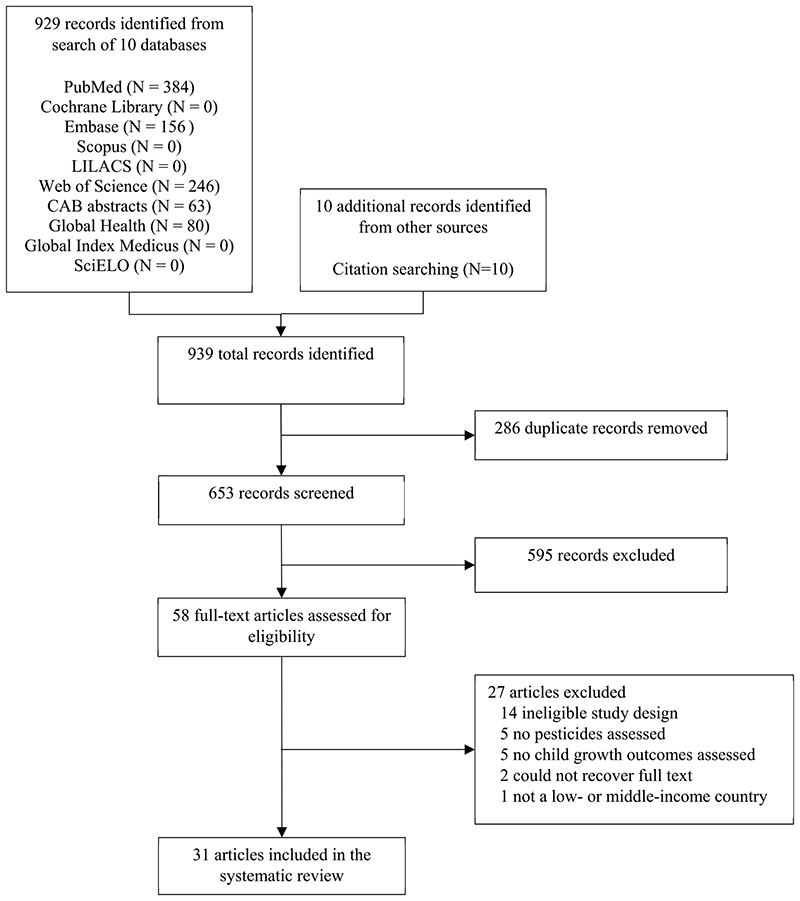
Results: Of 939 records retrieved, 31 studies met inclusion criteria (11 cohort, 20 cross-sectional). All studies assessed prenatal exposure. Twenty-four studies reported on birth weight. Four found positive associations with organochlorines (0.01-0.25 standardised mean difference (SMD)) and two found negative associations (-0.009 SMD to -55 g). Negative associations with organophosphates (-170 g, n = 1) and pyrethroids (-97 to -233 g, n = 2) were also documented. Two (out of 15) studies reporting on birth length found positive associations with organochlorines (0.21-0.25 SMD) and one found negative associations (-0.25 to -0.32 SMD). Organophosphate exposure was negatively associated with birth length (-0.37 cm, n = 1). Organophosphate exposure was also associated with higher risk/prevalence of low birth weight (2 out of nine studies) and preterm birth (2 out of six studies). Certainty of the evidence was "very low" for all outcomes.
Conclusion: The limited literature from LMICs shows inconclusive associations between prenatal pesticide exposure, child growth, and birth outcomes. Studies with accurate quantitative data on exposure to commonly used pesticides in LMICs using consistent methodologies in comparable populations are needed to better understand how pesticides influence child growth.
Keywords: Birth weight; Low birth weight; Organochlorines; Organophosphates; Prenatal exposure; Pyrethroids.
Copyright © 2022 The Author(s). Published by Elsevier Inc. All rights reserved.
Conflict of interest statement
Declaration of competing interest The authors declare that they have no known competing financial interests or personal relationships that could have appeared to influence the work reported in this paper.
Figures
References
-
- Anderson KA, Seck D, Hobbie KA, Traore AN, McCartney MA, Ndaye A, et al. Passive sampling devices enable capacity building and characterization of bioavailable pesticide along the Niger, Senegal and Bani Rivers of Africa. Philos Trans R Soc B Biol Sci. 2014;369:20130110. doi: 10.1098/rstb.2013.0110. - DOI - PMC - PubMed
-
- Asare H, Rosi A, Faber M, Smuts CM, Ricci C. Animal-source foods as a suitable complementary food for improved physical growth in 6 to 24-month-old children in low- and middle-income countries: a systematic review and meta-analysis of randomised controlled trials. Br J Nutr. 2022:1–11. doi: 10.1017/S0007114522000290. - DOI - PubMed
Publication types
MeSH terms
Substances
Grants and funding
LinkOut - more resources
Full Text Sources
Medical
Miscellaneous
