


Socioeconomic impacts on Andean adolescents' growth: Variation between households, between communities and over time
- PMID: 36090675
- PMCID: PMC9454678
- DOI: 10.1093/emph/eoac033
Socioeconomic impacts on Andean adolescents' growth: Variation between households, between communities and over time
Abstract
Background/objectives: We evaluated potential socioeconomic contributors to variation in Andean adolescents' growth between households within a peri-urban community undergoing rapid demographic and economic change, between different community types (rural, peri-urban, urban) and over time. Because growth monitoring is widely used for assessing community needs and progress, we compared the prevalences of stunting, underweight, and overweight estimated by three different growth references.
Methods: Anthropometrics of 101 El Alto, Bolivia, adolescents (Alteños), 11.0-14.9 years old in 2003, were compared between households (economic status assessed by parental occupations); to one urban and two rural samples collected in 1983/1998/1977, respectively; and to the WHO growth reference, a representative sample of Bolivian children (MESA), and a region-wide sample of high-altitude Peruvian children (Puno).
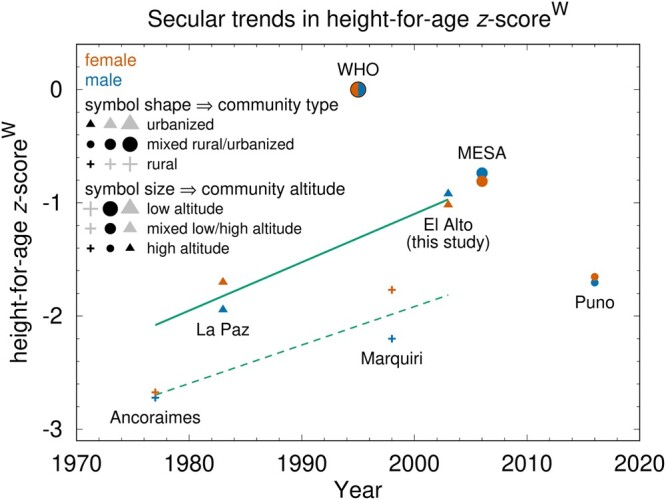
Results: Female Alteños' growth was positively associated with household and maternal income indices. Alteños' height averaged ∼0.8SD/∼0.6SD/∼2SDs greater than adolescents' height in urban and rural communities measured in 1983/1998/1977, respectively. Overweight prevalence was comparable to the WHO, and lower than MESA and Puno, references. Stunting was 8.5/2.5/0.5 times WHO/MESA/Puno samples, respectively.
Conclusions/implications: Both peri-urban conditions and temporal trends contributed to gains in Alteños' growth. Rural out-migration can alleviate migrants' poverty, partly because of more diverse economic options in urbanized communities, especially for women. Nonetheless, Alteños averaged below WHO and MESA height and weight medians. Evolved biological adaptations to environmental challenges, and the consequent variability in growth trajectories, favor using multiple growth references. Growth monitoring should be informed by community- and household-level studies to detect and understand local factors causing or alleviating health disparities.
Keywords: adolescent growth; children's growth references; double burden of malnutrition; health disparities; high-altitude adaptation; secular trend.
© The Author(s) 2022. Published by Oxford University Press on behalf of the Foundation for Evolution, Medicine, and Public Health.
Figures
References
-
- World Bank–UN Population Division. Urban Population (% of Total Population) | Data.2021. https://data.worldbank.org/indicator/SP.URB.TOTL.IN.ZS (31 August 2022, date last accessed).
-
- Mariscal CB, Tassi N, Miranda AR. et al. (eds.). Rural Migration in Bolivia: The Impact of Climate Change, Economic Crisis and State Policy. London: Internat. Inst. for Environment and Development, 2011.
-
- O’Hare G, Rivas S.. Changing poverty distribution in Bolivia: the role of rural-urban migration and urban services. GeoJournal 2007;68:307–26.
-
- Cockx L. Moving towards a Better Future? Migration and Children’s Health and Education. Leuven, Belgium: LICOS Centre for Institutions and Economic Performance, 2019, 67.
-
- Oths KS, Smith HN, Stein MJ. et al. A decade of rapid change: biocultural influences on child growth in highland Peru. Am J Hum Biol 2018;30:e23072. - PubMed
Associated data
LinkOut - more resources
Full Text Sources
Other Literature Sources
