. 2022 Sep;46(5):675-682.
doi: 10.1016/j.jgr.2021.12.009. Epub 2021 Dec 28.

A novel mechanism of Korean Red Ginseng-mediated anti-inflammatory action via targeting caspase-11 non-canonical inflammasome in macrophages

Affiliations

A novel mechanism of Korean Red Ginseng-mediated anti-inflammatory action via targeting caspase-11 non-canonical inflammasome in macrophages

Ji-Hyun Min et al. J Ginseng Res. 2022 Sep.

Abstract

Background: Korean Red Ginseng (KRG) was reported to play an anti-inflammatory role, however, previous studies largely focused on the effects of KRG on priming step, the inflammation-preparing step, and the anti-inflammatory effect of KRG on triggering, the inflammation-activating step has been poorly understood. This study demonstrated anti-inflammatory role of KRG in caspase-11 non-canonical inflammasome activation in macrophages during triggering of inflammatory responses.

Methods: Caspase-11 non-canonical inflammasome-activated J774A.1 macrophages were established by priming with Pam3CSK4 and triggering with lipopolysaccharide (LPS). Cell viability and pyroptosis were examined by MTT and lactate dehydrogenase (LDH) assays. Nitric oxide (NO)-inhibitory effect of KRG was assessed using a NO production assay. Expression and proteolytic cleavage of proteins were examined by Western blotting analysis. In vivo anti-inflammatory action of KRG was evaluated with the LPS-injected sepsis model in mice.

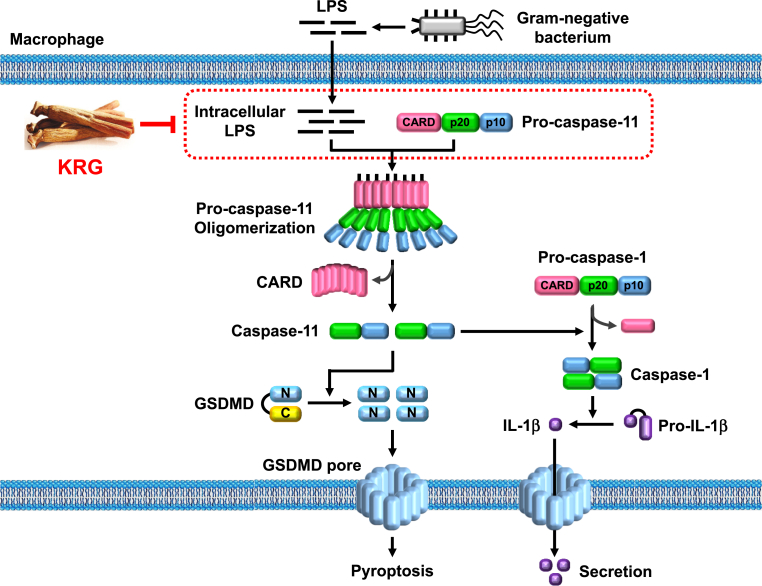
Results: KRG reduced LPS-stimulated NO production in J774A.1 cells and suppressed pyroptosis and IL-1β secretion in caspase-11 non-canonical inflammasome-activated J774A.1 cells. Mechanistic studies demonstrated that KRG suppressed the direct interaction between LPS and caspase-11 and inhibited proteolytic processing of both caspase-11 and gasdermin D in caspase-11 non-canonical inflammasome-activated J774A.1 cells. Furthermore, KRG significantly ameliorated LPS-mediated lethal septic shock in mice.

Conclusion: The results demonstrate a novel mechanism of KRG-mediated anti-inflammatory action that operates through targeting the caspase-11 non-canonical inflammasome at triggering step of macrophage-mediated inflammatory response.

Keywords: Caspase-11; Inflammation; KRG; Macrophage; Non-canonical inflammasome.


Conflict of interest statement

The author declares no conflict of interest.

Figures

Image 1
Graphical abstract
Fig. 1
Fig. 1
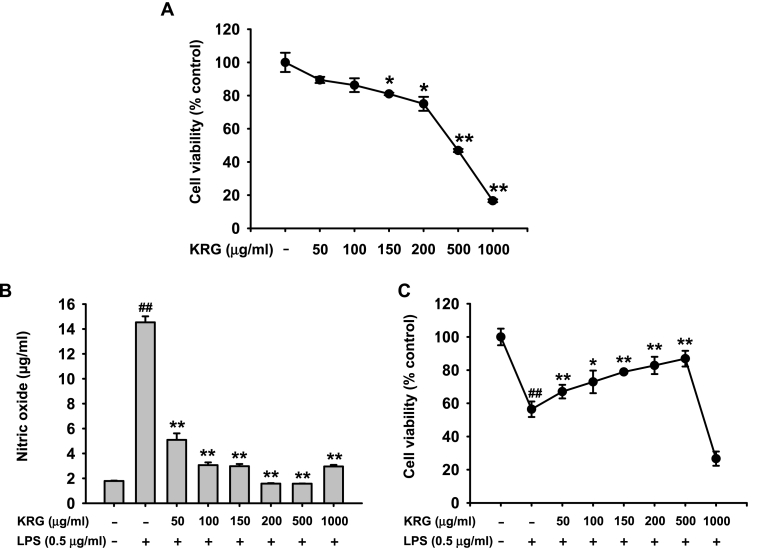
Inhibitory effect of KRG on NO production in J774A.1 cells. (A) J774A.1 cells were treated with KRG (0–1000 μg/mL) for 24 h, and the cell viability was determined by a MTT assay. J774A.1 cells pre-treated with KRG (0–1000 μg/mL) for 30 min were then treated with LPS (0.5 μg/mL) for 24 h. (B) The NO levels in culture medium were determined by a Griess assay, and (C) the cell viability was determined by a MTT assay. n = 3 independent experiments. ∗P < 0.05, ∗∗P < 0.01 compared to the vehicle-treated control in (A). ##P < 0.01 compared to the vehicle-treated control, and ∗P < 0.05, ∗∗P < 0.01 compared to the stimulator-treated controls (B–C).
Fig. 2
Fig. 2
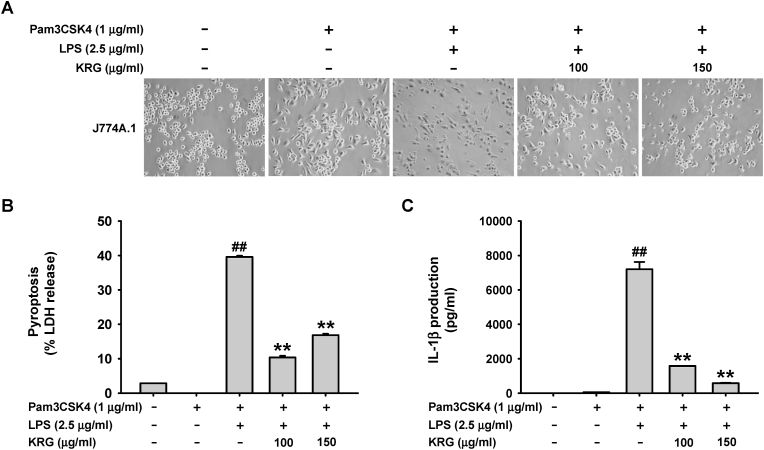
Inhibitory effect of KRG on caspase-11 non-canonical inflammasome activation in J774A.1 cells. J774A.1 cells pre-treated with KRG (100 and 150 μg/mL) for 30 min were treated with Pam3CSK4 (1 μg/mL) for 4 h and transfected with LPS (2.5 μg/mL) for 18 h. (A) Cell shapes were observed by a light microscope (magnification: 100 × ) and photographed with a digital camera. (B) Pyroptotic cell death was determined based on LDH release in culture medium. (C) IL-1β levels in culture medium were determined by an ELISA. n = 3 independent experiments. ##P < 0.01 compared to the vehicle-treated control, and ∗∗P < 0.01 compared to the stimulator-treated controls.
Fig. 3
Fig. 3
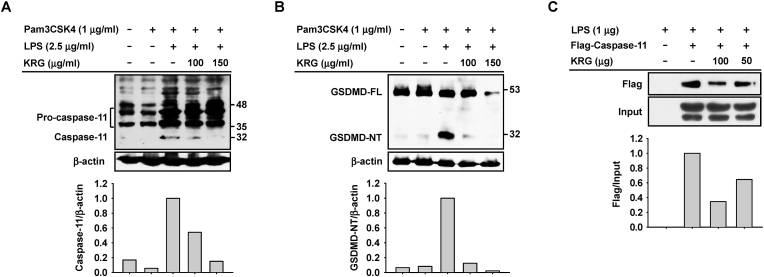
Mechanism of KRG-mediated inhibition of caspase-11 non-canonical inflammasome activation in J774A.1 cells. J774A.1 cells pre-treated with KRG (100 and 150 μg/mL) for 30 min were treated with Pam3CSK4 (1 μg/mL) for 4 h and transfected with LPS (2.5 μg/mL) for 18 h. (A) Pro-caspase-11 and caspase-11 and (B) GSDMD-FL and GSDMD-NT in whole cell lysates were detected by western blotting. (C) The whole lysates of the HEK293 cells transfected with empty or PCMV-flag-caspase-11 plasmids were incubated with LPS (1 μg) in the presence or absence of KRG (50 and 100 μg), and LPS-bound caspase-11 was detected through western blotting.
Fig. 4
Fig. 4
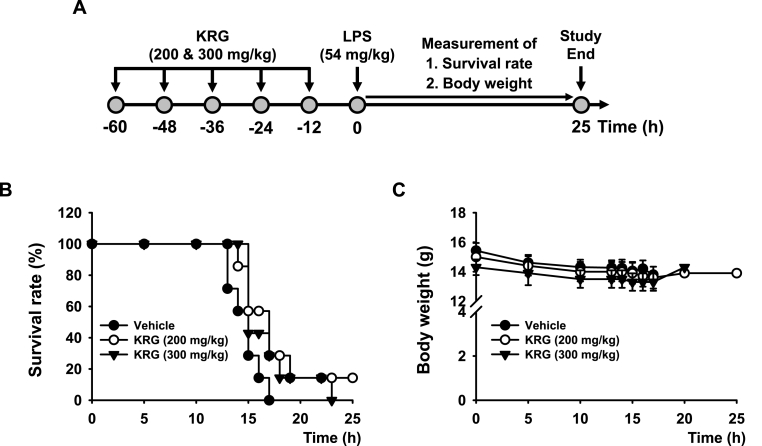
In vivo protective effect of KRG on lethal sepsis in mice. (A) Schematic summary of the experimental schedule. (B) Kaplan–Meier survival plots for the LPS (54 mg/kg)-challenged lethal sepsis mice administered KRG (200 and 300 mg/kg). (C) Body weight of the LPS (54 mg/kg)-challenged lethal sepsis mice administered KRG (200 and 300 mg/kg). n = 7 mice per group.
Fig. 5
Fig. 5
Schematic summary of the novel KRG-mediated anti-inflammatory action via targeting caspase-11 non-canonical inflammasome in macrophages.

References

    1. Janeway C.A., Jr., Medzhitov R. Innate immune recognition. Annu Rev Immunol. 2002;20:197–216. - PubMed
    1. Li D., Wu M. Pattern recognition receptors in health and diseases. Signal Transduct Target Ther. 2021;6:291. - PMC - PubMed
    1. McKernan D.P. Pattern recognition receptors as potential drug targets in inflammatory disorders. Adv Protein Chem Struct Biol. 2020;119:65–109. - PubMed
    1. Yi Young-Su. Syk-MyD88 Axis Is a Critical Determinant of Inflammatory-Response in Activated Macrophages. 2021 doi: 10.3389/fimmu.2021.767366. - DOI - PMC - PubMed
    1. Kelley N., Jeltema D., Duan Y., He Y. The NLRP3 inflammasome: an overview of mechanisms of activation and regulation. Int J Mol Sci. 2019;20 - PMC - PubMed

LinkOut - more resources