Are Kenyans Likely to Use COVID-19 Self-Testing Kits? Results From a Cross-Sectional Survey
- PMID: 36090834
- PMCID: PMC9459853
- DOI: 10.3389/ijph.2022.1604918
Are Kenyans Likely to Use COVID-19 Self-Testing Kits? Results From a Cross-Sectional Survey
Abstract
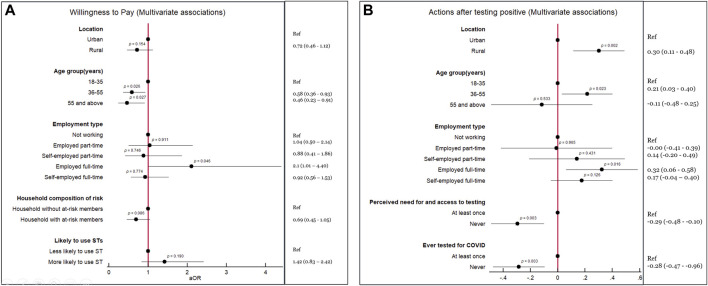
Objectives: To understand the public's perceptions around rapid SARS-CoV-2 antigen self-testing in Kenya, including the drivers of acceptability, willingness to pay, and adherence to hygiene and prevention recommendations following a positive self-test. Methods: A household-based, cross-sectional survey, using a 35-item questionnaire, was conducted in Mombasa and Taita-Taveta counties, Kenya, during August 2021. Individuals aged ≥18 years were enrolled using a stratified sampling approach. Results: There were 419 participants (mean age 35.7 years). A minority (10.5%) had ever tested for SARS-CoV-2. If SARS-CoV-2 self-testing were available, 39.9% and 41.5% would be likely and very likely, respectively, to use it. If unavailable free-of-charge, 63.01% would pay for it. Multivariate analyses suggested that people in rural areas (Coefficient 0.30, 95%CI: 0.11-0.48, p = 0.002), aged 36-55 (Coefficient 0.21, 95%CI: 0.03-0.40, p = 0.023), and employed full time (Coefficient 0.32, 95%CI: 0.06-0.58, p = 0.016) would have more odds to adhere to recommended hygiene and prevention actions. Conclusion: SARS-CoV-2 self-testing was considered acceptable. Availability of self-testing could expand access to COVID-19 testing in Kenya, particularly among rural communities who have limited access to testing, and among mildly symptomatic individuals.
Keywords: COVID-19; Kenya; SARS-CoV-2 testing; home diagnostics; self-testing; survey.
Copyright © 2022 Manguro, Shilton, Omenda, Owira, Batheja, Banerji, Chabeda, Temmerman, Jako, Ndungu, Luchters, Ivanova Reipold and Martínez-Pérez.
Conflict of interest statement
The authors declare that the research was conducted in the absence of any commercial or financial relationships that could be construed as a potential conflict of interest.
Figures

References
-
- Liu YC, Kuo RL, Shih SR. COVID-19: The First Documented Coronavirus Pandemic in History. Biomed J (2020) 43(4):328–33. 10.1016/j.bj.2020.04.007 PubMed Abstract | 10.1016/j.bj.2020.04.007 | Google Scholar - DOI - DOI - PMC - PubMed
-
- Wangari EN, Gichuki P, Abuor AA, Wambui J, Okeyo SO, Oyatsi HTN, et al. Kenya's Response to the COVID-19 Pandemic: A Balance between Minimising Morbidity and Adverse Economic Impact. AAS Open Res (2021) 4:3. 10.12688/aasopenres.13156.2 PubMed Abstract | 10.12688/aasopenres.13156.2 | Google Scholar - DOI - DOI - PMC - PubMed
-
- Archibong V, Usman IM, Kasozi KI, Aigbogun EO, Josiah I, Monima AL, et al. Anxiety, Anger and Depression Amongst Low-Income Earners in Southwestern Uganda during the COVID-19 Total Lockdown. Front Public Health (2021) 9:590458. 10.3389/fpubh.2021.590458 PubMed Abstract | 10.3389/fpubh.2021.590458 | Google Scholar - DOI - DOI - PMC - PubMed
-
- Nuwematsiko R, Nabiryo M, Bomboka JB, Nalinya S, Musoke D, Okello D, et al. Unintended Socio-Economic and Health Consequences of COVID-19 Among Slum Dwellers in Kampala, Uganda. BMC Public Health (2022) 22(1):88. 10.1186/s12889-021-12453-6 PubMed Abstract | 10.1186/s12889-021-12453-6 | Google Scholar - DOI - DOI - PMC - PubMed
-
- Nshimyiryo A, Barnhart DA, Cubaka VK, Dusengimana JMV, Dusabeyezu S, Ndagijimana D, et al. Barriers and Coping Mechanisms to Accessing Healthcare during the COVID-19 Lockdown: A Cross-Sectional Survey Among Patients with Chronic Diseases in Rural Rwanda. BMC Public Health (2021) 21(1):704. 10.1186/s12889-021-10783-z PubMed Abstract | 10.1186/s12889-021-10783-z | Google Scholar - DOI - DOI - PMC - PubMed
MeSH terms
LinkOut - more resources
Full Text Sources
Medical
Miscellaneous