


HIV pre-exposure prophylaxis during the SARS-CoV-2 pandemic: Results from a prospective observational study in Germany
- PMID: 36091531
- PMCID: PMC9449641
- DOI: 10.3389/fpubh.2022.930208
HIV pre-exposure prophylaxis during the SARS-CoV-2 pandemic: Results from a prospective observational study in Germany
Abstract
Aims: Since 2017, HIV pre-exposure prophylaxis (PrEP) care has been provided through an intersectoral collaboration at WIR (Walk-in-Ruhr, Center for Sexual Health and Medicine, Bochum, Germany). The aim of this study was to establish possible impact of COVID-restrictions on the sexual behavior of PrEP users in North Rhine-Westphalia.
Methods: The current PrEP study collected data of individuals using PrEP, their sexual behavior and sexually transmitted infections (STIs) before (each quarter of year 2018) and during the COVID-19 pandemic (each quarter of year 2020).
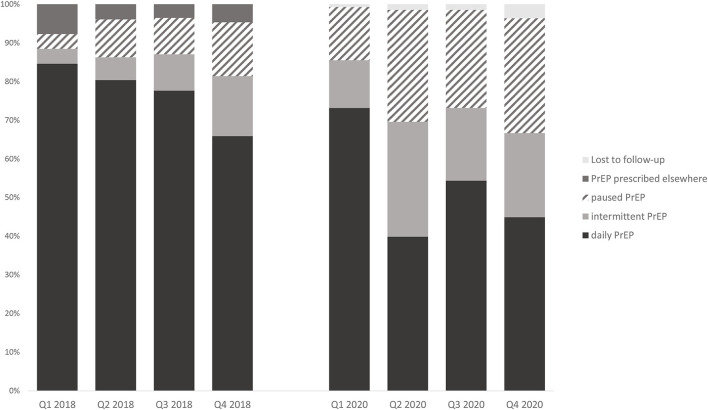
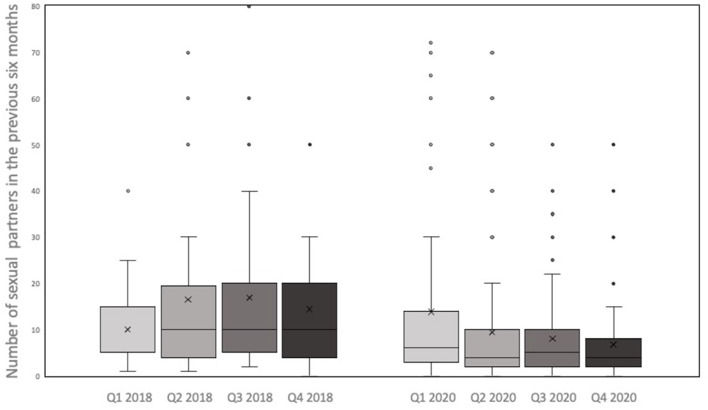
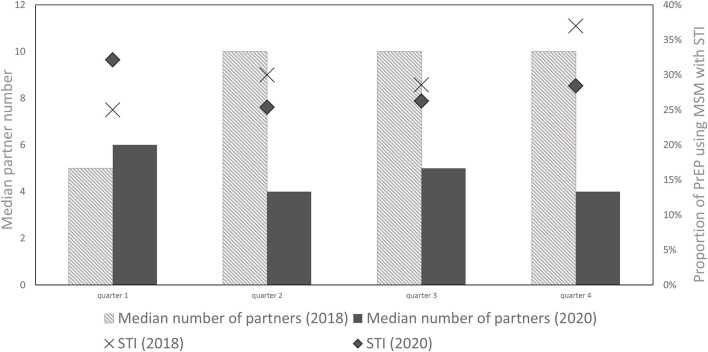
Results: During the first lockdown in Germany from mid-March until May 2020, PrEP-care appointments at WIR were postponed or canceled. Almost a third of PrEP users had discontinued their PrEP intake in the 2nd quarter of 2020 due to alteration of their sexual behavior. The number of sexual partners decreased from a median of 14 partners in the previous 6 months in 1st quarter of 2020, to 7 partners in 4th quarter of 2020. Despite such a significant reduction in partner number during the pandemic in comparison to the pre-pandemic period, a steady rate of STIs was observed among PrEP users in 2020.
Conclusion: The SARS-CoV-2-pandemic has impacted PrEP-using MSM in North Rhine-Westphalia with respect to their PrEP intake regimen and sexual behavior in 2020. Our study revealed a steady rate of STI among PrEP users even during the pandemic, thus highlighting the importance of ensuring appropriate HIV/STI prevention services in times of crisis.
Keywords: Chemsex drugs; HIV; MSM; SARS-CoV-2; pandemic (COVID-19); pre-exposure prophylaxis; sexual behavior; sexual transmission infection.
Copyright © 2022 Uhrmacher, Skaletz-Rorowski, Nambiar, Schmidt, Ahaus, Serova, Mordhorst, Kayser, Wach, Tiemann, Münstermann, Brockmeyer and Potthoff.
Conflict of interest statement
The authors declare that the research was conducted in the absence of any commercial or financial relationships that could be construed as a potential conflict of interest.
Figures
References
-
- Robert Koch Institute . Epidemiologisches Bulletin 31/2021 (2021). p. 19.
-
- Robert Koch Institute . Epidemiologisches Bulletin 47/2021 (2021). p. 28.
-
- Federal Ministry of Health. Strategy of HIV/HEP/STI. (2016). Available online at: https://www.bundesgesundheitsministerium.de/fileadmin/Dateien/5_Publikat... (accessed March 24, 2022).
-
- Grulich AE, Guy R, Amin J, Fengyi J, Selvey C, Holden J, et al. . Population-level effectiveness of rapid, targeted, high-coverage roll-out of HIV pre-exposure prophylaxis in men who have sex with men: the EPIC-NSW prospective cohort study. Lancet HIV. (2018) 5:e629–37. 10.1016/S2352-3018(18)30215-7 - DOI - PubMed
Publication types
MeSH terms
LinkOut - more resources
Full Text Sources
Medical
Miscellaneous
