Pyridine-Based NNS Tridentate Chitosan Thiosemicarbazones and Their Copper(II) Complexes: Synthesis, Characterization, and Anticancer Activity
- PMID: 36092560
- PMCID: PMC9453788
- DOI: 10.1021/acsomega.2c02966
Pyridine-Based NNS Tridentate Chitosan Thiosemicarbazones and Their Copper(II) Complexes: Synthesis, Characterization, and Anticancer Activity
Abstract
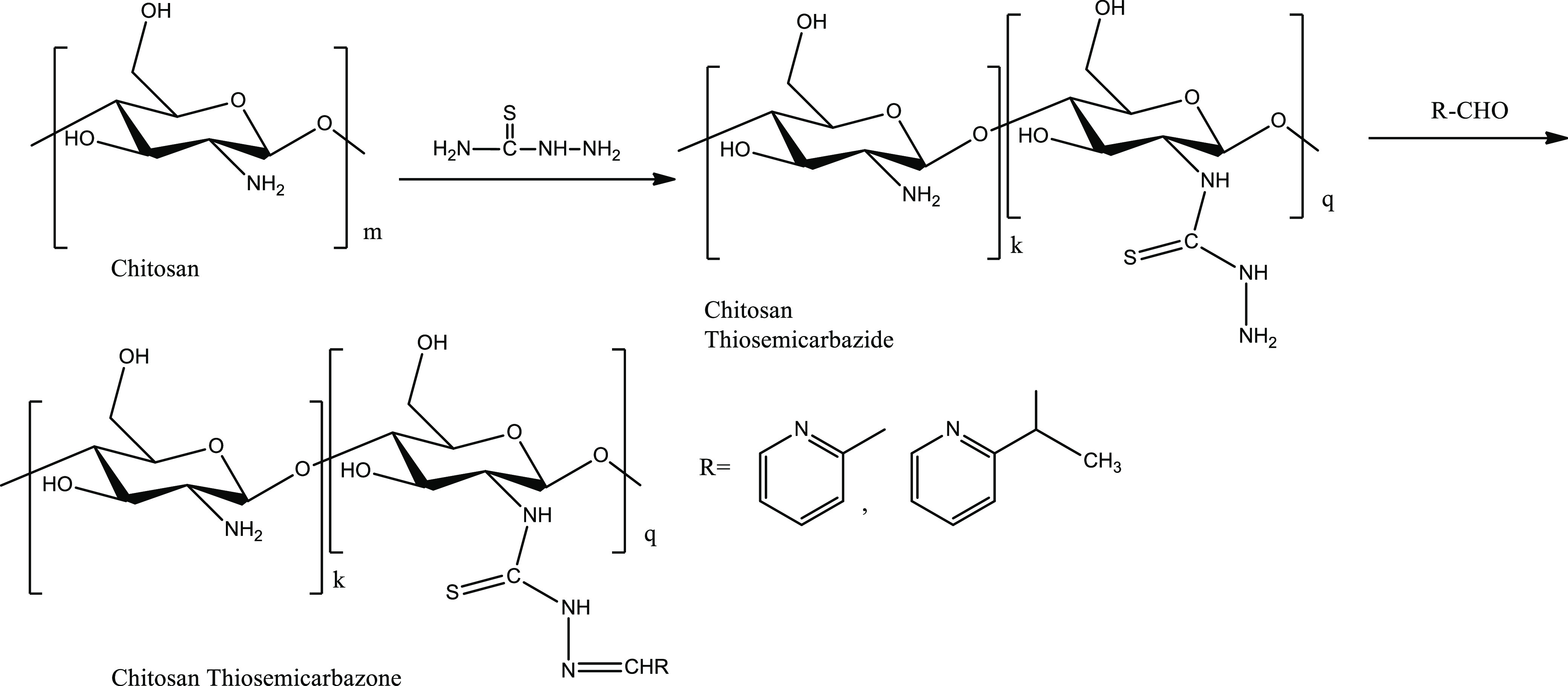
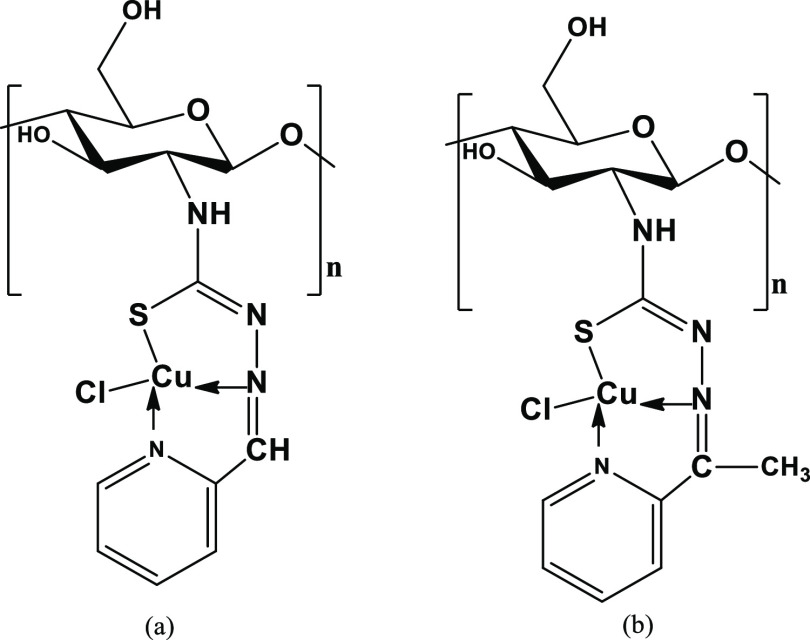
Chitosan-functionalized pyridine-based thiosemicarbazones and their copper(II) complexes have been found to own a substantial antiproliferative activity against the tumorigenic Madin Darby canine kidney (MDCK) and MCF-7 cancer cell lines. In the current study, chitosan oligosaccharide (CS) (87% DDA, Mw < 3000 Da) and crab shell chitosan (CCS) (67% DDA, M w 350 kDa) were functionalized as chitosan pyridine-2-thiosemicarbazones and chitosan 2-acetyl pyridine-2-thiosemicarbazones, and their copper(II) complexes were synthesized. The formation of chitosan thiosemicarbazones and their NNS tridentate behavior to give the square planar copper(II) chitosan thiosemicarbazone complexes were established by spectroscopic studies, powder X-ray diffraction, elemental analysis, and magnetic moment measurements. The thermal study showed a marked stability of these derivatives before the outset of chitosan backbone degradation at 200 °C. The colorimetric MTT assay revealed a higher activity of CS thiosemicarbazones, viz., CSTSC series (IC50 375-381 μg mL-1 in the MDCK cell line and 281-355 μg mL-1 in the MCF-7 cell line) than that of high-molecular-weight CCS thiosemicarbazones, viz., CCSTSC series (IC50 335-400 μg mL-1 in the MDCK cell line and 365-400 μg mL-1 in the MCF-7 cell line), showing an enhanced activity with a decrease in Mw and an increase in DDA of constituent chitosan, a higher activity of both of these series of thiosemicarbazones than that of their native chitosan, viz., CS (IC50 370 μg mL-1 in the MCF-7 cell line and >400 μg mL-1 in the MDCK cell line) and CCS (IC50 > 400 μg mL-1 in both cell lines), and a higher activity of the Cu-CSTSC complexes (IC50 322-342 μg mL-1 in the MDCK cell line and 278-352 μg mL-1 in the MCF-7 cell line) and Cu-CCSTSC complexes (IC50 274-400 μg mL-1 in the MDCK cell line and 231-352 μg mL-1 in the MCF-7 cell line) than that of their respective ligands.
© 2022 The Authors. Published by American Chemical Society.
Conflict of interest statement
The authors declare no competing financial interest.
Figures
References
-
- Wimardhani Y. S.; Suniarti D. F.; Freisleben H. J.; Wanandi S. I.; Ikeda M. A. Cytotoxic effects of chitosan against oral cancer cell lines is molecular-weight-dependent and cell type-specific. Int. J. Oral Res. 2012, 3, 1–10.
-
- Gavhane Y. N.; Gurav A. S.; Yadav A. V. Chitosan and Its Applications: A Review of Literature. Int. J. Res. Pharm. Biomed. Sci. 2013, 4, 312–331.
LinkOut - more resources
Full Text Sources