Review
. 2022 Aug 26:10:941750.
doi: 10.3389/fcell.2022.941750. eCollection 2022.

Current status and perspective of tumor immunotherapy for head and neck squamous cell carcinoma

Affiliations
Review

Current status and perspective of tumor immunotherapy for head and neck squamous cell carcinoma

Chenhang Yu et al. Front Cell Dev Biol. .

Abstract

Head and neck squamous cell carcinoma (HNSCC) have a high incidence and mortality rate, and investigating the pathogenesis and potential therapeutic strategies of HNSCC is required for further progress. Immunotherapy is a considerable therapeutic strategy for HNSCC due to its potential to produce a broad and long-lasting antitumor response. However, immune escape, which involves mechanisms including dyregulation of cytokines, perturbation of immune checkpoints, and recruitment of inhibitory cell populations, limit the efficacy of immunotherapy. Currently, multiple immunotherapy strategies for HNSCC have been exploited, including immune checkpoint inhibitors, costimulatory agonists, antigenic vaccines, oncolytic virus therapy, adoptive T cell transfer (ACT), and epidermal growth factor receptor (EGFR)-targeted therapy. Each of these strategies has unique advantages, and the appropriate application of these immunotherapies in HNSCC treatment has significant value for patients. Therefore, this review comprehensively summarizes the mechanisms of immune escape and the characteristics of different immunotherapy strategies in HNSCC to provide a foundation and consideration for the clinical treatment of HNSCC.

Keywords: head and neck cancer; immune escape; immunotherapy; oral squamous cell carcinoma; squamous cell carcinoma.


Conflict of interest statement

The authors declare that the research was conducted in the absence of any commercial or financial relationships that could be construed as a potential conflict of interest.

Figures
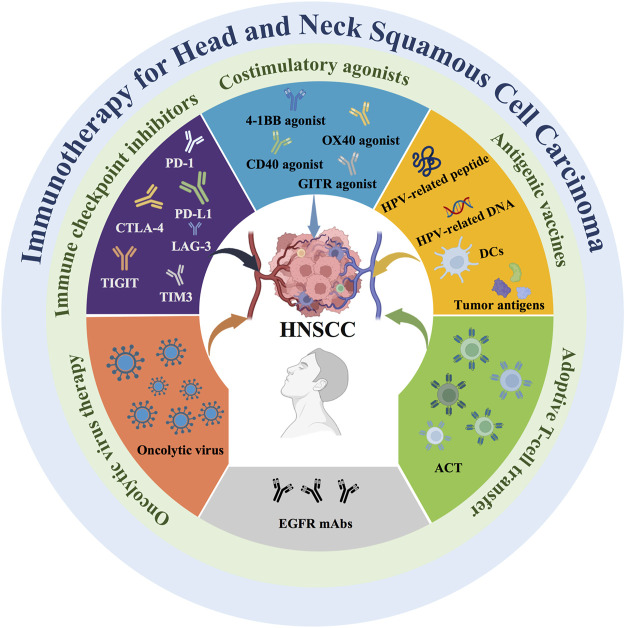
FIGURE 1
FIGURE 1
Current immunotherapy strategies for HNSCC. Current immunotherapies for HNSCC include immune checkpoint inhibitors, costimulatory agonists, antigenic vaccines, oncolytic virus therapy, adoptive T cell transfer (ACT), and epidermal growth factor receptor (EGFR)-targeted monoclonal antibodies (mAbs).
FIGURE 2
FIGURE 2
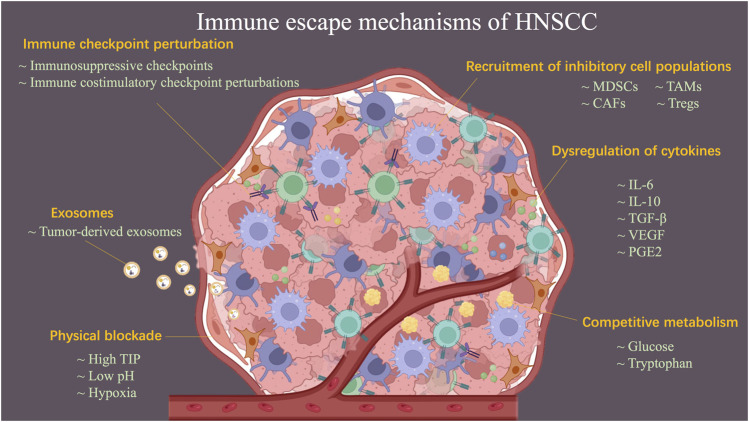
Schematic diagram describing the mechanisms of HNSCC-evaded immunity. Immune escape mechanisms, including physical blockade, dysregulation of cytokines, perturbation of immune checkpoint, recruitment of inhibitory cell populations, negative influences of exosomes, and competitive metabolism of tumor cells, result in HNSCC becoming a refractory tumor.
FIGURE 3
FIGURE 3
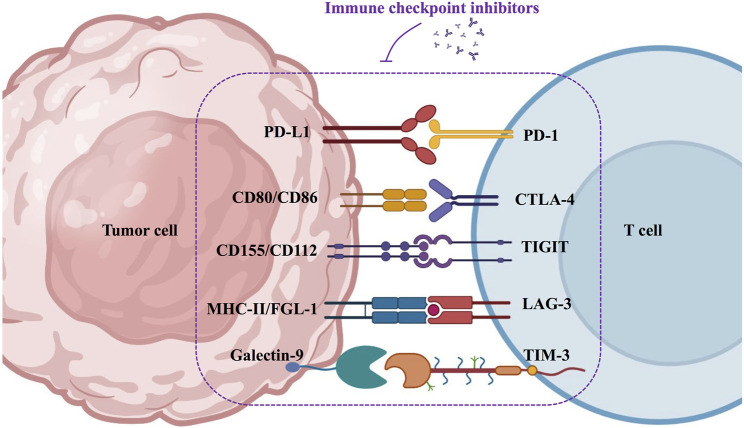
Schematic diagram of immune checkpoint inhibitors in immunotherapy for HNSCC.
FIGURE 4
FIGURE 4
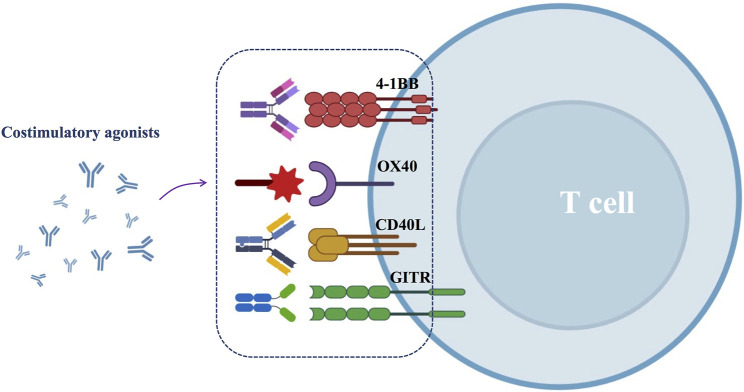
Schematic diagram of costimulatory agonists for HNSCC.
FIGURE 5
FIGURE 5
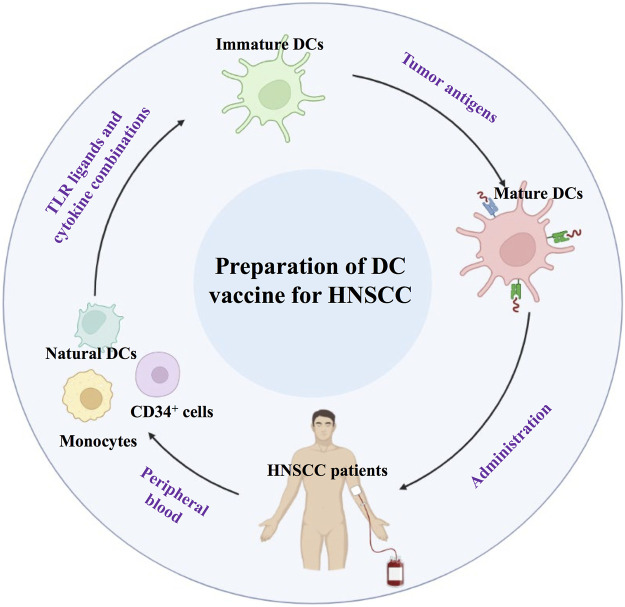
Schematic diagram of applying DC-based vaccination in HNSCC.
FIGURE 6
FIGURE 6
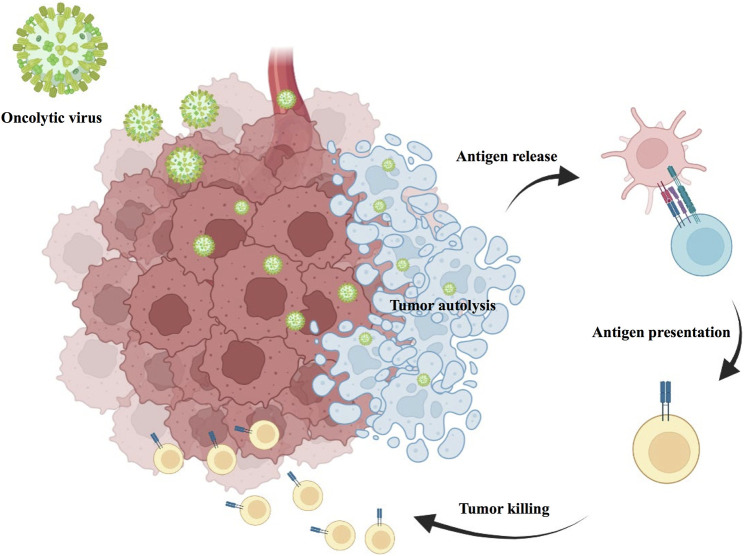
Immunomodulatory mechanisms of oncolytic viral therapy.
FIGURE 7
FIGURE 7
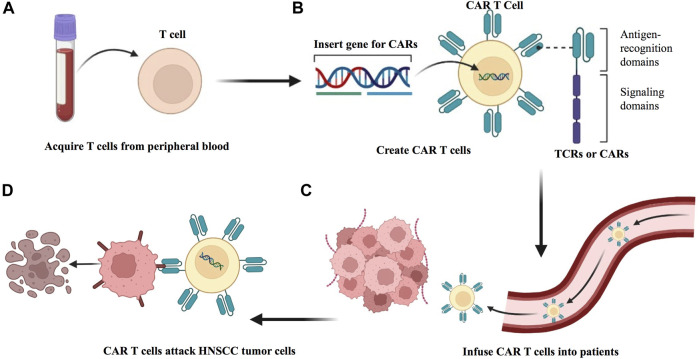
Preparation of ACT to treat HNSCC. (A) Adoptive transfer of antitumor T cells isolated from within the HNSCC tumor of the patient. (B) Tumor-infiltrating T cells (TILs) are extracted from surgically resected tumor samples and then expanded in vitro, followed by reinfusion into HNSCC patients. (C) T cells from patient peripheral blood are isolated and expanded in culture and genetically modified to express either a T cell receptor (TCR) or a chimeric antigen receptor (CAR). (D) The modified T cell confers the ability to specifically recognize and killing HNSCC tumor cells.

References

    1. Aggarwal C., Cohen R. B., Morrow M. P., Kraynyak K. A., Sylvester A. J., Knoblock D. M., et al. (2019). Immunotherapy targeting HPV16/18 generates potent immune responses in HPV-associated head and neck cancer. Clin. Cancer Res. 25 (1), 110–124. 10.1158/1078-0432.CCR-18-1763 - DOI - PMC - PubMed
    1. Aggarwal C., Saba N., Algazi A., Sukari A., Seiwert T., Haigentz M., et al. (2020). 916MO Safety and efficacy of MEDI0457 plus durvalumab in patients (pts) with human papillomavirus-associated recurrent/metastatic head and neck squamous cell carcinoma (HPV+ R/M HNSCC). Ann. Oncol. 31, S661–S662. 10.1016/j.annonc.2020.08.1031 - DOI - PMC - PubMed
    1. Agulnik M. (2012). New approaches to EGFR inhibition for locally advanced or metastatic squamous cell carcinoma of the head and neck (SCCHN). Med. Oncol. 29 (4), 2481–2491. 10.1007/s12032-012-0159-2 - DOI - PMC - PubMed
    1. Ahn S.-H., Song S., Kim S. (2020). Adjuvant postoperative CD40 agonist and PD-1 antagonist combination therapy in syngeneic tongue cancer mouse model. Anticancer Res. 40 (5), 2707–2713. 10.21873/anticanres.14242 - DOI - PubMed
    1. Ambade A., Mulherkar R. (2008). Adoptive T cell transfer augments IL-2 mediated tumour regression in a HNSCC xenograft nude mouse model. Cancer Lett. 272 (2), 316–324. 10.1016/j.canlet.2008.07.023 - DOI - PubMed