Review
. 2022 Jul 21;13(32):9128-9146.
doi: 10.1039/d2sc01806c. eCollection 2022 Aug 17.

Enzyme-powered micro- and nano-motors: key parameters for an application-oriented design

Affiliations
Review

Enzyme-powered micro- and nano-motors: key parameters for an application-oriented design

Xavier Arqué et al. Chem Sci. .

Erratum in

Abstract

Nature has inspired the creation of artificial micro- and nanomotors that self-propel converting chemical energy into mechanical action. These tiny machines have appeared as promising biomedical tools for treatment and diagnosis and have also been used for environmental, antimicrobial or sensing applications. Among the possible catalytic engines, enzymes have emerged as an alternative to inorganic catalysts due to their biocompatibility and the variety and bioavailability of fuels. Although the field of enzyme-powered micro- and nano-motors has a trajectory of more than a decade, a comprehensive framework on how to rationally design, control and optimize their motion is still missing. With this purpose, herein we performed a thorough bibliographic study on the key parameters governing the propulsion of these enzyme-powered devices, namely the chassis shape, the material composition, the motor size, the enzyme type, the method used to incorporate enzymes, the distribution of the product released, the motion mechanism, the motion media and the technique used for motion detection. In conclusion, from the library of options that each parameter offers there needs to be a rational selection and intelligent design of enzymatic motors based on the specific application envisioned.


Conflict of interest statement

There are no conflicts to declare.

Figures
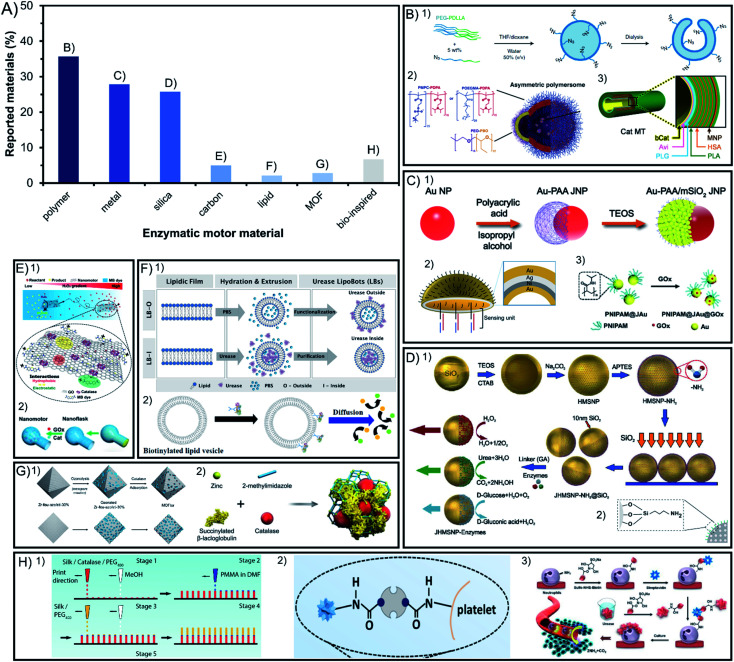
Fig. 1
Fig. 1. Chassis materials of enzyme-powered micro- and nano-motors. (A) Representation of each chassis material in the publications of the field. Examples of enzymatic motors made of (B) polymers, (C) metals, (D) silica, (E) carbon, (F) lipid vesicles, (G) MOFs and (H) bio-inspired materials. Panel (B) adapted with permission from (1) ref. Copyright 2019 Springer Nature, (2) ref. Copyright 2017 AAAS, and (3) ref. Copyright 2021 Royal Society of Chemistry. Panel (C) adapted with permission from (1) ref. Copyright 2021 American Chemical Society, (2) ref. Copyright 2019 American Chemical Society, and (3) ref. Copyright 2019 Wiley. Panel (D) adapted with permission from (1) ref. Copyright 2015 American Chemical Society and (2) ref. Copyright 2021 AAAS. Panel (E) adapted with permission from (1) ref. Copyright 2021 Wiley and (2) ref. Copyright 2019 American Chemical Society. Panel (F) adapted with permission from (1) ref. Copyright 2020 Wiley and (2) ref. Copyright 2019 American Chemical Society. Panel (G) adapted with permission from (1) ref. Copyright 2020 American Chemical Society and (2) ref. Copyright 2019 Wiley. Panel (H) adapted with permission from (1) ref. Copyright 2016 Wiley, (2) ref. Copyright 2020 AAAS, and (3) ref. Copyright 2022 American Chemical Society.
Fig. 2
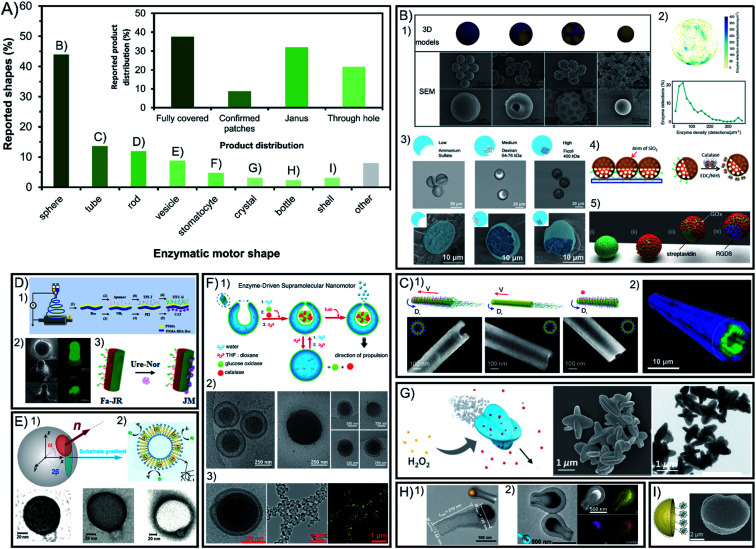
Fig. 2. Chassis shape and product release distribution of enzyme-powered micro- and nano-motors. (A) Representation of each chassis shape in the publications of the field. Inset: representation of each configuration of product release in the publications of the field. Examples of enzymatic motors with shapes of (B) spheres, (C) tubes, (D) rods, (E) vesicles, (F) stomatocytes, (G) crystals, (H) bottles and (I) shells. Panel (B) adapted with permission from (1) ref. Copyright 2019 Elsevier, (2) ref. Copyright 2018 American Chemical Society, (3) ref. Copyright 2019 Wiley, (4) ref. Copyright 2017 Elsevier and (5) ref. Copyright 2017 Royal Society of Chemistry. Panel (C) adapted with permission from (1) ref. Copyright 2016 American Chemical Society and (2) ref. Copyright 2016 Wiley. Panel (D) adapted with permission from (1) ref. Copyright 2020 Elsevier, (2) ref. Copyright 2016 Wiley, and (3) ref. Copyright 2021 Elsevier. Panel (E) adapted with permission from (1) ref. Copyright 2017 AAAS and (2) ref. Copyright 2019 American Chemical Society. Panel (F) adapted with permission from (1) ref. Copyright 2016 American Chemical Society, (2) ref. Copyright 2019 Springer Nature and (3) ref. Copyright 2016 American Chemical Society. Panel (G) adapted with permission from (1) ref. Copyright 2019 Wiley. Panel (H) adapted with permission from (1) ref. Copyright 2021 American Chemical Society and (2) ref. Copyright 2022 Wiley. Panel (I) adapted with permission from (1) ref. Copyright 2019 Wiley.
Fig. 3
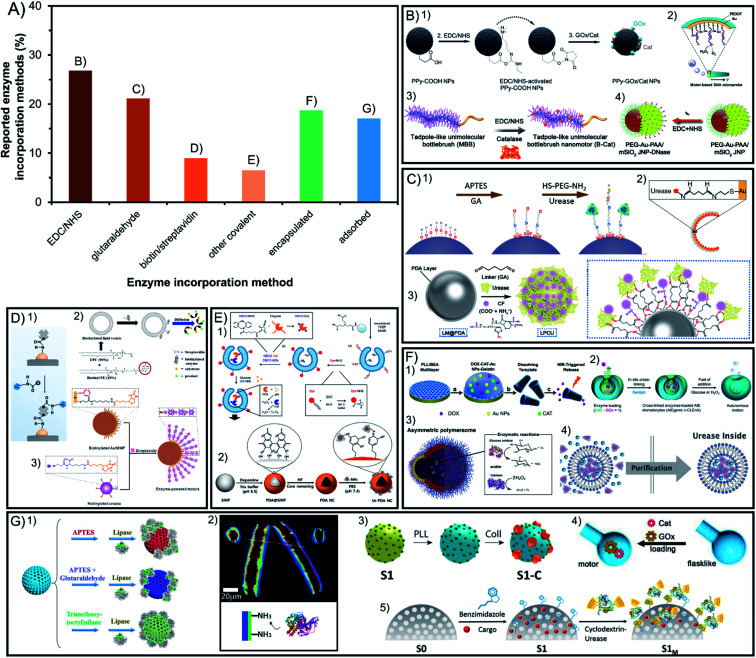
Fig. 3. Enzyme incorporation method of enzyme-powered micro- and nano-motors. (A) Representation of each enzyme incorporation method in the publications of the field. Examples of enzymatic motors with enzymes attached by using covalent attachment like (B) EDC/NHS, (C) glutaraldehyde, (D) biotin/streptavidin or (E) other covalent methods, and non-covalent incorporation methods like (F) encapsulation and (G) non-covalent interaction. Panel (B) adapted with permission from (1) ref. Copyright 2021 American Chemical Society, (2) ref. Copyright 2017 Elsevier, (3) ref. Copyright 2019 American Chemical Society, and (4) ref. Copyright 2021 American Chemical Society. Panel (C) adapted with permission from (1) ref. Copyright 2019 American Chemical Society, (2) ref. Copyright 2021 American Institute of Physics and (3) ref. Copyright 2021 American Chemical Society. Panel (D) adapted with permission from (1) ref. Copyright 2020 AAAS, (2) ref. Copyright 2019 American Chemical Society, and (3) ref. Copyright 2020 American Chemical Society. Panel (E) adapted with permission from (1) ref. Copyright 2019 Springer Nature and (2) ref. Copyright 2022 Elsevier. Panel (F) adapted with permission from (1) ref. Copyright 2015 American Chemical Society, (2) ref. Copyright 2021 Multidisciplinary Digital Publishing Institute, (3) ref. Copyright 2017 AAAS and (4) ref. Copyright 2020 Wiley. Panel (G) adapted with permission from (1) ref. Copyright 2020 Wiley, (2) ref. Copyright 2016 Wiley, (3) ref. Copyright 2019 American Chemical Society, (4) ref. Copyright 2022 Wiley, and (5) ref. Copyright 2019 American Chemical Society.
Fig. 4
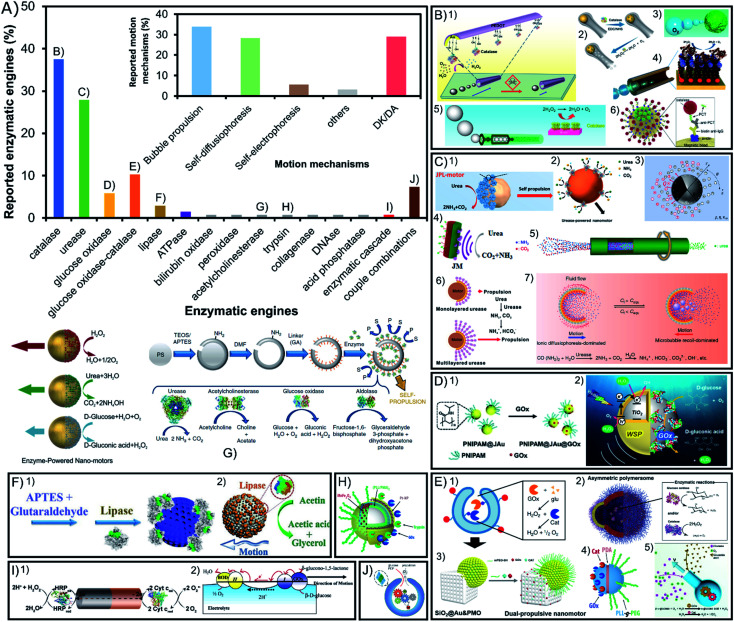
Fig. 4. Enzyme type and motion mechanism of enzyme-powered micro- and nano-motors. (A) Representation of each enzyme type in the publications of the field. Inset: representation of each motion mechanism in the publications of the field. Examples of enzymatic motors powered with the enzymes (B) catalase, (C) urease, (D) glucose oxidase, (E) glucose oxidase and catalase, (F) lipase, (G) acetylcholinesterase, (H) trypsin, (I) enzyme combinations and (J) enzymatic pathway. Panel (B) adapted with permission from (1) ref. Copyright 2013 American Chemical Society, (2) ref. Copyright 2021 American Chemical Society, (3) ref. Copyright 2019 American Chemical Society, (4) ref. Copyright 2010 American Chemical Society, (5) ref. Copyright 2018 American Chemical Society, and (6) ref. Copyright 2019 Elsevier. Panel (C) adapted with permission from (1) ref. Copyright 2020 AAAS, (2) ref. Copyright 2020 American Chemical Society, (3) ref. Copyright 2020 American Physical Society, (4) ref. Copyright 2021 Elsevier, (5) ref. Copyright 2019 Wiley, (6) ref. Copyright 2020 American Chemical Society, and (7) ref. Copyright 2021 American Institute of Physics. Panel (D) adapted with permission from (1) ref. Copyright 2019 Wiley and (2) ref. Copyright 2021 American Chemical Society. Panel (E) adapted with permission from (1) ref. Copyright 2019 Springer Nature, (2) ref. Copyright 2017 AAAS, (3) ref. Copyright 2022 American Chemical Society, (4) ref. Copyright 2015 American Chemical Society, and (5) ref. Copyright 2022 Wiley. Panel (F) adapted with permission from (1) ref. Copyright 2020 Wiley and (2) ref. Copyright 2019 Wiley. Panel (G) adapted with permission from (1) ref. Copyright 2019 Springer Nature and (2) ref. Copyright 2015 American Chemical Society. Panel (H) adapted with permission from (1) ref. Copyright 2017 American Chemical Society. Panel (I) adapted with permission from (1) ref. Copyright 2016 American Chemical Society. Panel (J) adapted with permission from (1) ref. Copyright 2014 Wiley and (2) ref. Copyright 2005 American Chemical Society.
Fig. 5
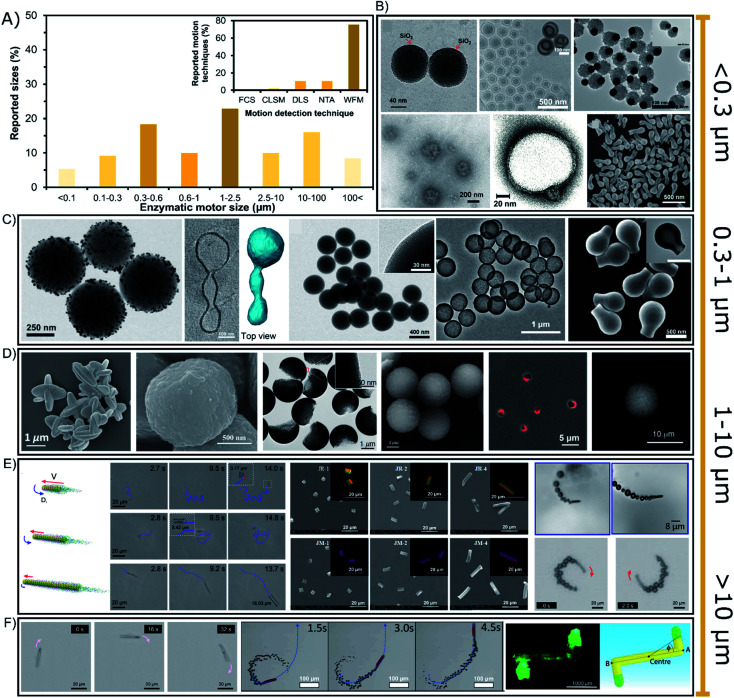
Fig. 5. (A) Sizes of enzyme-powered micro- and nano-motors and motion detection technique. Representation the different motor sizes in the publications of the field. Inset: representation of each motion detection technique in the publications of the field. Examples of enzymatic motors powered with sizes of (B) < 0.3 (ref. , , , , and 95), (C) 0.3–1 (ref. , , , and 103), (D and E) 1–10 (ref. , , , , , , , and 52) and (F) > 10 μm. Panel (B) < 0.3 μm adapted with permission from ref. Copyright 2017 Elsevier, ref. Copyright 2019 American Chemical Society, ref. Copyright 2021 American Chemical Society, ref. Copyright 2021 Elsevier, ref. Copyright 2017 AAAS, and ref. Copyright 2021 American Chemical Society. Panel (C) 0.3–1 μm adapted with permission from ref. Copyright 2021 AAAS, ref. Copyright 2021 American Chemical Society, ref. Copyright 2020 Wiley, ref. Copyright 2021 American Chemical Society, and ref. Copyright 2019 American Chemical Society. Panels (D and E) 1–10 μm adapted with permission from ref. Copyright 2019 Wiley, ref. Copyright 2021 American Chemical Society, ref. Copyright 2021 American Institute of Physics, ref. Copyright 2020 AAAS, ref. Copyright 2020 AAAS, ref. Copyright 2017 Royal Society of Chemistry, ref. Copyright 2016 American Chemical Society, ref. Copyright 2020 Elsevier, and ref. Copyright 2013 American Chemical Society. Panel (F) > 10 μm adapted with permission from ref. Copyright 2021 Royal Society of Chemistry, ref. Copyright 2019 Wiley, ref. Copyright 2016 Wiley, and ref. Copyright 2019 Wiley.
Fig. 6
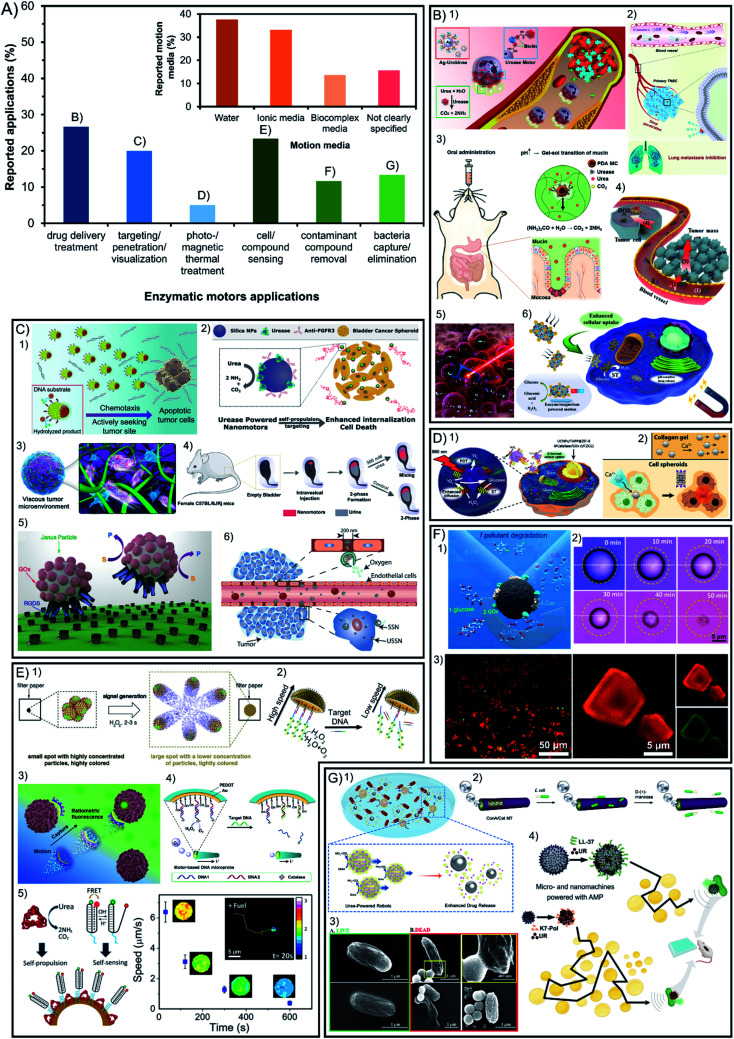
Fig. 6. (A) Applications of enzyme-powered micro- and nano-motors and motion detection technique. Representation the different motor applications in the publications of the field. Inset: representation of each motion media in the publications of the field. Examples of enzymatic motors applied in (B) drug delivery treatment, (C) visualization inside organisms exploiting enhanced targeting and penetration, (D) photo- and magnetic thermal treatment, (E) cell and compound sensing, (F) contaminant compound removal and (G) bacteria capture or elimination. Panel (B) adapted with permission from (1) ref. Copyright 2022 American Chemical Society, (2) ref. Copyright 2021 Elsevier, (3) ref. Copyright 2022 Elsevier, (4) ref. Copyright 2021 Elsevier, (5) ref. Copyright 2015 American Chemical Society, and (6) ref. Copyright 2021 American Chemical Society. Panel (C) adapted with permission from (1) ref. Copyright 2021 American Chemical Society, (2) ref. Copyright 2019 American Chemical Society, (3) ref. Copyright 2019 American Chemical Society, (4) ref. Copyright 2021 AAAS, (5) ref. Copyright 2017 Royal Society of Chemistry, and (6) ref. Copyright 2019 American Chemical Society. Panel (D) adapted with permission from (1) ref. Copyright 2019 Elsevier and (2) ref. Copyright 2019 American Chemical Society. Panel (E) adapted with permission from (1) ref. Copyright 2019 Elsevier, (2) ref. Copyright 2019 American Chemical Society, (3) ref. Copyright 2020 Elsevier, (4) ref. Copyright 2017 Elsevier, and (5) ref. Copyright 2019 American Chemical Society. Panel (F) adapted with permission from (1) ref. Copyright 2021 American Chemical Society, (2) ref. Copyright 2019 Wiley, and (3) ref. Copyright 2020 American Chemical Society. Panel (G) adapted with permission from (1) ref. Copyright 2021 American Chemical Society, (2) ref. Copyright 2021 Royal Society of Chemistry, (3) ref. Copyright 2021 American Chemical Society, and (4) ref. Copyright 2022 American Chemical Society.

References

    1. Zhang Y. Hess H. Nat. Rev. Chem. 2021;5:500–510. doi: 10.1038/s41570-021-00281-6. - DOI - PubMed
    1. Mathesh M. Sun J. Wilson D. A. J. Mater. Chem. B. 2020;8:7319–7334. doi: 10.1039/D0TB01245A. - DOI - PubMed
    1. Parmar J. Vilela D. Villa K. Wang J. Sánchez S. J. Am. Chem. Soc. 2018;140:9317–9331. doi: 10.1021/jacs.8b05762. - DOI - PubMed
    1. Guo Z. Liu J. Wang D.-W. Xu J. Liang K. Biophys. Rep. 2020;6:179–192. doi: 10.1007/s41048-020-00119-6. - DOI - PMC - PubMed
    1. Salinas G. Beladi-Mousavi S. M. Kuhn A. Curr. Opin. Electrochem. 2022;32:100887. doi: 10.1016/j.coelec.2021.100887. - DOI