Male triple negative axillary accessory breast cancer-a case report
- PMID: 36093543
- PMCID: PMC9459534
- DOI: 10.21037/tcr-22-33
Male triple negative axillary accessory breast cancer-a case report
Abstract
Background: Breast cancer is the most common malignancy among women worldwide. In men, cases of breast cancer are few and account for less than 1% of all cases of breast cancer. Majority of male breast cancer is hormone receptor-positive. The incidence of male breast cancer derived from axillary accessory breast is very low. Here we report a case of male triple negative axillary accessory breast cancer.
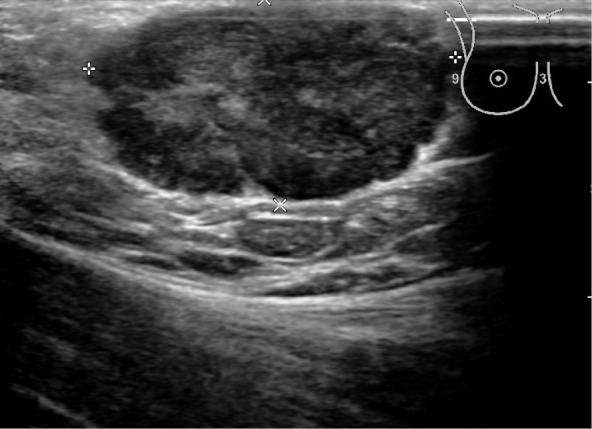
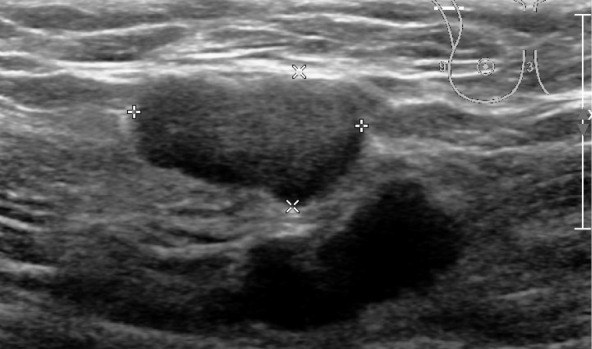
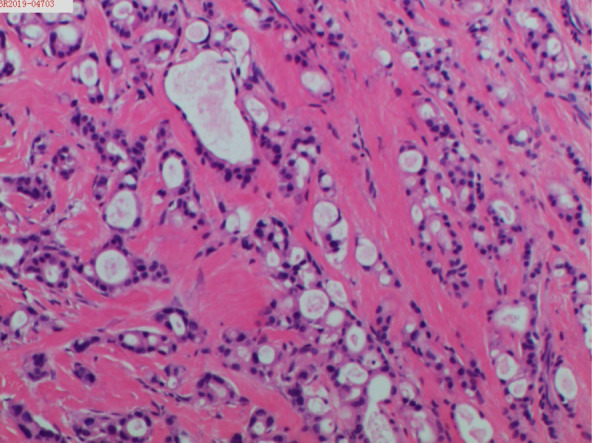
Case description: We present a case of male triple negative axillary accessory breast cancer in a 67-year-old man, which progressively increased in size through a period of 1 year. Ultrasound examination showed a 31 mm × 17 mm mass in the right axillary tail region with some accessory breast tissue around. We performed right accessory breast resection and right axillary lymph nodes dissection. Postoperative pathological analysis revealed right accessory breast invasive ductal carcinoma with apocrine metaplasia. The tumor size was 3.5 cm × 3.3 cm. In addition, 5 metastatic lymph nodes were seen in 27 axillary lymph nodes. Immunohistochemistry showed estrogen-receptor (ER) (-), progesterone-receptor (PR) (-), human epidermal growth factor receptor 2 (HER2) (2+). Fluorescence in situ hybridization (FISH) test obtained a negative result. The patient was treated with adjuvant chemotherapy and radiotherapy. Until now, no obvious signs of recurrence or metastasis have been observed during regular follow-ups.
Conclusions: Male triple negative axillary accessory breast cancer is rare. Treatment of male triple negative axillary accessory breast cancer is similar to that of women. Most patients undergo surgery and adjuvant chemotherapy.
Keywords: Male breast cancer; accessory breast cancer; case report; triple negative breast cancer.
2022 Translational Cancer Research. All rights reserved.
Conflict of interest statement
Conflicts of Interest: Both authors have completed the ICMJE uniform disclosure form (available at https://tcr.amegroups.com/article/view/10.21037/tcr-22-33/coif). The authors have no conflicts of interest to declare.
Figures
References
-
- Serdy KM, Leone JP, Dabbs DJ, et al. Male Breast Cancer. Am J Clin Pathol 2017;147:110-9. - PubMed
Publication types
LinkOut - more resources
Full Text Sources
Research Materials
Miscellaneous