


Clinical impact of severe acute kidney injury on post-operative and brain injury outcomes in preterm infants following surgical necrotizing enterocolitis
- PMID: 36093832
- PMCID: PMC10986639
- DOI: 10.1080/14767058.2022.2121917
Clinical impact of severe acute kidney injury on post-operative and brain injury outcomes in preterm infants following surgical necrotizing enterocolitis
Abstract
Background: To evaluate post-operative outcomes and white matter injury (WMI) using brain MRI at term equivalent in neonates with and without severe acute kidney injury (AKI) following surgical necrotizing enterocolitis (NEC).
Methods: A retrospective cohort study comparing neonates with severe (Stage 2/3) vs. other (no AKI/Stage 1) AKI using KDIGO classification with multivariable models assessing this association in the context of multiple systemic comorbidities.
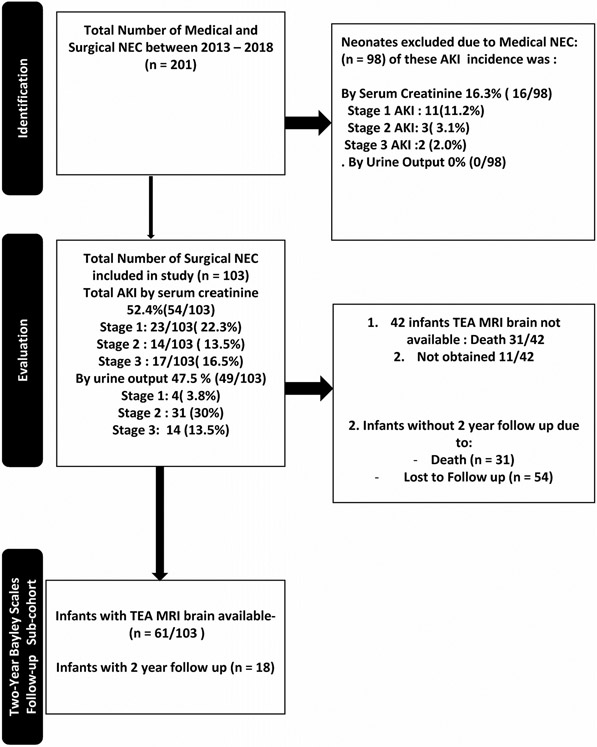
Results: Of 103 neonates with surgical NEC, 60 (58%) had severe AKI. Those with severe AKI had lower birth weight (BW; 715 vs. 950 g; p = .023), more frequently treated with indomethacin (18.3 vs. 2.4%); p = .014), higher CRP levels at 24 h after NEC onset (14.4 [6.4-19.8] vs. 4.8 [1.6-13.4]; p = .005), higher presence of cholestasis (73.3 vs. 51.2%); p = .023), later age of NEC onset (14 vs. 7 d); p = .004), longer length of bowel resected (14.9 vs. 4.3 cm); p = .011), longer post-operative ileus days (14 vs. 9 d); p < .001), longer post-operative days at starting enteral feedings (15 vs. 10 d; p < .001), longer days of attainment of full enteral feedings (75 vs. 44.5 d; p = .008) and longer length of stay (140.5 vs. 94 d; p = .028) compared to those without severe AKI. Compared to infants without AKI by serum creatinine, those with AKI had significantly more cases of white matter abnormality (WMA; 90 vs. 36.6%; p < .001) and retinopathy of prematurity (63.9 vs. 35.3%; p = .017). In addition, the presence of AKI Stage 2 and 3 by serum creatinine was independently associated with higher odds of sustaining severe WMI level on an ordinal scale (OR = 6.2; 95% CI = (1.1-35.5); p = .041).
Conclusions: Neonates with severe AKI following surgical NEC were more likely to experience longer post-operative morbidity and higher WMI by MRI at term.
Keywords: Acute kidney injury; brain injury; postoperative outcomes; preterm infants.
Conflict of interest statement
Disclosure statement
The authors disclose no conflicts. All authors declare no real or perceived conflicts of interest that could affect the study design, collection, analysis, and interpretation of data, writing of the report, or the decision to submit for publication. PMG designed the study; PMG, AB, JP, DA collected and analyzed the data; MZ and WBH participated in the data analysis. PMG, DA, MZ, WBH, JFP, and KS wrote the article. All the authors approved the manuscript. For full disclosure, we provide here an additional list of other author’s commitments and funding sources that are not directly related to this study: David J Askenazi is a consultant for Baxter, Nuwellis, Medtronic Bioporto, the AKI Foundation, and SeaStar. In addition, he receives grant funding for education and studies not related to this project from Baxter, Nuwellis, and Medtronic. He has patents pending in the area of urine collection and kidney support therapy.
Figures
References
-
- Sankaran K, Puckett B, Lee DS, et al. Variations in incidence of necrotizing enterocolitis in Canadian neonatal intensive care units. J Pediatr Gastroenterol Nutr. 2004;39:366–372. - PubMed
-
- Knell J, Han SM, Jaksic T, et al. Current status of necrotizing enterocolitis. Curr Probl Surg. 2019;56(1):11–38. - PubMed
MeSH terms
Substances
Grants and funding
LinkOut - more resources
Full Text Sources
Other Literature Sources
Medical
Research Materials
Miscellaneous
