. 2022 Oct;11(5):2045-2061.
doi: 10.1007/s40121-022-00683-z. Epub 2022 Sep 12.

COVID-19 Vaccine Booster Strategies in Light of Emerging Viral Variants: Frequency, Timing, and Target Groups

Affiliations

COVID-19 Vaccine Booster Strategies in Light of Emerging Viral Variants: Frequency, Timing, and Target Groups

Sherrie L Kelly et al. Infect Dis Ther. 2022 Oct.

Abstract

Background: Vaccinations have reduced severe burden of COVID-19 and allowed for lifting of non-pharmaceutical interventions. However, with immunity waning alongside emergence of more transmissible variants of concern, vaccination strategies must be examined.

Methods: Here we apply a SARS-CoV-2 transmission model to identify preferred frequency, timing, and target groups for vaccine boosters to reduce public health burden and health systems risk. We estimated new infections and hospital admissions averted over 2 years through annual or biannual boosting of those eligible (those who received doses one and two) who are (1) most vulnerable (60+ or living with comorbidities) or (2) those 5+, at universal (98% of eligible) or lower coverage (85% of those 50+ or with comorbidities and 50% of 5-49 year olds) representing moderate vaccine fatigue and/or hesitancy. We simulated three emerging variant scenarios: (1) no new variants; (2) 25% more infectious and immune-evading Omicron-level severity variants emerge annually and become dominant; (3) emerge biannually. We further explored the impact of varying seasonality, variant immune-evading capacity, infectivity, severity, timing, and vaccine infection blocking assumptions.

Results: To reduce COVID-19-related hospitalisations over the next 2 years, boosters should be provided for all those eligible annually 3-4 months ahead of peak winter whether or not new variants of concern emerge. Only boosting those most vulnerable is unlikely to ensure reduced stress on health systems. Moreover, boosting all eligible better protects those most vulnerable than only boosting the vulnerable group. Conversely, while this strategy may not ensure reduced stress on health systems, as an indication of cost-effectiveness, per booster dose more hospitalisations could be averted through annual boosting of those most vulnerable versus all eligible, since those most vulnerable are more likely to seek hospital care once infected, whereas increasing to biannual boosting showed diminishing returns. Results were robust when key model parameters were varied. However, we found that the more frequently variants emerge, the less the effect boosters will have, regardless of whether administered annually or biannually.

Conclusions: Delivering well-timed annual COVID-19 vaccine boosters to all those eligible, prioritising those most vulnerable, can reduce infections and hospital admissions. Findings provide model-based evidence for decision-makers to plan for administering COVID-19 boosters ahead of winter 2022-2023 to help mitigate the health burden and health system stress.

Keywords: Booster; COVID-19; Immunity; Modelling; SARS-CoV-2; Vaccination.


Figures

Fig. 1
Fig. 1
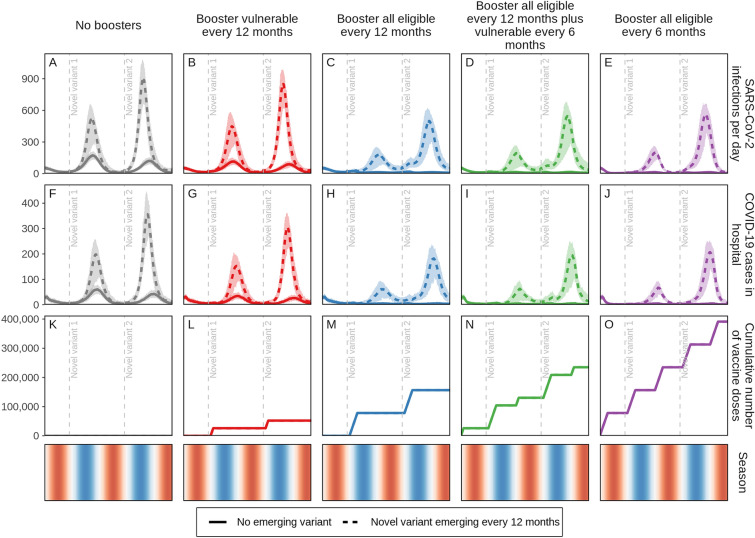
Daily projected impact on SARS-CoV-2 infections and COVID-19-related hospital admissions in just over a 2-year period in a population of 100,000 individuals. Those who previously received vaccine doses one and two were eligible to receive a first-generation COVID-19 vaccine booster dose. Individuals who received boosters every 12 or 6 months are aggregated in two groups, (1) those most vulnerable, defined as those 60 years and older or persons with comorbidities, and (2) all eligible subjects 5 years and older. For these groups, either no new variant emerged—and thus the same infectiousness and severity as the Omicron variant was assumed (solid curves)—or 25% more infectious and immune-evading novel variants, with Omicron-level variant severity, emerged annually (dashed curves) with vertical dashed lines indicating initial variant emergence. Shaded areas represent stochastic uncertainty surrounding projections. Cumulative number and timing of vaccine doses are shown for each scenario. Seasonality is illustrated in the bottom row where red shading indicates warmer spring and summer seasons, blue cooler fall and winter seasons, and white the seasonal transition. See Figures S3A–S5B in the Electronic Supplementary Material for details
Fig. 2
Fig. 2
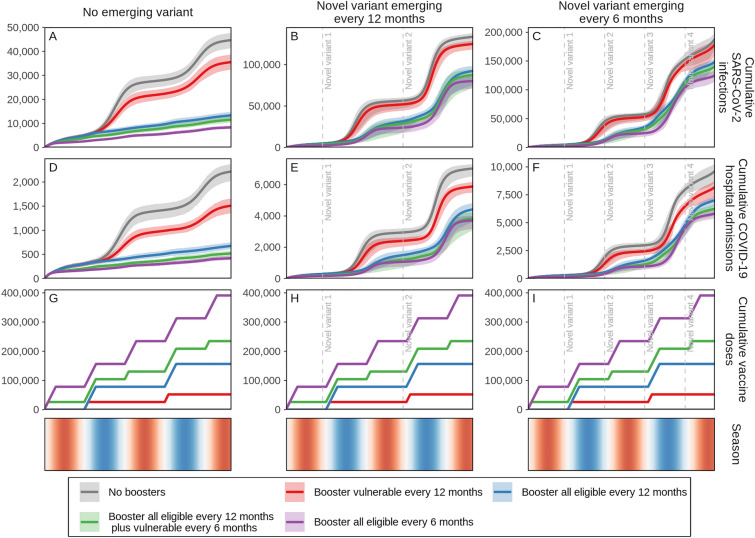
Cumulative projected impact on SARS-CoV-2 infections and COVID-19-related hospital admissions for just over a 2-year period in a simulated population of 100,000 individuals with those who previously received vaccine doses one and two being eligible to receive first-generation COVID-19 vaccine booster doses. Individuals who received boosters every 12 or 6 months are aggregated in two groups: (1) those most vulnerable, defined as those 60 years and older or persons with comorbidities, and (2) all eligible subjects 5 years and older. For these two groups, scenarios were designed either with no new emerging SARS-CoV-2 variants, assuming the same infectiousness and severity of the Omicron variant (A, D, and G), or with 25% more infectious and immune-evading novel variants with the same severity as the Omicron variant emerging annually (B, E, and H) or biannually (C, F, and I) with initial emergence indicated by vertical dashed lines. Shaded areas represent the stochastic uncertainty surrounding projections. Cumulative number and timing of vaccine doses are shown for each scenario. Seasonality is illustrated in the bottom row where red shading indicates warmer spring and summer seasons, blue cooler fall and winter seasons, and white seasonal transitions. See Figures S6, S7, and S10–S14B in the Electronic Supplementary Material for details
Fig. 3
Fig. 3
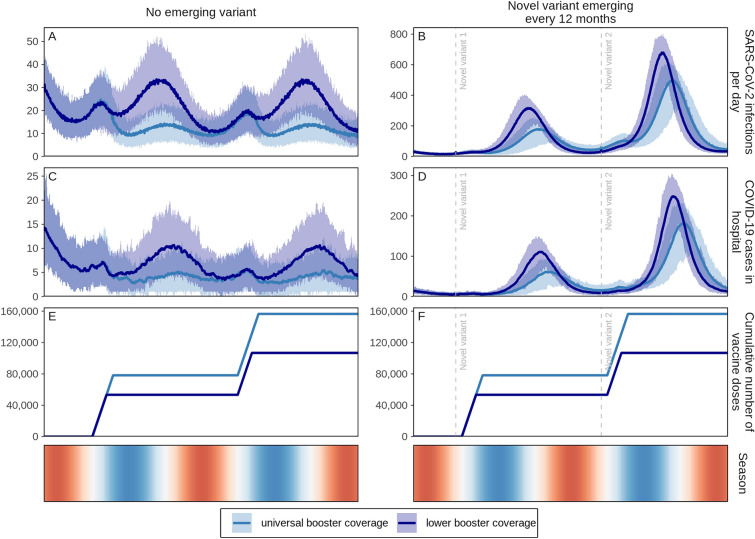
Daily projected impact on SARS-CoV-2 infections and COVID-19-related hospital admissions over 2 years in a simulated population of 100,000 individuals with first-generation COVID-19 vaccine boosters administered annually. Boosters were administered at universal coverage (98% of those eligible to receive a booster dose (including 93% of those 60 years and older or persons with comorbidities, 90% of 50–59 year olds, 80% of 30–49 year olds, and 75% of 5–29 year olds who received doses one and two) and lower coverage levels (85% of those eligible who are 50 years and older or who are living with comorbidities and 50% of those eligible 5–49 years of age). For these two groups, either no new SARS-CoV-2 variants emerged, assuming the same infectiousness, immune-evading capacity, and severity as the Omicron variant (A, C, and E), or novel variants with 25% more infectiousness and immune-evading capacity than the previously dominant variant but with the same level of severity as the Omicron variant emerged every 12 months, with initial variant emergence indicated by vertical dashed lines (B, D, and F). Shaded areas represent stochastic uncertainty surrounding projections. Cumulative number and timing of boosters are shown for each scenario. Seasonality is illustrated in the bottom row where red shading indicates warmer spring and summer seasons, blue cooler fall and winter seasons, and white the seasonal transition. See Figure S7 in the Electronic Supplementary Material for cumulative impact
Fig. 4
Fig. 4
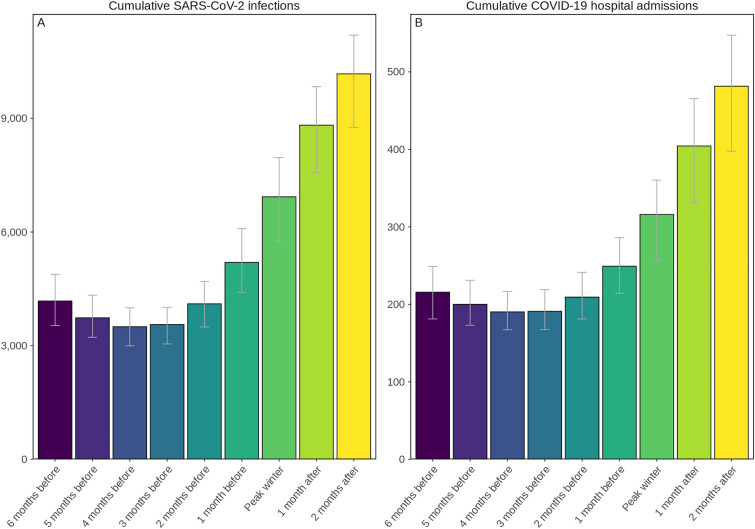
Projected cumulative annual impact on new SARS-CoV-2 infections (A) and COVID-19-related hospital admissions (B) of delivering vaccine boosters to all those eligible 5 years of age and older from either 6 months before to 2 months after peak winter temperatures assuming a 25% more infectious and immune-evading novel variant but with the same severity as the Omicron variant emerges prior to the fall season. Error bars represent the uncertainty in model projections. See Figures S8, S16A, and S16B in the Electronic Supplementary Material for details
Fig. 5
Fig. 5
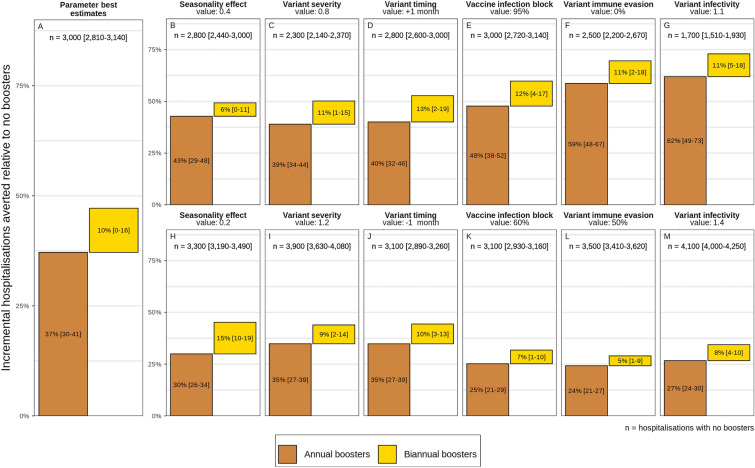
Projected percentage incremental hospitalisations averted over a 2-year period by annual (brown bars) and biannual (yellow bars) COVID-19 vaccine boosters for those eligible under varying seasonality, emerging variant severity, variant timing, vaccine infection-blocking efficacy, emerging variant immune-evading capacity, and emerging variant infectivity from best estimate values as listed in Table 1. See Figures S15 and S17 in the Electronic Supplementary Material for details
Fig. 6
Fig. 6
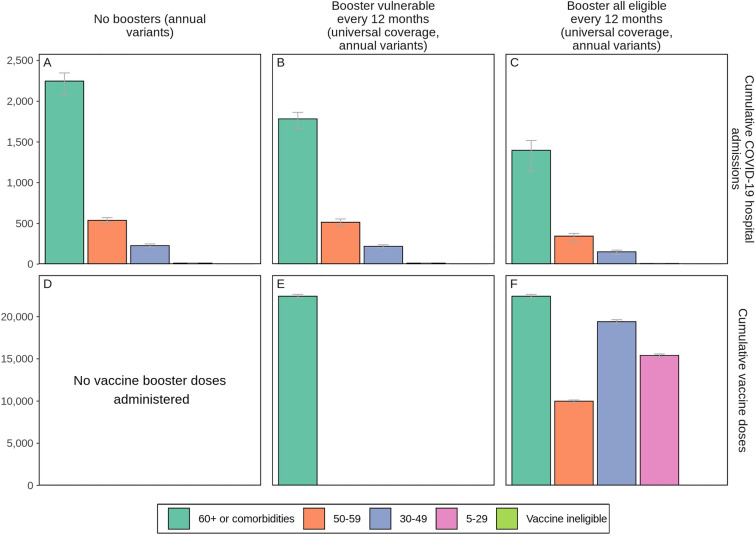
Cumulative projected impact of administering COVID-19 vaccine boosters to those most vulnerable or to all those eligible every 12 months on COVID-19-related hospital admissions by age and risk group over a 2-year period in a simulated population of 100,000 individuals when new SARS-CoV-2 variants with 25% more infectiousness and immune-evading capacity than the previously dominant variant but with the same severity as Omicron emerge annually. Cumulative numbers of vaccine doses are shown in panels D-F. Error bars represent the stochastic uncertainty in model projections. See Figure S9 in the Electronic Supplementary Material for details.

References

    1. WHO Coronavirus (COVID-19) Dashboard Geneva: WHO; 2022. https://covid19.who.int/. Accessed 28 May 2022.
    1. Andrews N, Stowe J, Kirsebom F, Toffa S, Rickeard T, Gallagher E, et al. COVID-19 vaccine effectiveness against the omicron (B.1.1.529) variant. N Engl J Med. 2022;386:1532–1546. doi: 10.1056/NEJMoa2119451. - DOI - PMC - PubMed
    1. Khoury DS, Steain M, Triccas JA, Sigal A, Davenport MP, Cromer D. A meta-analysis of early results to predict vaccine efficacy against omicron. medRxiv. 2021 doi: 10.1101/2021.12.13.21267748v2. - DOI - PubMed
    1. Callaway E. Are COVID surges becoming more predictable? New Omicron variants offer a hint. Nat News. 2022;605(7909):204–206. doi: 10.1038/d41586-022-01240-x. - DOI - PubMed
    1. Nyberg T, Ferguson NM, Nash SG, Webster HH, Flaxman S, Andrews N, et al. Comparative analysis of the risks of hospitalisation and death associated with SARS-CoV-2 omicron (B.1.1.529) and delta (B.1.617.2) variants in England: a cohort study. Lancet. 2022;399(10332):1303–1312. doi: 10.1016/S0140-6736(22)00462-7. - DOI - PMC - PubMed

LinkOut - more resources