


Diet and irritable bowel syndrome: an update from a UK consensus meeting
- PMID: 36096789
- PMCID: PMC9469508
- DOI: 10.1186/s12916-022-02496-w
Diet and irritable bowel syndrome: an update from a UK consensus meeting
Abstract
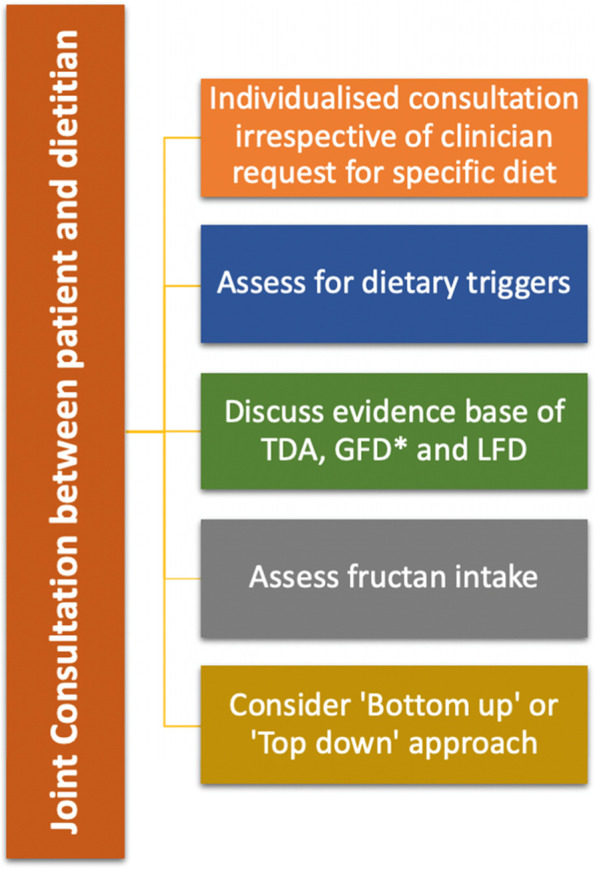
There has been a renewed interest in the role of dietary therapies to manage irritable bowel syndrome (IBS), with diet high on the agenda for patients. Currently, interest has focussed on the use of traditional dietary advice (TDA), a gluten-free diet (GFD) and the low FODMAP diet (LFD). A consensus meeting was held to assess the role of these dietary therapies in IBS, in Sheffield, United Kingdom.Evidence for TDA is from case control studies and clinical experience. Randomised controlled trials (RCT) have demonstrated the benefit of soluble fibre in IBS. No studies have assessed TDA in comparison to a habitual or sham diet. There have been a number of RCTs demonstrating the efficacy of a GFD at short-term follow-up, with a lack of long-term outcomes. Whilst gluten may lead to symptom generation in IBS, other components of wheat may also play an important role, with recent interest in the role of fructans, wheat germ agglutinins, as well as alpha amylase trypsin inhibitors. There is good evidence for the use of a LFD at short-term follow-up, with emerging evidence demonstrating its efficacy at long-term follow-up. There is overlap between the LFD and GFD with IBS patients self-initiating gluten or wheat reduction as part of their LFD. Currently, there is a lack of evidence to suggest superiority of one diet over another, although TDA is more acceptable to patients.In view of this evidence, our consensus group recommends that dietary therapies for IBS should be offered by dietitians who first assess dietary triggers and then tailor the intervention according to patient choice. Given the lack of dietetic services, novel approaches such as employing group clinics and online webinars may maximise capacity and accessibility for patients. Further research is also required to assess the comparative efficacy of dietary therapies to other management strategies available to manage IBS.
Keywords: Gluten-free diet; Irritable bowel syndrome; Low FODMAP diet; Traditional dietary advice.
© 2022. The Author(s).
Conflict of interest statement
DSS receives an educational grant from Schaer (a gluten-free food manufacturer). Dr Schaer did not have any input in drafting of this manuscript. The other authors declare they have no competing interests.
Figures
References
-
- Sperber AD, Bangdiwala SI, Drossman DA, et al. Worldwide prevalence and burden of functional gastrointestinal disorders, results of Rome Foundation Global Study. Gastroenterology. 2020. 10.1053/j.gastro.2020.04.014. - PubMed
-
- Halpert A, Dalton CB, Palsson O, et al. What patients know about irritable bowel syndrome (IBS) and what they would like to know. National Survey on Patient Educational Needs in IBS and development and validation of the Patient Educational Needs Questionnaire (PEQ) Am J Gastroenterol. 2007;102(9):1972–1982. doi: 10.1111/j.1572-0241.2007.01254.x. - DOI - PubMed
-
- Sturkenboom R, Keszthelyi D, Masclee AAM, Essers BAB. Discrete choice experiment reveals strong preference for dietary treatment among patients with irritable bowel syndrome. Clin Gastroenterol Hepatol. 2022. 10.1016/j.cgh.2022.02.016. - PubMed
Publication types
MeSH terms
Substances
LinkOut - more resources
Full Text Sources
