. 2022 Nov;76(11):2697-2711.
doi: 10.1111/evo.14624. Epub 2022 Sep 27.

Ecological outcomes of hybridization vary extensively in Catostomus fishes

Affiliations

Ecological outcomes of hybridization vary extensively in Catostomus fishes

Elizabeth G Mandeville et al. Evolution. 2022 Nov.

Abstract

Hybridization outcomes vary geographically and can depend on the environment. Hybridization can also reshape biotic interactions, leading to ecological shifts. If hybrids function differently ecologically in ways that enhance or reduce fitness, and those ecological roles vary geographically, ecological factors might explain variation in hybridization outcomes. However, relatively few studies have focused on ecological traits of hybrids. We compared the feeding ecology of Catostomus fish species and hybrids by using stable isotopes (δ13 C and δ15 N) as a proxy for diet and habitat use, and compared two native species, an introduced species, and three interspecific hybrid crosses. We included hybrids and parental species from seven rivers where hybridization outcomes vary. Relative isotopic niches of native species varied geographically, but native species did not fully overlap in isotopic space in any river sampled, suggesting little overlap of resource use between historically sympatric species. The introduced species overlapped with one or both native species in every river, suggesting similar resource use and potential competition. Hybrids occupied intermediate, matching, or more transgressive isotopic niches, and varied within and among rivers. Ecological outcomes of hybridization varied across locations, implying that hybridization might have unpredictable, idiosyncratic ecological effects.

Keywords: Hybridization; ecological interactions; fitness; stable isotopes.


Figures

Figure 1:
Figure 1:
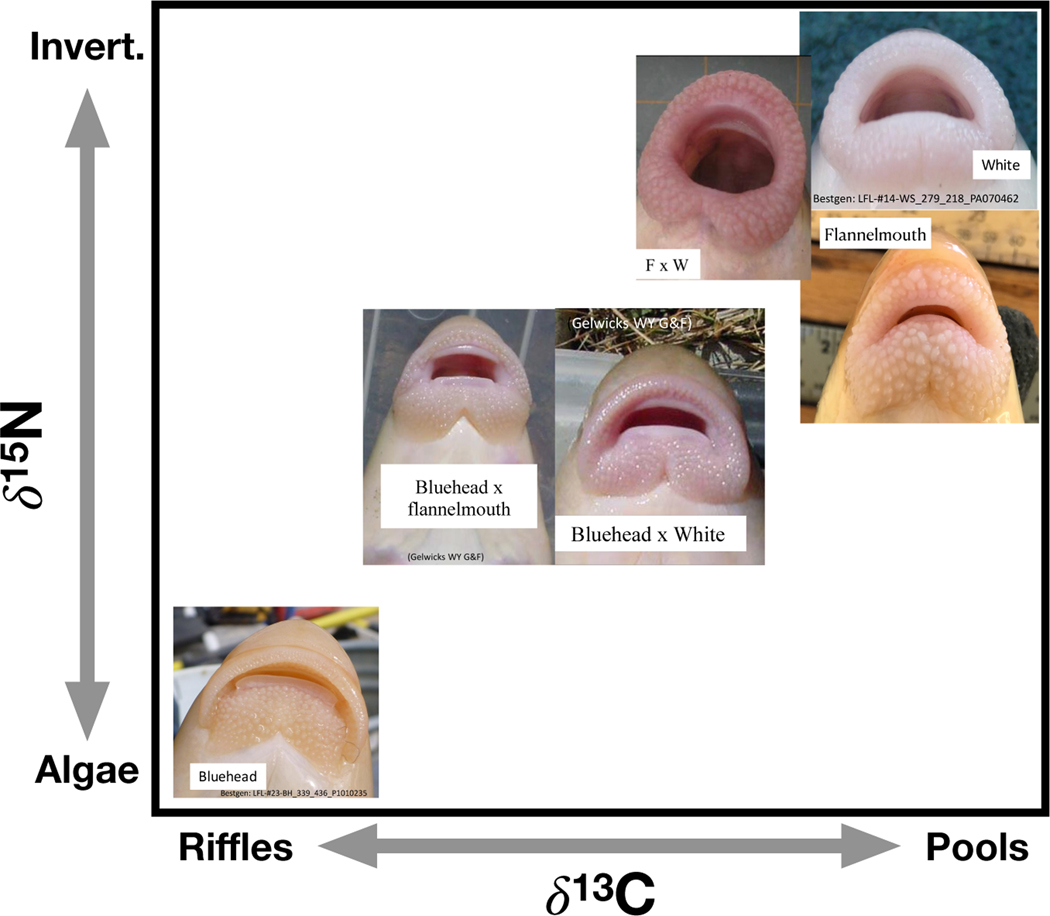
Hypothesized distribution of the three most widely sampled Catostomus fish species and their hybrids in isotopic space. Previous studies and mouth morphology suggested that bluehead suckers eat more algae, and feed primarily in riffles, leading to lower δ13C and δ 15N. Flannelmouth and white suckers are expected to eat more invertebrates and in pools, leading to higher δ 13C and δ 15N. Due to morphological intermediacy, bluehead×flannelmouth and bluehead × white hybrids were expected to be dietarily intermediate between parental species. Flannelmouth × white hybrids were expected to match the dietary phenotypes of their parental species. Mountain and longnose sucker were excluded from this figure because each species (and a small number of hybrids) were found in only one river each. Based on mouth morphology, mountain suckers are expected to be similar to bluehead suckers, while longnose would likely be more similar to flannelmouth and white suckers.
Figure 2:
Figure 2:
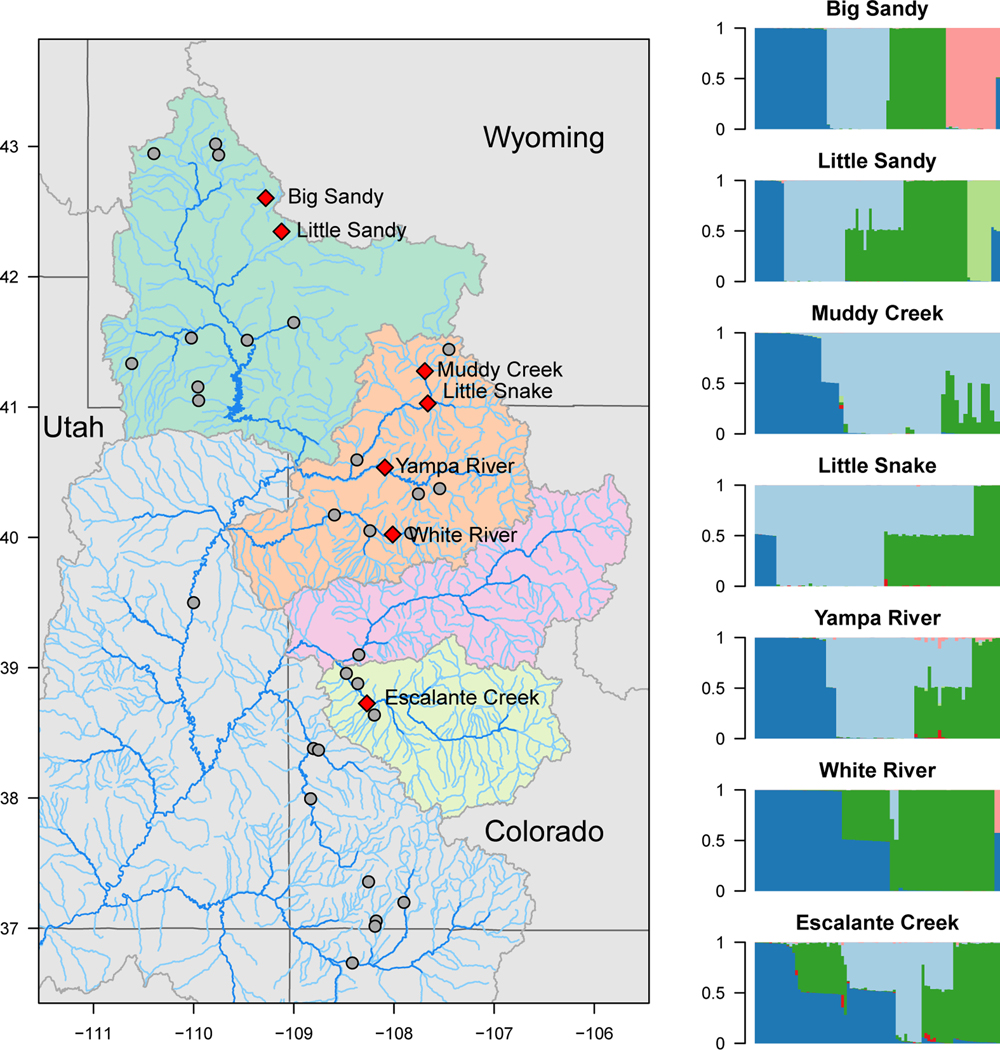
Seven rivers in Wyoming and Colorado and corresponding genetics outcomes of hybridization. Gray dots on the map at left represent all sampling points from Mandeville et al. (2017); the focal rivers for this study are shown with red diamonds. Barplots at right show proportional genetic ancestry of individual fish used for stable isotope analysis (dark blue = bluehead sucker; light blue = white sucker; dark green = flannelmouth sucker; pink = longnose sucker; light green = mountain sucker). A range of hybrids between Catostomus species were present (Mandeville et al. 2017). The most common crosses were flannelmouth×white (closely related, F1 and backcrossed hybrids), and bluehead×white and bluehead×flannelmouth (more distantly related; mostly F1 hybrids).
Figure 3:
Figure 3:
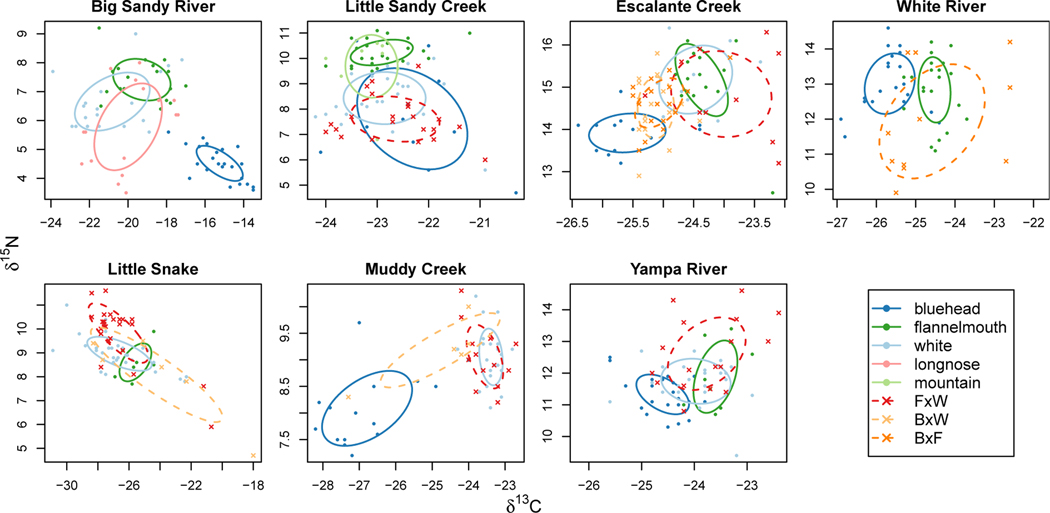
Standard ellipses summarize stable isotopic ratios (δ13C and δ15N; plots oriented the same as Fig. 1) by encompassing approximately 40% of individual fish within each of five species and three hybrid crosses. Ellipses were estimated using a maximum likelihood and a bivariate normal distribution, implemented in SIAR (Jackson et al. 2011). Species ellipses are solid lines; hybrid ellipses are dashed lines. Ecological relationships between parental species varied across rivers, but the two native parental species (bluehead and flannelmouth) did not overlap in isotopic space in any sampled locations. Hybrids among these three parental species had matching, intermediate, or transgressive isotopic ratios relative to parental species, and are shown more clearly in Fig. 4.
Figure 4:
Figure 4:
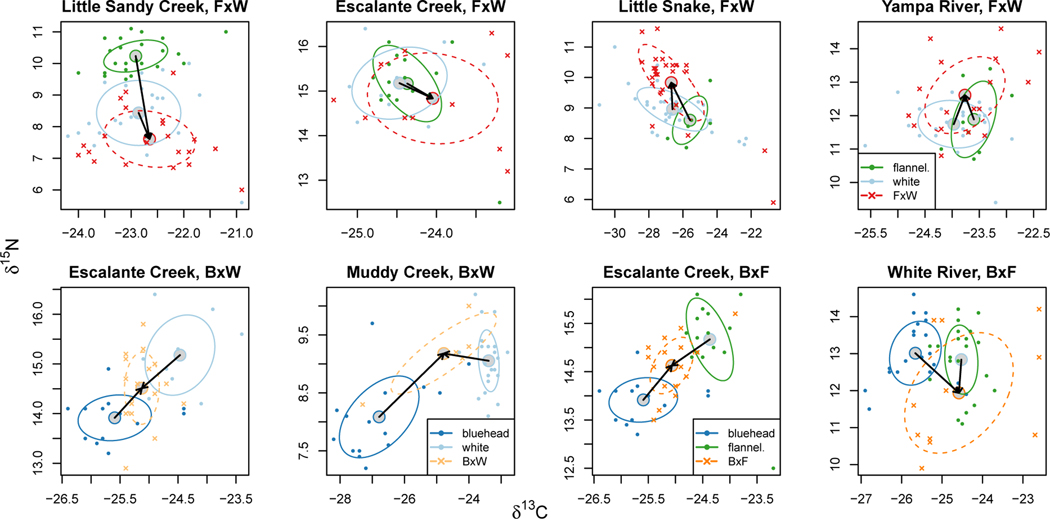
Subset plots show pairwise relationships of parental species and hybrids. Means for genetically-defined species and hybrid crosses are shown with gray points; individual fish are denoted by points color-coded by species or hybrid cross. Flannelmouth×white sucker hybrids (top row) displayed matching and transgressive isotopic ratios relative to parental species, as shown by arrows from the mean values for parental species to the mean value for hybrids. Bluehead×white sucker hybrids (bottom row, left) were intermediate between isotopic values for the two parental species. Bluehead×flannelmouth sucker hybrids (bottom row, right) were intermediate between values for the two parental species in Escalante Creek, but individuals were a mixture of matching and transgressive relative to parental species in the White River.
Figure 5:
Figure 5:
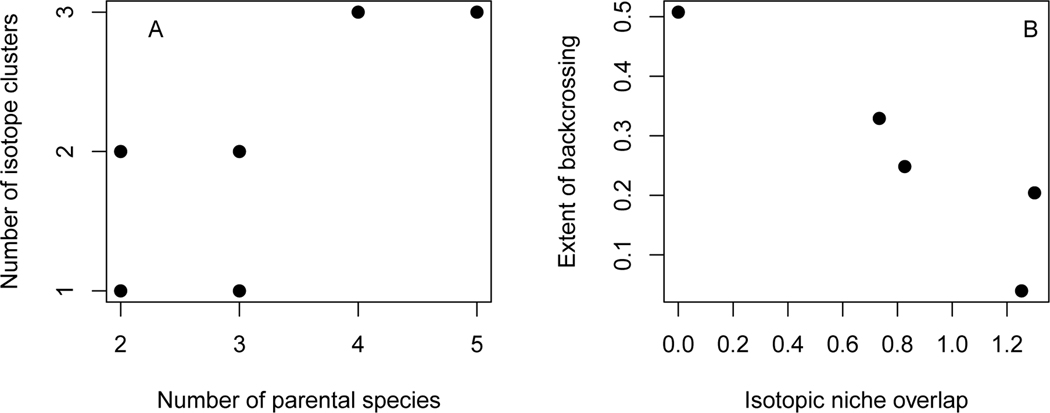
A) Number of clusters of ecologically similar individuals (identified by a hierarchical Bayesian model) correlated with the number of parental species sampled in a river (Pearson correlation 0.764, p < 0.05). B) Extent of backcrossing in flannelmouth×white hybrids negatively correlated with isotopic niche area overlap in 6 river locations (Pearson correlation −0.922, p < 0.05).

References

    1. Aldridge G, and Campbell DR 2009. Genetic and morphological patterns show variation in frequency of hybrids between Ipomopsis (Polemoniaceae) zones of sympatry. Heredity 102:257–265. - PubMed
    1. Anderson R, and Neumann RM 1996. Length, weight, and associated structural indices. Pages 447–482 in Fisheries Techniques, 2nd Edition. American Fisheries Society.
    1. Arnegard ME, McGee MD, Matthews B, Marchinko KB, Conte GL, Kabir S, Bedford N, Bergek S, Chan YF, Jones FC, Kingsley DM, Peichel CL, and Schluter D. 2014. Genetics of ecological divergence during speciation. Nature 511:307–311. - PMC - PubMed
    1. Arnold ML, Ballerini ES, and Brothers AN 2012. Hybrid fitness, adaptation and evolutionary diversification: lessons learned from Louisiana Irises. Heredity 108:159–166. - PMC - PubMed
    1. Arnold ML, and Hodges SA 1995. Are natural hybrids fit or unfit relative to their parents? Trends in Ecology & Evolution 10:67–71. - PubMed

Publication types