


Role of interatrial conduction in atrial fibrillation: Mechanistic insights from renewal theory-based fibrillatory dynamic analysis
- PMID: 36097465
- PMCID: PMC9463713
- DOI: 10.1016/j.hroo.2022.05.007
Role of interatrial conduction in atrial fibrillation: Mechanistic insights from renewal theory-based fibrillatory dynamic analysis
Abstract
Background: Interatrial conduction has been postulated to play an important role in atrial fibrillation (AF). The pathways involved in interatrial conduction during AF remain incompletely defined.
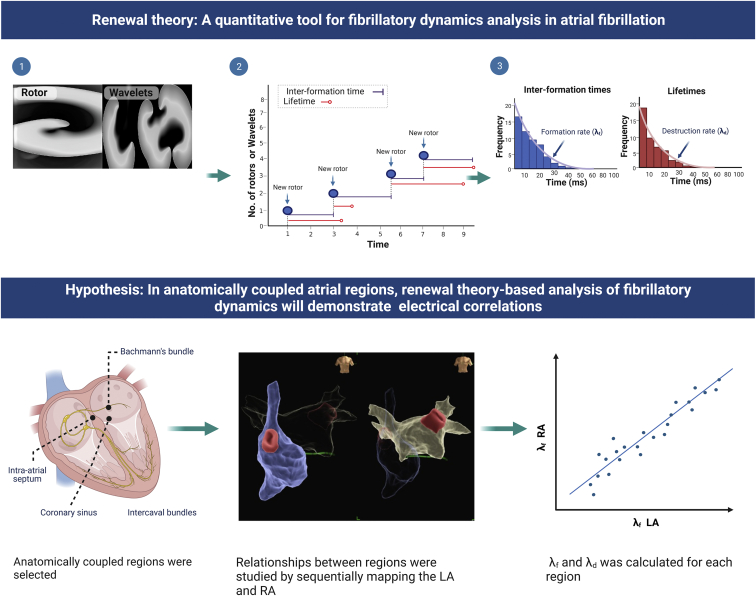
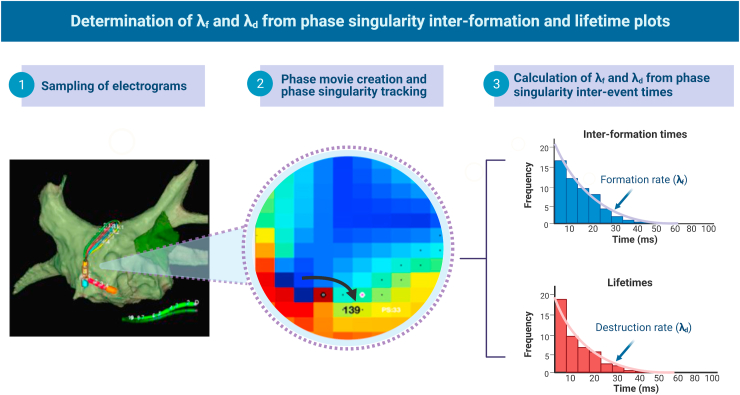
Objective: We recently showed physiological assessment of fibrillatory dynamics could be performed using renewal theory, which determines rates of phase singularity formation (λf) and destruction (λd). Using the renewal approach, we aimed to understand the role of the interatrial septum and other electrically coupled regions during AF.
Method: RENEWAL-AF is a prospective multicenter observational study recruiting AF ablation patients (ACTRN 12619001172190). We studied unipolar electrograms obtained from 16 biatrial locations prior to ablation using a 16-electrode Advisor HD Grid catheter. Renewal rate constants λf and λd were calculated, and the relationships between these rate constants in regions of interatrial connectivity were examined.
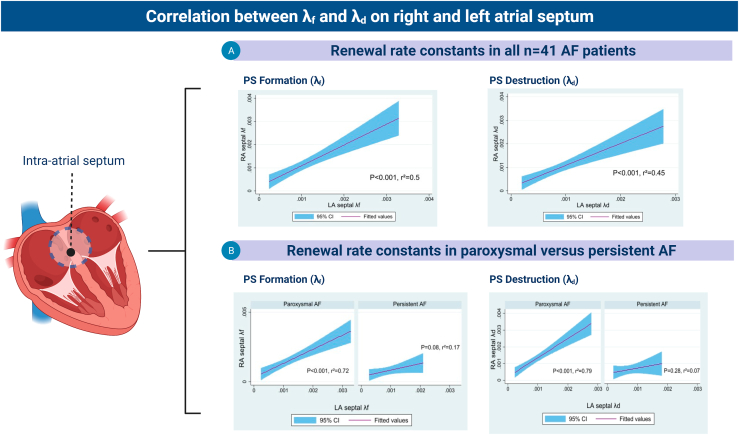
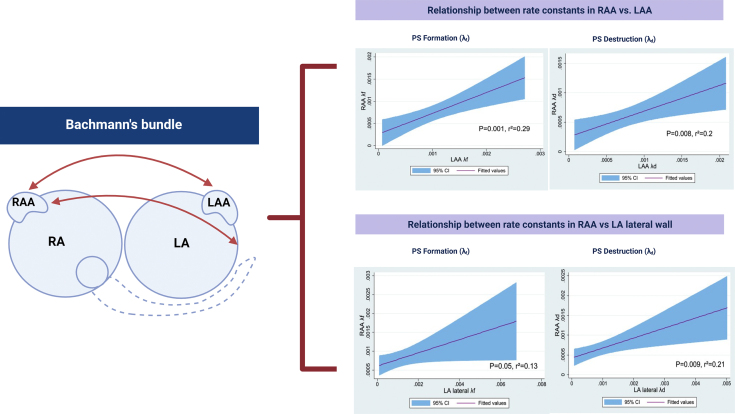
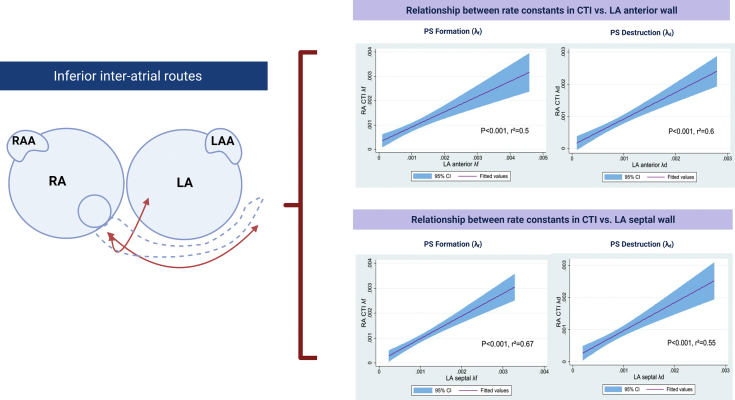
Results: Forty-one AF patients (28.5% female) were recruited. A positive linear correlation was observed between λf and λd (1) across the interatrial septum (λf r2 = 0.5, P < .001, λd r2 = 0.45, P < .001), (2) in regions connected by the Bachmann bundle (right atrial appendage-left atrial appendage λf r2 = 0.29, P = .001; λd r2 = 0.2, P = .008), and (3) across the inferior interatrial routes (cavotricuspid isthmus-left atrial septum λf r2 = 0.67, P < .001; λd r2 = 0.55, P < .001). Persistent AF status and left atrial volume were found to be important effect modifiers of the degree of interatrial renewal rate statistical correlation.
Conclusion: Our findings support the role of interseptal statistically determined electrical disrelation in sustaining AF. Additionally, renewal theory identified preferential conduction through specific interatrial pathways during fibrillation. These findings may be of importance in identifying clinically significant targets for ablation in AF patients.
Keywords: Atrial fibrillation; Bachmann’s bundle; Interatrial conduction; Interatrial septum; Renewal theory.
© 2022 Heart Rhythm Society. Published by Elsevier Inc.
Figures
References
-
- Kumagai K., Khrestian C., Waldo A.L. Simultaneous multisite mapping studies during induced atrial fibrillation in the sterile pericarditis model. Insights into the mechanism of its maintenance. Circulation. 1997;95:511–521. - PubMed
-
- Kharbanda R.K., Özdemir E.H., Taverne Y.J.H.J., et al. Current concepts of anatomy, electrophysiology, and therapeutic implications of the interatrial septum. JACC Clin Electrophysiol. 2019;5:647–656. - PubMed
-
- Tondo C., Scherlag B.J., Otomo K., et al. Critical atrial site for ablation of pacing-induced atrial fibrillation in the normal dog heart. J Cardiovasc Electrophysiol. 1997;8:1255–1265. - PubMed
-
- Platonov P.G. Interatrial conduction in the mechanisms of atrial fibrillation: from anatomy to cardiac signals and new treatment modalities. Europace. 2007;9(Suppl 6):vi10–vi16. - PubMed
-
- Nakashima H., Kumagai K., Urata H., et al. Angiotensin II antagonist prevents electrical remodeling in atrial fibrillation. Circulation. 2000;101:2612–2617. - PubMed
LinkOut - more resources
Full Text Sources
